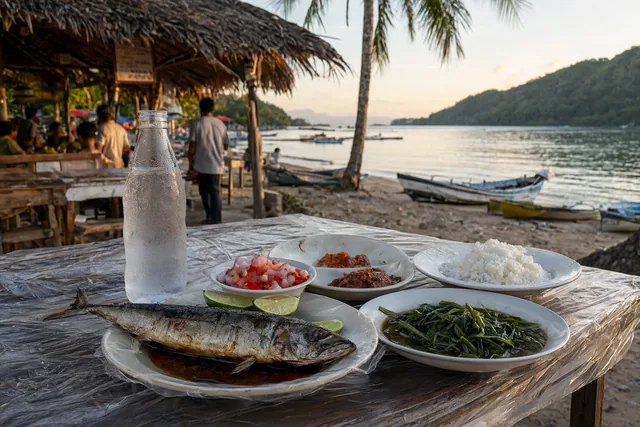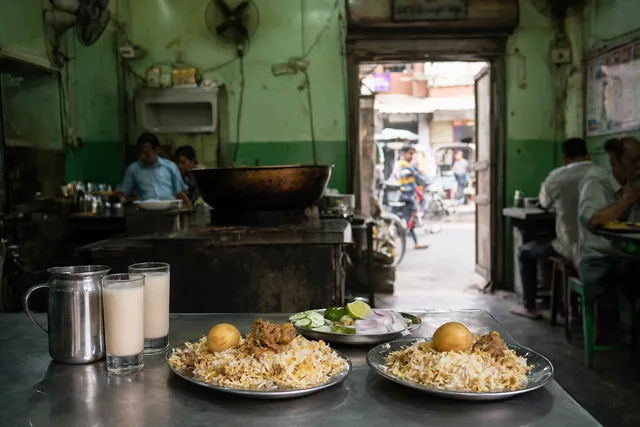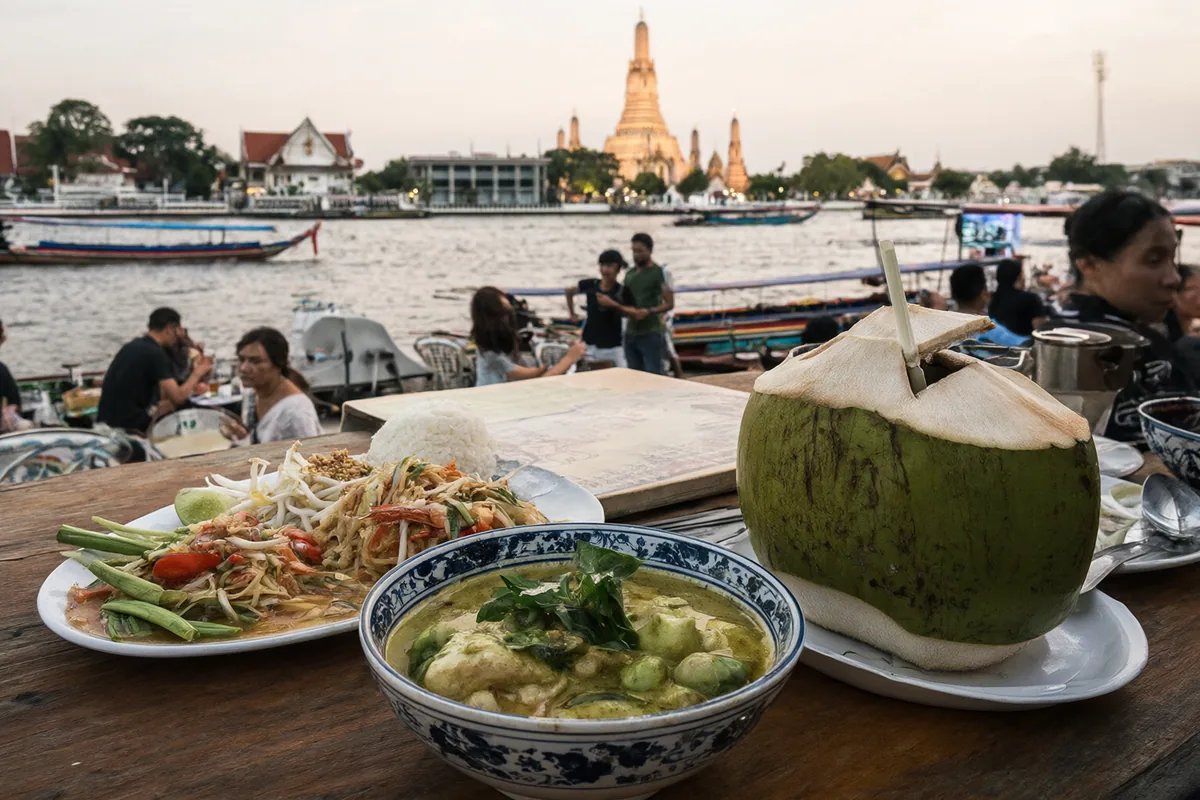
Thai food balances sour, sweet, salty, bitter and hot in a single dish, and in Thailand it is cooked everywhere: at street carts, night markets, shophouse kitchens and riverside restaurants. This Thailand food guide covers the dishes to know, the menu words that matter most, how tipping and paying in baht work, and then goes city by city through where to eat in Bangkok, Chiang Mai, Phuket, Chiang Rai, Ayutthaya, Krabi, Koh Samui and Hua Hin. Thai cooking is regional: the north is milder and herbal, the northeast (Isan) is fiery and sour, the south is the hottest of all and leans on turmeric and seafood, and the central plains around Bangkok bring the coconut curries most visitors know.
What to eat in Thailand: 12 dishes to know
These are the dishes worth seeking out, with the region they come from. Most Thai meals are shared: order several dishes with rice for the table rather than one main each.
- Pad kra pao (everywhere): minced pork or chicken stir-fried with holy basil, garlic and chilli, served on rice with a crisp fried egg (kai dao). The dish Thais order when they cannot decide.
- Tom yum goong (central Thailand): hot and sour prawn soup with lemongrass, galangal, kaffir lime leaf and chilli, in a clear or creamy version.
- Gaeng khiao wan (central Thailand): green curry, made with fresh green chilli paste and coconut milk, usually with chicken or fish balls and Thai aubergine.
- Som tam (Isan): green papaya salad pounded in a mortar with chilli, lime, fish sauce and peanuts. Som tam Thai is sweeter; som tam poo pla ra has salted crab and fermented fish.
- Larb and gai yang (Isan): a minced meat salad with lime, chilli, mint and toasted rice powder, and charcoal-grilled chicken, eaten with sticky rice (khao niao).
- Pad thai (everywhere): stir-fried rice noodles with tamarind, egg, tofu, dried shrimp, bean sprouts and peanuts. Good versions are sour and smoky, not sweet.
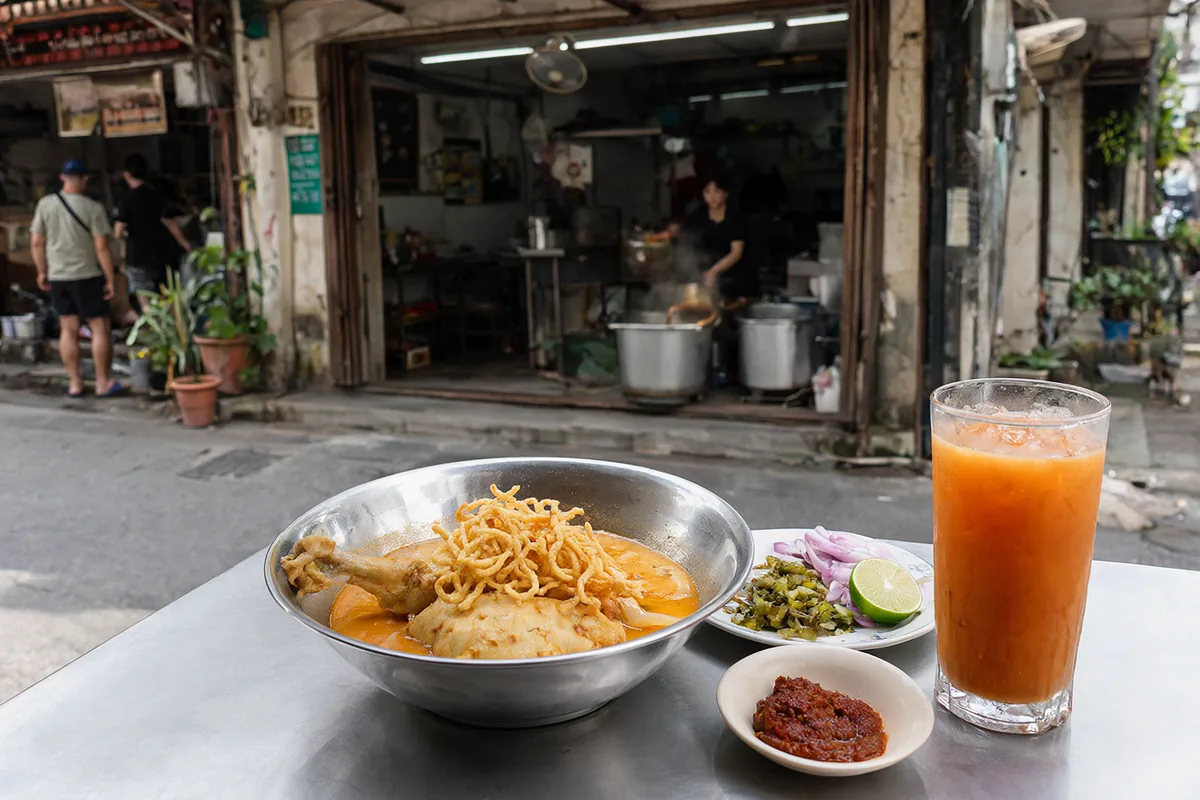
- Khao soi (Chiang Mai and the north): egg noodles in a rich curry coconut broth, topped with crisp fried noodles, with pickled mustard greens and shallots on the side.
- Massaman curry (central and south): a mild, rich curry with Persian and Indian roots, made with beef or chicken, potatoes, peanuts and warm spices.
- Khao man gai (everywhere): poached chicken on rice cooked in chicken fat, with a ginger, garlic and fermented soybean sauce and a cup of broth.
- Kuay tiew reua (Bangkok and Ayutthaya): "boat noodles", small, dark, intensely spiced bowls of beef or pork noodle soup, traditionally thickened with blood. Order several.
- Moo ping (everywhere): sweet, garlicky grilled pork skewers sold with sticky rice from morning carts, a cheap Bangkok breakfast.
- Khao niao mamuang (everywhere, best March to June): mango sticky rice, sweet coconut sticky rice with ripe mango in season.
How to read a Thai menu
Thai uses its own alphabet, and English spellings of Thai dishes vary wildly, so pad kra pao may also appear as phat kaphrao or pad gaprow. Thai dish names are usually descriptive: a cooking method, then the main ingredient, then the flavour. Our dedicated guide to how to read a Thai menu has the full word lists for meats, seafood, noodles and spice. These are the ten words to learn first.
| Thai | Romanised | Meaning |
|---|---|---|
| ผัด | phat / pad | Stir-fried |
| ทอด | thot / tod | Deep-fried |
| ต้ม | tom | Boiled, usually a soup |
| แกง | gaeng / kaeng | Curry or curried soup |
| ยำ | yam | Spicy, sour salad |
| ย่าง / ปิ้ง | yang / ping | Grilled |
| ข้าว | khao | Rice, and by extension a meal |
| ก๋วยเตี๋ยว | kuay tiew | Rice noodles |
| หมู / ไก่ / กุ้ง | moo / gai / goong | Pork / chicken / prawn |
| ไม่เผ็ด / เผ็ดน้อย | mai phet / phet noi | Not spicy / a little spicy |
Street stalls and shophouse kitchens often have a menu written only in Thai on the wall, with no prices for some items. Photograph it with swap.menu and every dish is translated and explained in your language, with prices converted from baht, so you can order beyond pad thai and green curry with confidence.
Tipping, paying and meal times in Thailand
Tipping is not a traditional part of eating out in Thailand, and nobody expects it at a street stall or a simple restaurant. In sit-down restaurants it is common to leave the coins from your change or round up, and in tourist areas a tip of a few percent for good service is appreciated. Hotels, malls and many upmarket restaurants add a 10 percent service charge and 7 percent VAT, and menus show this as "++" after the price, which adds about 17.7 percent to the total once tax is charged on the service. Our guide to tax and service charges on menus explains how these lines work.
The currency is the Thai baht (THB, written ฿ or บาท). Street food, markets, small restaurants and tuk-tuks are cash only, and stalls appreciate small notes. Thais pay almost everything by scanning QR codes, but this generally needs a Thai bank account. Cards are accepted in malls, hotels, chain restaurants and most mid-range and upmarket places. Thai ATMs charge foreign cards a fixed withdrawal fee, so take out larger amounts less often. When a card machine offers to charge you in your home currency, choose baht: our guide to paying in local currency explains why.
Thais eat little and often, so there is no single dinner rush. Breakfast carts run from early morning, lunch is from about 11am to 1pm, and dinner from 6pm to 8pm, with night markets going until 10pm or later. Many street stalls specialise in one time of day: morning rice porridge, lunchtime curry-and-rice shops that sell out by early afternoon, and evening grills. Alcohol sales in shops are limited to set hours, and alcohol is not sold on several Buddhist holy days, when some bars close.
Where to eat in Thailand, city by city
Thailand's cities, islands and old capitals each have their own food, from Lanna curries in the north to Hokkien noodles on Phuket and fresh seafood on the southern coast. Jump to a destination:
Where to eat in Bangkok
Bangkok is one of the great street food cities of the world, and it brings together food from every region of Thailand. The most famous place to eat at night is Yaowarat, Bangkok's Chinatown, where the main road fills after dark with stalls selling grilled seafood, rolled rice noodle soup, oyster omelettes, roast duck and sweet bird's nest drinks. Nearby Talat Noi has quieter lanes and old shophouses, and Charoen Krung Road in Bang Rak is lined with old-school stalls for roast duck, khao man gai and congee. For boat noodles, go to the canal-side alley near Victory Monument, where several shops serve small bowls stacked high on the tables.
Or Tor Kor Market, near Chatuchak, is one of the best fresh markets in the country, with perfect fruit, curry pastes and a food court of regional dishes, and the Chatuchak Weekend Market itself has hundreds of food stalls. Banglamphu, around Khao San Road and Phra Athit, has good old family restaurants a few streets back from the backpacker bars, and Wang Lang Market across the river by Siriraj is a busy lunchtime market for locals. Mall food courts are clean, cheap and air-conditioned, and you usually pay with a prepaid card. Many street stalls in central Bangkok take Monday off, so save your street food crawl for another night.
Where to eat in Chiang Mai
Chiang Mai, the capital of the old Lanna kingdom, has the best northern Thai food in the country. The dish to order first is khao soi, brought to the region by Chinese Muslim traders, and the streets around the mosques east of the old city are a good place to look for it. Northern cooking also brings sai ua (herby grilled pork sausage with lemongrass and kaffir lime), nam prik noom (a smoky roasted green chilli dip) and nam prik ong (a pork and tomato dip) with pork crackling and vegetables, gaeng hang lay (a sweet, sour Burmese-style pork curry) and khanom jeen nam ngiao (rice noodles in a tomato and pork broth). A traditional khantoke dinner serves several northern dishes on a low round tray.
The Warorot Market (Kad Luang) on the river side of the old city is the place to buy northern sausages, pork crackling and chilli pastes. In the evening, the stalls at the Chang Phueak Gate on the north side of the old city and at Chiang Mai Gate on the south side serve cheap dinners, and the Sunday Walking Street through the old city and the Saturday market on Wualai Road have long rows of food stalls. Nimmanhaemin is the area for cafés and newer restaurants. Chiang Mai is also the most popular place in Thailand for cooking classes, many of which start with a market visit and run on farms outside the city.
Where to eat in Phuket
Phuket is more than its beaches: it was a tin-mining centre settled by Hokkien Chinese, and its Peranakan food culture earned it a place as a UNESCO City of Gastronomy. Local dishes to look for are mee hokkien (thick yellow noodles stir-fried with pork, seafood and greens), moo hong (pork belly braised with black pepper and garlic), oh tao (a sticky omelette of oysters and taro) and a breakfast of khanom jeen, rice noodles with a choice of curries and a free-for-all of fresh vegetables. Phuket also has a strong dim sum breakfast tradition in its old cafés.
Phuket Old Town, with its pastel Sino-Portuguese shophouses, is where to find these dishes, and the Thalang Road Sunday walking street market fills the lanes with snacks. The Phuket Weekend Night Market near the town centre is bigger and more local than the beach markets. At Rawai on the south coast, you can buy fresh seafood at the fishing market and take it across the road to be cooked for a set fee. Restaurants on the beach strips at Patong cater mainly to visitors, so head to Phuket Town for the most local food.
Where to eat in Chiang Rai
Chiang Rai, in the far north near the borders with Laos and Myanmar, is smaller and quieter than Chiang Mai, with the same northern dishes and fewer crowds. Order khao soi, khanom jeen nam ngiao, a northern noodle dish that is especially popular in Chiang Rai, northern sausage and larb made the northern way with dried spices rather than lime. The Night Bazaar has a large open-air food court with stages for live music, and the Saturday Walking Street runs through the old streets near the centre with hundreds of stalls.
The mountains around Chiang Rai grow some of Thailand's best coffee and tea, and the city has a surprising number of cafés roasting beans from hill farms. In Mae Salong, a mountain town founded by Chinese soldiers who stayed after the civil war, the food is Yunnanese, with braised pork leg, mushroom dishes and noodles, and tea plantations sell oolong. Chiang Rai is usually visited for its white temple and the Golden Triangle, but it is worth a night for dinner at the bazaar.
Where to eat in Ayutthaya
Ayutthaya, the old royal capital an hour or so north of Bangkok, is ringed by rivers, and its food reflects that. It is famous for giant river prawns, grilled whole and split open to show the rich orange head fat, served at riverside restaurants with a spicy seafood dipping sauce. It is also a home of boat noodles, which were once sold from boats on the canals, and you can still eat them in small, dark, spiced bowls near the river.
Ayutthaya's sweet speciality is roti sai mai, threads of spun sugar candy wrapped in thin, soft pandan or plain crepes, sold by vendors from the town's long-established Muslim community. The evening markets around the temple ruins sell grilled meats, noodles and sweets, and the riverside restaurants are a good way to end a day of cycling between temples. Most visitors come to Ayutthaya on a day trip from Bangkok, so restaurants are busiest at lunch.
Where to eat in Krabi
Krabi, on the Andaman coast, is the place to try southern Thai food, which is the spiciest in the country. Look for gaeng som (a sour, fiery yellow curry with fish and vegetables, without coconut milk), khua kling (a dry curry of minced meat with turmeric and lots of chilli), and gaeng tai pla, a pungent curry made with fermented fish innards. Southern breakfasts are khanom jeen with curry and a big tray of free fresh vegetables, or roti with curry and sweet tea, a sign of the region's large Muslim community. Khao mok gai, a Thai chicken biryani, is common too.
In Krabi Town, a walking street market sets up at weekends with food stalls and local music, and the riverside stalls near the town's pier serve seafood and grilled dishes. Ao Nang, the main beach area, has seafood restaurants that display the day's catch on ice to be priced by weight and cooked as you like, and a night market of grilled skewers and pancakes. Ask the price per kilo before choosing your fish. Krabi is mostly Muslim outside the tourist strips, so pork is less common than in Bangkok.
Where to eat in Koh Samui
Koh Samui, in the Gulf of Thailand, was a coconut island long before it was a resort island, and coconut still runs through its food, from curries to fresh young coconuts served everywhere. Eating on Koh Samui ranges from beach shacks to expensive resort restaurants, but the local food is southern Thai: spicy fish curries, khua kling, stir-fried morning glory and plenty of grilled seafood, especially squid, prawns and fish caught in the gulf.
The Fisherman's Village in Bophut, a strip of old wooden shophouses on the north coast, holds a walking street market on Friday evenings with grilled seafood and street snacks, and its restaurants look over the water. The Lamai night market and the evening stalls in Chaweng are good for cheap Thai dinners. For the most local food on Koh Samui, look for small restaurants in Nathon, the ferry town on the west coast, and roadside curry-and-rice shops at lunchtime. Resort prices often add the "++" service and VAT, so check before you order.
Where to eat in Hua Hin
Hua Hin, about three hours south of Bangkok, has been a seaside escape for Bangkok families for a century, and its food is all about seafood. Restaurants built on stilts over the water near the old fishing pier serve steamed crab, grilled squid, prawns and whole fried fish, and dried squid and fish are sold as souvenirs. The Hua Hin Night Market, in the centre of town, is a long street of seafood grills, noodle stalls and sweets that runs every evening.
At weekends, Cicada Market and the neighbouring Tamarind Market south of the centre combine crafts, live music and a food court of Thai and international stalls. Hua Hin's morning markets sell pa thong ko (Thai fried dough) with sweet soy milk, and local fruit from nearby orchards. Hua Hin is popular with Thai visitors at weekends, so seafood restaurants are busiest on Friday and Saturday nights.
Vegetarian, vegan and allergy tips
Thailand has a strong tradition of vegetarian food, but ordinary Thai cooking relies on animal products. Fish sauce (nam pla) seasons almost everything, curry pastes usually contain shrimp paste (kapi), oyster sauce is used in stir-fries, and som tam and pad thai often include dried shrimp. The word for vegetarian is mangsawirat (มังสวิรัติ). Look also for jay (เจ) food, a Chinese Buddhist style of vegan cooking that also avoids garlic and onion: jay restaurants and stalls hang yellow flags with red lettering, and during the annual vegetarian festival in autumn, especially in Phuket, they are everywhere.
Peanuts are in pad thai, som tam, massaman curry, satay sauce and many dips, and are often added without warning. Shellfish and fish appear in pastes and sauces you cannot see. Rice and rice noodles are naturally gluten-free, but soy and oyster sauces contain wheat. Say mai sai ("don't add") followed by the ingredient. Our guide to eating abroad with food allergies explains how to explain an allergy clearly.
Useful Thai phrases for ordering
Thai speakers end polite sentences with khrap (if you are a man) or kha (if you are a woman), and adding it makes any phrase friendlier.
สวัสดีครับ / ค่ะ Sawatdee khrap / kha: "Hello"
ขอเมนูหน่อย Kho menu noi: "Could I have the menu?"
เอาอันนี้ Ao an nee: "I'll have this one" (pointing)
ไม่เผ็ด Mai phet: "Not spicy" (เผ็ดนิดหน่อย phet nit noi is "a little spicy")
ไม่ใส่น้ำปลา Mai sai nam pla: "No fish sauce"
ผม / ฉัน กินมังสวิรัติ Phom (man) / chan (woman) gin mangsawirat: "I eat vegetarian"
เช็คบิลด้วย Check bin duay: "The bill, please"
อร่อยมาก Aroi mak: "Very delicious"
How swap.menu helps you eat in Thailand
Thai menus are full of dishes most visitors have never heard of, and the English spelling, when there is one, rarely helps. Photograph the menu with swap.menu and every dish appears in your language with the Thai name beside it and a short explanation, so you know that yam pla duk foo is crispy fluffed catfish salad with green mango, that gaeng tai pla is a pungent southern fish curry, and that larb leuat contains raw blood. Every price is converted from baht to your home currency, and "++" lines are explained before the bill arrives.
Tap the dishes you want, add a note such as "not spicy", "no peanuts" or "no fish sauce", typed or spoken, and swap.menu translates your order into Thai. Show the cook your phone, or let them scan the QR code and read your order on their own screen. You can try it right now on a sample menu with the free demo, or see travel pass prices.
Off to Thailand? Your first 3 menu scans are free, and a travel pass starts from $4.99 with nothing that renews.
Start free with 3 scansThailand food FAQ
Do you tip in restaurants in Thailand?
Tipping is not expected at street stalls or simple restaurants, though leaving small change is common in sit-down places. Hotels, malls and upmarket restaurants usually add a 10 percent service charge and 7 percent VAT, shown on menus as "++".
What food is Thailand most famous for?
Pad thai, tom yum goong, green curry, som tam, massaman curry, pad kra pao and mango sticky rice. Regional dishes such as khao soi from the north, larb from Isan and gaeng som from the south are just as important.
Is Thailand expensive to eat out?
Street food and local restaurants are very cheap, and a filling meal costs a small fraction of what it would in Australia or the UK. Imported wine, cocktails, resort restaurants and fine dining in Bangkok can cost as much as at home.
Which city in Thailand is best for food?
Bangkok has the greatest range and the best street food, Chiang Mai is best for northern dishes like khao soi, and Phuket Town is the place for Peranakan and Hokkien food. Each destination in this guide has its own section on where to eat.
Is tap water safe to drink in Thailand?
Tap water is not recommended for drinking. Use bottled water or the coin-operated refill machines found in many towns. Ice in restaurants and from street vendors is usually made commercially from purified water.
How can I read a Thai menu if I do not speak Thai?
Learn a few words like phat, tom, gaeng and khao and the words for chicken, pork and prawn, or photograph the menu with swap.menu. It translates every dish into your language, explains what it is, converts prices from baht and translates your order into Thai for the staff.
Travelling further in Southeast Asia? Read our Thai menu guide and food guides for nearby countries:
- How to read a Thai menu
- Laos food guide
- Cambodia food guide
- Malaysia food guide
- Vietnam food guide
- Myanmar food guide
Or browse every travel food guide.