San Marino is one of the oldest republics in the world, a small country of nine villages on and around Monte Titano, entirely surrounded by Italy. Most visitors come on a day trip from Rimini, walk the walls and towers, and leave with a box of torta Tre Monti. Stay for a meal and you find solid home cooking from the hills of Romagna and Montefeltro. This San Marino food guide covers the dishes to know, how to read an Italian menu, the coperto and tipping, then goes through where to eat in the City of San Marino, Borgo Maggiore, Serravalle, Domagnano and the smaller villages, and two nearby areas in Italy that pair well with a visit: Rimini on the Adriatic coast and San Leo in the Montefeltro hills. The food here is the food of Emilia-Romagna, so read our Italy food guide too, especially the section on Bologna.
What to eat in San Marino: 12 dishes to know
Sammarinese cooking is rustic and seasonal: fresh egg pasta, flatbreads, slow-cooked meat, beans, wild fennel and truffles from the surrounding hills. These are the dishes to order.
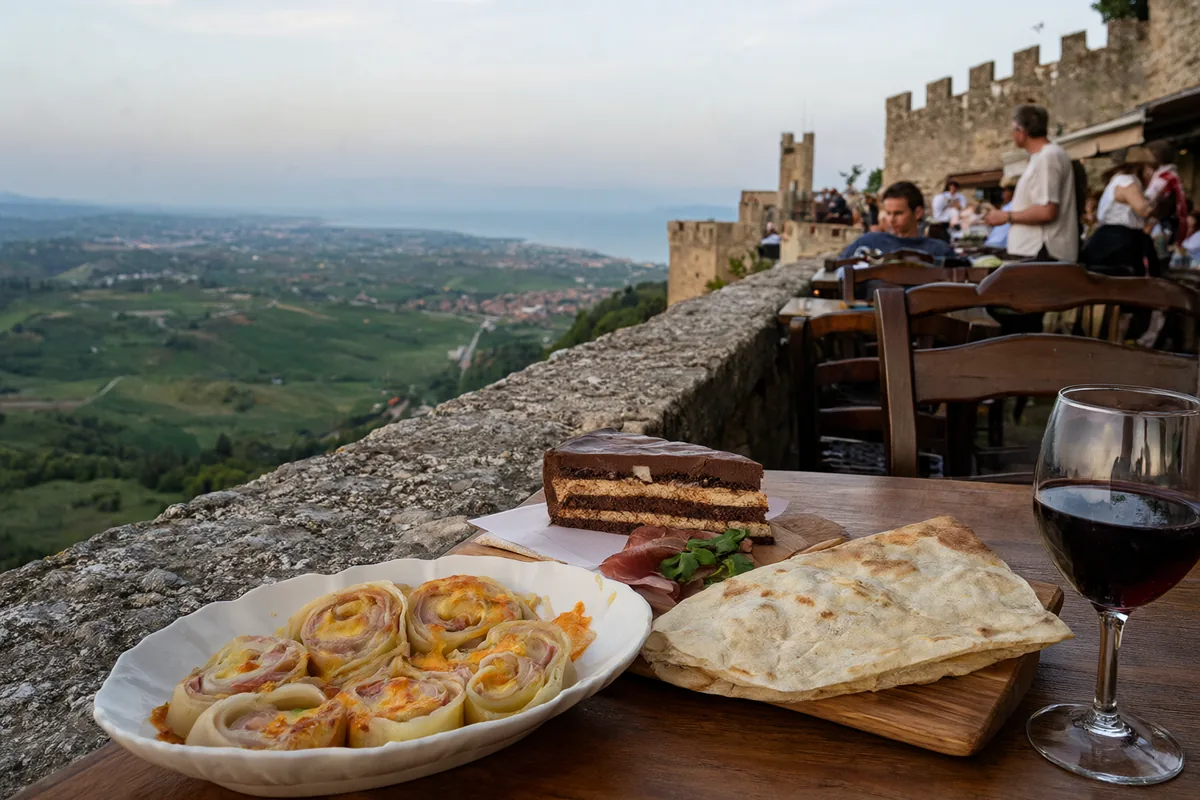
- Torta Tre Monti (everywhere): San Marino's best-known sweet, thin layers of crisp wafer sandwiched with hazelnut and chocolate cream and coated in chocolate. The name refers to the three towers on Monte Titano. It travels well, so it is the classic edible souvenir.
- Nidi di rondine (traditional restaurants): "swallows' nests", sheets of fresh pasta rolled up with ham, cheese and béchamel or tomato sauce, sliced into spirals and baked until golden.
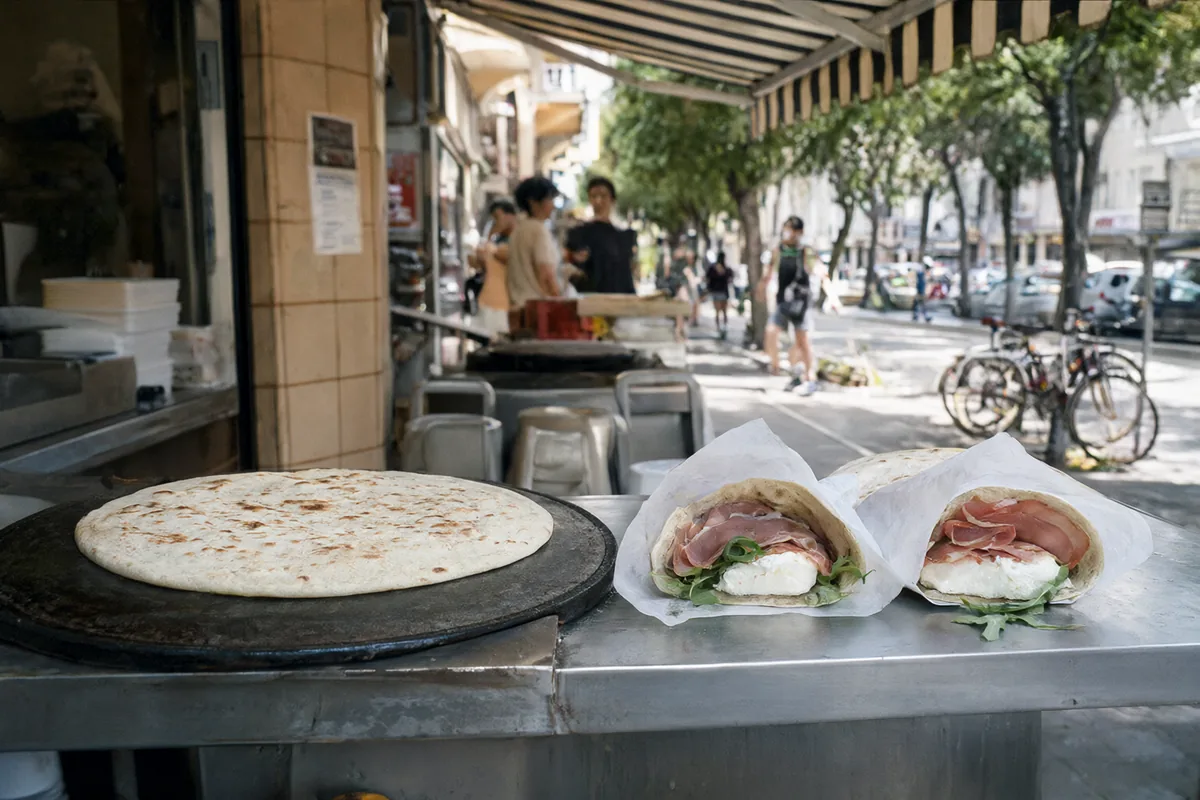
- Piadina (everywhere): the Romagna flatbread, cooked on a hot griddle and folded around fillings such as prosciutto, squacquerone (a soft fresh cheese) and rocket, or sausage and grilled greens.
- Tagliatelle al ragù (everywhere): flat egg pasta with slow-cooked meat sauce, the Sunday dish of the whole region.
- Strozzapreti (everywhere): "priest stranglers", short hand-rolled twists of pasta, served with sausage, with ragù, or with peas and cream.
- Passatelli in brodo (winter): thick strands of breadcrumbs, Parmesan, egg and nutmeg pushed through a press and cooked in meat broth.
- Cappelletti in brodo (winter and holidays): small hat-shaped filled pasta in broth, traditional at Christmas.
- Coniglio in porchetta (traditional restaurants): rabbit roasted with wild fennel, garlic and sometimes pancetta, cooked the way porchetta pork is.
- Fagioli con le cotiche (winter): a thick stew of beans and pork rind, simple farmhouse food from the hills.
- Grigliata mista (everywhere): mixed grilled meats, usually sausage, pork, lamb and chicken, served with roast potatoes or grilled vegetables.
- Bustrengo (bakeries and home kitchens): a rustic cake made from breadcrumbs or cornmeal, milk, honey, dried figs, apples and raisins, once made from leftovers and still popular around Christmas.
- Cacciatello (traditional restaurants): a simple baked milk and egg pudding with caramel, similar to crème caramel, often listed as a Sammarinese dessert.
How to read an Italian menu in San Marino
Italian is the official language of San Marino, and menus are written in Italian, often with English and German in the tourist streets of the old city. Locals also speak a Romagnol dialect, but you will not see it on menus. A meal runs in the Italian order: antipasto, primo (pasta or soup), secondo (meat or fish) with a contorno (side dish), then dolce. Nobody expects you to order every course. Many restaurants also offer a fixed-price menu turistico or menu del giorno.
| Italian | Meaning |
|---|---|
| Antipasti | Starters: cured meats, cheese, crostini |
| Primi (piatti) | First courses: pasta, risotto, soup |
| Secondi (piatti) | Main courses of meat or fish |
| Contorni | Side dishes, ordered separately |
| Dolci | Desserts |
| Pasta fatta in casa | Homemade pasta |
| In brodo | In broth |
| Al ragù | With meat sauce |
| Alla griglia / al forno | Grilled / baked |
| Salsiccia / maiale / agnello / coniglio | Sausage / pork / lamb / rabbit |
| Tartufo | Truffle, often with a price supplement |
| Coperto | Cover charge per person |
| Menu turistico / menu del giorno | Fixed-price tourist menu / menu of the day |
| Vino della casa | House wine |
Truffle dishes are often listed with a supplement or "secondo grammatura", meaning the price depends on how much truffle is shaved over your plate. Ask how much it will be before you say yes. swap.menu reads Italian menus, explains every dish and flags supplements and priced-by-weight items so you know what you are paying.
Coperto, tipping and paying the bill
San Marino follows Italian habits at the table. Many sit-down restaurants add a coperto, a per-person cover charge for bread and the table setting, which should be shown on the menu. Tax is included in menu prices, and a separate service charge is rare. Our guide to tax and service charges on menus explains how these lines work around the world.
Tipping is not expected. Locals round up or leave a euro or two for good service, and that is plenty. At a bar, a coffee drunk standing at the counter is the normal way to do it, and it is usually cheaper than sitting at a table on a terrace with a view.
San Marino is not in the European Union but uses the euro (€) and mints its own euro coins, which collectors prize and which are valid across the eurozone. Cards and contactless payment are widely accepted, although small bars and bakeries may prefer cash for small amounts. If a card machine offers to charge you in your home currency, choose euros: our guide to paying in local currency explains why.
Lunch runs from about 12:30pm to 2:30pm and dinner from about 7:30pm. Many restaurants in the old city cater mainly to day visitors and are busiest at lunch, while some close early in the evening outside summer. If you want dinner on Monte Titano, book or check opening hours in advance. Tap water is safe to drink.
Where to eat in San Marino, village by village
San Marino is divided into nine castelli, or municipalities, from the walled city on top of Monte Titano down to small farming villages on its slopes. Rimini and the Montefeltro hills in Italy are close enough to combine with a visit. Jump to a destination:
- City of San Marino
- Borgo Maggiore
- Serravalle
- Domagnano and the villages
- Rimini
- San Leo and Montefeltro
Where to eat in the City of San Marino
The City of San Marino, the capital, is a walled medieval town on the ridge of Monte Titano, part of a UNESCO World Heritage site, with the three towers along the cliff edge and views over Romagna to the Adriatic. Its steep lanes between Porta San Francesco, the main gate, and Piazza della Libertà are full of restaurants, cafés and shops selling torta Tre Monti, liqueurs and souvenirs. Many restaurants in the City of San Marino offer a set tourist menu at lunch, and the best of them still make their pasta by hand, so look for pasta fatta in casa on the menu.
The restaurants with terraces on the cliff side have the views and charge for them, but at lunch a plate of nidi di rondine or strozzapreti with sausage on a panoramic terrace is part of the experience. For better value, walk away from the main square towards the quieter lanes near the towers, where small trattorias and bars serve piadina, grilled meat and local wine. Day-trip crowds thin out by late afternoon, which makes an early dinner in the City of San Marino much calmer, with the lights of the coast coming on below.
Where to eat in Borgo Maggiore
Borgo Maggiore sits below the capital and is linked to it by a cable car, the funivia, which takes only a couple of minutes. It has been the republic's market town for centuries, and its arcaded main square, Piazza Grande, is still the place for a weekly market. Borgo Maggiore is less polished than the old city above and feels more local, with bakeries, bars and family restaurants serving everyday Romagna food.
This is a good place to try a proper piadina at lunch, or a plate of tagliatelle al ragù in a trattoria where most customers are Sammarinese. Prices in Borgo Maggiore are generally lower than on the hilltop. A practical plan is to take the cable car up to the City of San Marino in the morning, walk the towers, then come back down to Borgo Maggiore to eat.
Where to eat in Serravalle
Serravalle is the largest and most populous of the castelli, in the lower north of the country, and it includes Dogana, the commercial area where the main road from Rimini crosses the border. It is not a sightseeing destination, but this is where many Sammarinese live and work, and it has the widest choice of everyday restaurants in San Marino: pizzerias, piadinerie, grills and seafood places that draw customers from the coast.
Serravalle also has a small historic core around its old castle, with a few quieter places to eat. If you are driving or arriving by bus from Rimini, Serravalle and Dogana are good for a cheaper lunch or dinner without climbing the mountain. Pizzerias here bake late into the evening, and on weekends they are busy with families from both sides of the border.
Where to eat in Domagnano and the villages
The smaller castelli of Domagnano, Faetano, Fiorentino, Montegiardino, Chiesanuova and Acquaviva are farming villages on the slopes around Monte Titano, with vineyards, olive groves and wooded valleys. This is where San Marino's countryside cooking lives on, in country restaurants and farm-style places that serve grilled meat, rabbit with wild fennel, mushroom and truffle dishes in autumn, and local Sangiovese wine.
The villages are quiet and spread out, so you need a car or a taxi, and many restaurants open only for lunch on weekdays or for dinner on weekends. Montegiardino, the smallest castello, and Faetano near the Italian border are pleasant for a slow lunch with views. Ask locally which places are open, and expect a short menu of homemade pasta, grilled meats and seasonal vegetables rather than a long list.
Where to eat in Rimini
Rimini, on the Adriatic coast about 25 kilometres from San Marino, is the usual base for visitors and is linked to San Marino by regular buses. It is the capital of the piadina, sold from small kiosks and piadinerie all over town, folded around prosciutto, squacquerone and rocket or rolled around sausage and greens. Rimini's seafood is the other draw: sardoncini (small grilled sardines), poveracce (small clams), canocchie (mantis shrimp), fritto misto and brodetto, a fish stew.
The old town around Piazza Cavour and the Borgo San Giuliano quarter by the Roman bridge have the best trattorias and osterie in Rimini, while the long beachfront has seafood restaurants and beach bars in summer. The covered Mercato Coperto in the centre is the place to see the morning's fish. Our Italy food guide covers Bologna and the rest of Emilia-Romagna.
Where to eat in San Leo and Montefeltro
West and south of San Marino lies the Montefeltro, a hilly area of fortified villages straddling Emilia-Romagna and the Marche. San Leo, with its dramatic fortress on a rock, is the closest and easiest to combine with San Marino. The food here is the same mountain cooking with a stronger focus on truffles, mushrooms, game and cheese, including formaggio di fossa, sheep's or cow's milk cheese aged for months in pits dug in rock, a speciality of nearby Talamello and Sogliano al Rubicone.
In autumn, Sant'Agata Feltria holds a well-known white truffle fair on Sundays in October, and many restaurants in the area offer truffle dishes over tagliatelle, eggs or meat. Village trattorias serve homemade pasta, grilled lamb and wild boar. You need a car to explore the Montefeltro, and lunch is the main meal, so plan your day around a long one.
Vegetarian, vegan and allergy tips
San Marino is reasonably easy for vegetarians. Pasta with tomato, butter and sage, mushrooms or truffles, piadina with cheese and greens, grilled vegetables and pizza are on most menus. Watch for hidden meat, though: broth-based soups such as passatelli and cappelletti use meat stock, cappelletti are usually filled with meat, nidi di rondine contain ham, and many vegetable dishes are finished with pancetta. The Italian word for vegetarian is vegetariano (vegetariana for a woman), and for vegan vegano.
Vegans should know that fresh pasta in this region is almost always made with egg, and piadina dough is traditionally made with lard (strutto), although some places now use olive oil. Hazelnuts are central to torta Tre Monti and many local sweets. Gluten-free is senza glutine, and coeliac disease is well understood. Our guide to eating abroad with food allergies explains how to explain an allergy clearly when you do not speak the language.
Useful Italian phrases for ordering
Buongiorno / Buonasera "Good morning / Good evening", the polite greeting as you walk in
Un tavolo per due, per favore "A table for two, please"
Qual è il piatto tipico? "What is the local speciality?"
La pasta è fatta in casa? "Is the pasta homemade?"
Vorrei questo, per favore "I would like this, please" (pointing)
Sono allergico / allergica a... "I am allergic to..." (allergico for a man, allergica for a woman)
Il conto, per favore "The bill, please"
Grazie, era buonissimo "Thank you, it was delicious"
How swap.menu helps you eat in San Marino
Many San Marino menus list local dishes in Italian only, and names such as nidi di rondine, strozzapreti or passatelli tell a visitor very little. Photograph the menu with swap.menu and every dish appears in your language with the Italian name beside it and a short explanation, so you know that squacquerone is a soft fresh cheese and that cotiche is pork rind before you order. Every price is converted from euros to your home currency, and swap.menu points out the coperto and any truffle supplement so the bill holds no surprises.
Tap the dishes you want, add a note such as "no pork" or "I am allergic to nuts", typed or spoken, and swap.menu translates your order into Italian. Show the waiter your phone, or let them scan the QR code and read your order on their own screen. It works the same in Rimini and the rest of Italy. Try it on a sample menu with the free demo, or see travel pass prices.
Off to San Marino? Your first 3 menu scans are free, and a travel pass starts from $4.99 with nothing that renews.
Start free with 3 scansSan Marino food FAQ
Do you tip in restaurants in San Marino?
Tipping is not expected in San Marino. Many restaurants charge a coperto (cover charge) for bread and the table, and rounding up the bill or leaving a euro or two for good service is a kind gesture but never required.
What food is San Marino famous for?
San Marino is best known for torta Tre Monti, a chocolate-coated wafer cake named after the three towers of Monte Titano. Local dishes include nidi di rondine (baked rolled pasta with ham and cheese), strozzapreti, coniglio in porchetta (rabbit with wild fennel), bustrengo cake and the piadina flatbread shared with Romagna.
Is it expensive to eat in San Marino?
Eating out in San Marino costs about the same as in the rest of northern Italy. Restaurants with views in the old city charge more, while set lunch menus, piadina and the trattorias of Borgo Maggiore and Serravalle are good value.
Is San Marino worth visiting for food?
San Marino is worth a long lunch rather than a dedicated food trip. Combine it with Rimini for piadina and Adriatic seafood, and with the Montefeltro hills for truffles and formaggio di fossa, and you have some of the best country cooking in this part of Italy.
Is tap water safe to drink in San Marino?
Yes, tap water in San Marino is safe to drink. Restaurants usually offer bottled still or sparkling water, but you can ask for tap water if you prefer.
How can I read a menu in San Marino if I do not speak Italian?
Learn the course headings (antipasti, primi, secondi, contorni, dolci) and a few cooking words, or photograph the menu with swap.menu. It translates every dish into your language, explains local specialities, converts prices from euros to your currency and translates your order back into Italian.
Travelling further in Europe? Read our food guides for nearby countries:
- Italy food guide
- Monaco food guide
- Slovenia food guide
- Croatia food guide
- Malta food guide
- Switzerland food guide
Or browse every travel food guide.