Monaco is the second smallest country in the world, a strip of coast you can walk across in under an hour, and most visitors assume it only has expensive hotel dining rooms. There is more to it than that. This Monaco food guide covers the Monegasque dishes worth ordering, how to read the French menus you will find everywhere, how service charges and tipping work, then goes district by district through where to eat in Monte-Carlo, La Condamine, Monaco-Ville, Fontvieille and Larvotto, with a section on Nice and Menton just along the coast. Monaco's cooking belongs to the Riviera: it shares dishes with Nice, borrows freely from Liguria across the Italian border, and has a few specialities of its own, starting with the little fried pastry called the barbajuan. If you are travelling further, read our France food guide and Italy food guide, because both countries are less than half an hour away by train.
What to eat in Monaco: 12 dishes to know
Monegasque food is Mediterranean home cooking built on chard, chickpeas, olive oil, salt cod and fresh fish. These are the dishes to look for, from the true local specialities to the Riviera classics you will see on almost every menu.
- Barbajuan (everywhere): Monaco's national dish, a small fried pastry parcel filled with Swiss chard, ricotta, Parmesan and herbs, sometimes with leek or rice. The name is spelt barbagiuan in Monegasque. Eat them hot as an aperitivo snack.
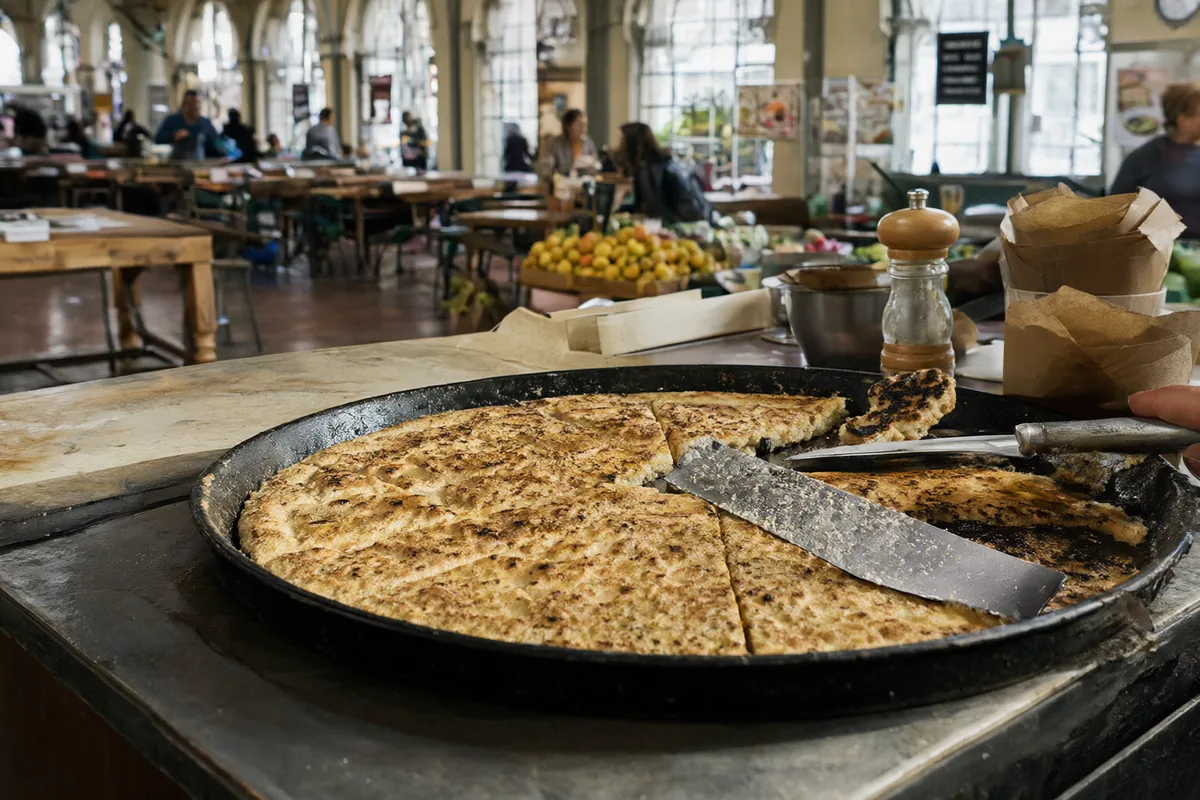
- Socca (markets): a thin, crisp pancake of chickpea flour, water and olive oil baked in a very hot oven, cut into ragged pieces and eaten with black pepper. It is shared with Nice and is best straight from the oven.
- Fougasse monégasque (bakeries, especially in November and December): a sweet, flat bread flavoured with orange flower water and topped with nuts and red and white aniseed sugar dragées, the colours of Monaco's flag.
- Stocafi (traditional restaurants): stockfish, cod dried in the wind, soaked and slowly stewed with tomato, onion, garlic, black olives and white wine. A dish of Monaco's fishing past.
- Brandamincium (traditional restaurants): the Monegasque version of brandade, salt cod pounded with olive oil, garlic and potato into a creamy purée.
- Pissaladière (bakeries): a bread dough base covered with slow-cooked onions, anchovies and black olives, sold by the slice.
- Pan bagnat (markets and beach cafés): a round bread roll soaked with olive oil and filled with tuna, egg, tomato, radish, onion and olives. A salade niçoise in a sandwich.
- Salade niçoise (everywhere): raw vegetables, tomato, egg, olives, tuna or anchovy and olive oil. A traditional version has no cooked potatoes or green beans.
- Tourte de blettes (bakeries): a chard pie, made either savoury with cheese or sweet with raisins, pine nuts and apple, and dusted with sugar.
- Gnocchi and ravioli (everywhere): pasta is everyday food here thanks to the Italian border, and ravioli filled with daube (beef stew) or chard is a Riviera speciality.
- Loup de mer and rouget (seafood restaurants): sea bass and red mullet from the Mediterranean, usually grilled or baked whole and often priced by weight.
- Petits farcis (bistros): small vegetables such as courgettes, tomatoes and onions stuffed with meat, rice and herbs and baked, a Niçoise dish common on Monaco menus.
How to read a French menu in Monaco
French is the official language of Monaco and nearly every menu is written in French, often with English and Italian alongside in the busier districts. Monegasque, a dialect related to Ligurian, is taught in schools and appears in dish names such as barbagiuan and stocafi, but you will not need it to order. A French menu runs in courses, and at lunch many restaurants offer a formule or menu du jour, a fixed-price set meal that is the best value way to eat out in Monaco.
| French | Meaning |
|---|---|
| Entrées | Starters (not main courses, as in American English) |
| Plats | Main courses |
| Desserts | Desserts |
| Plat du jour | Dish of the day |
| Formule / menu du jour | Fixed-price set menu, usually two or three courses |
| Poisson / fruits de mer | Fish / seafood |
| Viande / boeuf / veau / agneau | Meat / beef / veal / lamb |
| Poulet / porc | Chicken / pork |
| Grillé / frit / au four | Grilled / fried / baked |
| Fait maison | Homemade |
| Prix selon arrivage / au poids | Price depends on the catch / priced by weight |
| Les 100 g / le kg | Per 100 grams / per kilo, common for whole fish |
| Service compris | Service included in the price |
| Carafe d'eau | Jug of tap water, free on request |
Whole fish in Monaco is often listed "au poids" or with a price per 100 grams, and a large sea bass for two can cost far more than the figure printed on the menu. Ask the waiter to weigh it or tell you the price before it is cooked. swap.menu flags priced-by-weight dishes when it reads the menu, so you see the real cost before you order.
Tipping, service and paying the bill
Monaco follows French practice: menu prices include service, shown as service compris, and they include TVA, the sales tax Monaco applies on the French model. You should not see extra tax or service lines on the bill, and there is no cover charge. Some beach clubs and hotel restaurants add a separate charge for sunbeds or bread, which should be listed on the menu. Our guide to tax and service charges on menus explains how these lines work around the world.
Tipping is optional. In cafés people round up or leave small change, and in restaurants leaving around 5 to 10 percent for good service is normal and appreciated, more so in the smarter places in Monte-Carlo. Leave the tip in cash on the table or ask to add it to the card payment before the machine is handed over.
Monaco uses the euro (€) and mints its own euro coins, which are valid everywhere in the eurozone. Cards and contactless payment are accepted almost everywhere, including market stalls. If a card machine asks whether to charge you in your home currency, choose euros: our guide to paying in local currency explains why that matters.
Lunch runs from about noon to 2pm and dinner from about 7:30pm, with most restaurants busiest from 8:30pm. Many smaller places close one day a week. During the Monaco Grand Prix in May and the Monaco Yacht Show in September, terraces near the harbour are booked out, set menus replace the usual card and prices rise, so book well ahead or eat in Fontvieille or across the border in France. Tap water is safe to drink, and you can ask for a carafe d'eau at no charge.
Where to eat in Monaco, district by district
Monaco is divided into districts that sit on different levels of the hillside, connected by public lifts, escalators and a good bus network. Each has its own kind of food, from market stalls to harbour terraces, and Nice and Menton are a short train ride away in France. Jump to a district:
Where to eat in Monte-Carlo
Monte-Carlo is the Monaco of the postcards: the Casino, the grand hotels and the gardens of Casino Square, where some of the most expensive dining rooms on the Riviera serve French haute cuisine to people who arrived by yacht. If you want a famous tasting menu, this is where to find it, and you will need to book weeks in advance. For a more relaxed meal in Monte-Carlo, the terraces around the square are the classic place for a coffee or an aperitif while you watch the cars, though you pay for the view.
Walk a few minutes uphill to Boulevard des Moulins and the streets behind it, and Monte-Carlo becomes a normal place where residents live and shop. Here you find bakeries selling barbajuans and pissaladière, Italian trattorias, pizzerias and brasseries with a lunchtime formule at reasonable prices. Monte-Carlo also merges into Beausoleil, the French town on the hillside directly above, where restaurant prices drop noticeably. A good tip in Monte-Carlo is to eat your big meal at lunch, when even smart restaurants offer set menus at a fraction of the dinner price.
Where to eat in La Condamine
La Condamine is the district around Port Hercule, the main harbour, and it is the best part of Monaco for everyday eating. The heart of it is the Marché de la Condamine on the Place d'Armes, a market that has run since the 1880s. The open-air stalls sell fruit, vegetables and flowers in the morning, and the covered hall beside them has food counters where locals eat socca, barbajuans, fresh pasta, pizza and plates of the day at shared tables. It is the cheapest good meal in Monaco and one of the few places where you can try socca and barbajuans side by side.
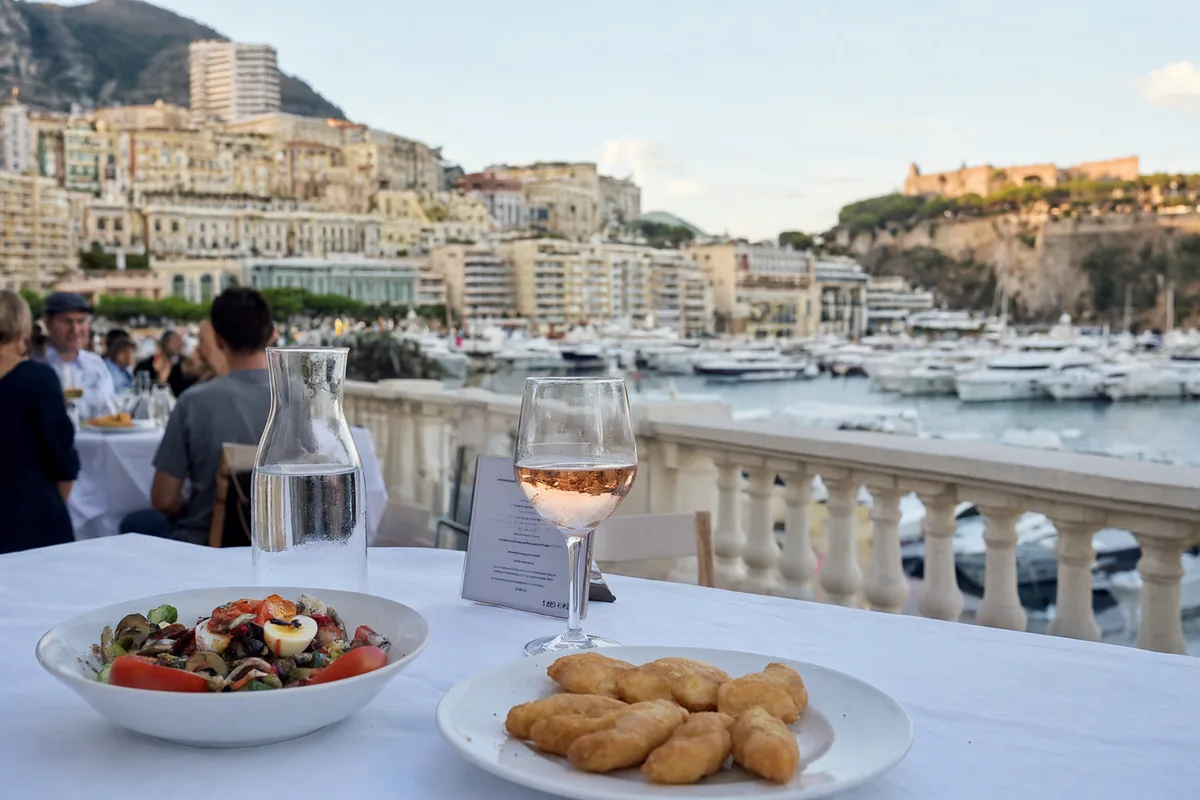
From the market, Rue Princesse Caroline is a pedestrian street lined with restaurant terraces serving Italian, Monegasque and seafood dishes, and Rue Grimaldi nearby has more cafés and casual places. Along the quayside of Port Hercule, bars and restaurants look out over the yachts and fill up on warm evenings. La Condamine is also where the Formula 1 circuit passes, so during the Grand Prix much of the harbour front becomes grandstands and hospitality areas. Outside race week, an evening in La Condamine with a glass of rosé and a plate of fried fish is very good value by Monaco standards.
Where to eat in Monaco-Ville
Monaco-Ville, known as Le Rocher (the Rock), is the old town on the headland, home to the Prince's Palace, the cathedral and the Oceanographic Museum. Its narrow lanes, such as Rue Basse and Rue Comte Félix Gastaldi, have small restaurants, bakeries and souvenir shops in ochre and pink buildings. This is the best district in Monaco to find traditional Monegasque cooking, and some small places serve stocafi, brandamincium and barbajuans alongside Italian pasta dishes.
Because the Rock fills with day visitors in the late morning, especially around the changing of the guard at the palace just before noon, the restaurants nearest the Place du Palais are priced for tourists. Eat earlier or later, or come back in the evening when the coach groups have gone and the lanes are quiet. A bakery barbajuan or a slice of fougasse eaten on the ramparts above the harbour is one of the nicest cheap snacks in Monaco-Ville.
Where to eat in Fontvieille
Fontvieille is the newest district, built on land reclaimed from the sea in the 1970s and 1980s on the far side of the Rock. It is mostly residential and commercial, with the Stade Louis II, a shopping centre, the Princess Grace Rose Garden and the small Port de Fontvieille. The quays around this harbour are lined with restaurant terraces, mainly Italian, pizza and seafood places, that are popular with people who live and work in Monaco.
Fontvieille is calmer and usually cheaper than Monte-Carlo or the harbour in La Condamine, and it is a good choice during big events when the rest of Monaco is packed. It is also handy for families, with space to walk and gardens nearby. Expect wood-fired pizza, pasta with seafood, grilled fish and generous salads, and a lunchtime plat du jour in the office cafés around the district.
Where to eat in Larvotto
Larvotto is Monaco's public beach, at the eastern end of the country beyond Monte-Carlo, and it was rebuilt and reopened with a new promenade in the early 2020s. Along Avenue Princesse Grace and the beachfront you find beach clubs, cafés and restaurants serving salads, grilled fish, carpaccio, pasta and sushi, with sunbed hire at some of them. Prices in Larvotto range from casual beach café to very expensive, and the menu at the door will tell you which kind you are in.
For a cheaper day at Larvotto, the public beach is free, and you can bring a pan bagnat and a slice of pissaladière from a bakery in Monte-Carlo. In the evening, some beach restaurants turn into lounge bars. In summer, book ahead for a table on the sand, and check whether a beach restaurant charges a minimum spend or a sunbed fee before you sit down.
Where to eat in Nice and Menton
Monaco sits between two French towns that are well worth a food trip, both reached by frequent regional trains. Nice, about 20 minutes west, is the home of most Riviera classics: socca, pan bagnat, salade niçoise, pissaladière, petits farcis and daube niçoise. The Cours Saleya market in the old town, Vieux Nice, sells flowers and produce in the morning and is surrounded by socca stalls and small restaurants. Nice is also a cheaper base than Monaco for accommodation and eating out.
Menton, about 10 minutes east and right on the Italian border, is famous for its lemons, which have their own festival, the Fête du Citron, every February. The covered market in the old town sells local citrus, olive oil and Ligurian specialities, and the restaurants along the seafront mix French and Italian cooking. Just across the border, the Italian town of Ventimiglia has a large Friday market and the start of Ligurian food country, with focaccia, farinata (the Italian name for socca) and pesto. Our France food guide covers Nice and the rest of France, and the Italy food guide covers Liguria and beyond.
Vegetarian, vegan and allergy tips
Monaco is a reasonably easy place to eat vegetarian. Socca is vegan, barbajuans and tourte de blettes are usually vegetarian, and the Italian influence means pasta, pizza and risotto are on almost every menu. The French word for vegetarian is végétarien (végétarienne for a woman) and for vegan végétalien or simply vegan. Ask whether a dish contains viande (meat) or poisson (fish).
Watch for hidden ingredients. Anchovies turn up in pissaladière, salade niçoise, tapenade and many sauces, and fish stock is common in soups and risotto. Some barbajuan recipes include rice or a little ham, and pastry may be made with lard or butter, so ask if it matters to you. Nuts and pine nuts appear in sweet tourte de blettes, pesto and fougasse. Gluten-free is sans gluten, and most upmarket restaurants understand allergies well. Our guide to eating abroad with food allergies explains how to explain an allergy clearly when you do not speak the language.
Useful French phrases for ordering
Bonjour / Bonsoir "Hello / Good evening", always said when you walk into a shop, café or restaurant
Une table pour deux, s'il vous plaît "A table for two, please"
Qu'est-ce que vous me conseillez ? "What do you recommend?"
Je voudrais ceci "I would like this" (pointing at the menu)
C'est combien, ce poisson ? "How much is this fish?", useful when fish is priced by weight
Je suis allergique à... "I am allergic to..."
L'addition, s'il vous plaît "The bill, please"
Merci, c'était délicieux "Thank you, it was delicious"
How swap.menu helps you eat in Monaco
Most Monaco menus are in French, and the traditional dishes are often listed only under their Monegasque or Niçoise names. Photograph the menu with swap.menu and every dish appears in your language with the original name beside it and a short explanation, so you know that stocafi is a stockfish stew and brandamincium is salt cod purée before you order. Every price is converted from euros to your home currency, and swap.menu flags fish sold by weight and any extra charges, so a beach club bill or a whole sea bass holds no surprises.
Tap the dishes you want, add a note such as "no anchovies" or "I am allergic to nuts", typed or spoken, and swap.menu translates your order into French. Show the waiter your phone, or let them scan the QR code and read your order on their own screen. The same works in Nice, Menton and across the border in Italy. Try it on a sample menu with the free demo, or see travel pass prices.
Off to Monaco? Your first 3 menu scans are free, and a travel pass starts from $4.99 with nothing that renews.
Start free with 3 scansMonaco food FAQ
Do you tip in restaurants in Monaco?
Service is included in menu prices in Monaco, as in France, so a tip is not required. Leaving around 5 to 10 percent for good service in a restaurant is normal, and rounding up is enough in a café.
What food is Monaco famous for?
Monaco's national dish is the barbajuan, a fried pastry filled with Swiss chard and ricotta. Other local specialities are stocafi (stockfish stew), brandamincium (salt cod purée) and fougasse monégasque, a sweet orange flower bread. Riviera dishes such as socca, pissaladière and salade niçoise are on menus everywhere.
Is it expensive to eat out in Monaco?
Monaco is one of the most expensive places in Europe to eat out, especially around Casino Square and the harbour. You can eat well for much less at the Marché de la Condamine, in bakeries, with a lunchtime set menu, or by crossing into Beausoleil or Nice.
Where is the cheapest place to eat in Monaco?
The food hall at the Marché de la Condamine is the best value, with socca, barbajuans, pasta and dishes of the day at shared tables. Bakeries all over Monaco sell pissaladière, pan bagnat and barbajuans, and Fontvieille has reasonably priced pizza and pasta restaurants.
Is tap water safe to drink in Monaco?
Yes, tap water in Monaco is safe to drink. In restaurants you can ask for a carafe d'eau, a jug of tap water, at no charge instead of buying bottled water.
How can I read a menu in Monaco if I do not speak French?
Learn the course words (entrées, plats, desserts) and a few cooking terms, or photograph the menu with swap.menu. It translates every dish into your language, explains Monegasque specialities, converts prices from euros to your currency and translates your order back into French for the waiter.
Travelling further in Europe? Read our food guides for nearby countries:
- France food guide
- Italy food guide
- San Marino food guide
- Andorra food guide
- Switzerland food guide
- Spain food guide
Or browse every travel food guide.