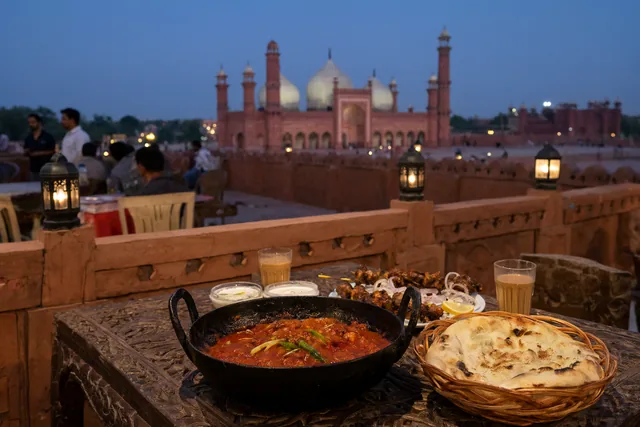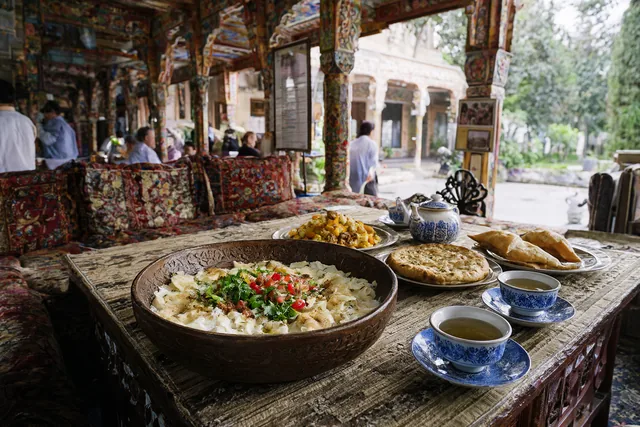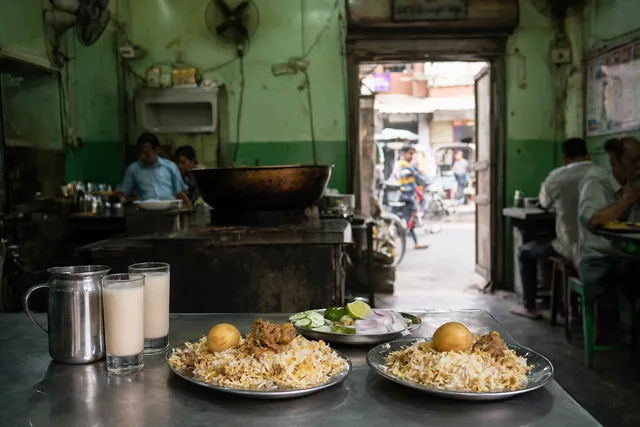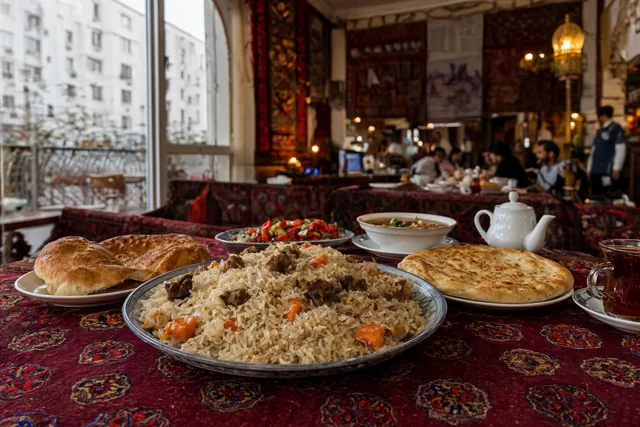
Kyrgyzstan is a country of mountains, high pastures and nomadic tradition, and its food is hearty and meat-based: mutton and horse meat, hand-cut noodles, bread from clay ovens, rich dairy and endless bowls of tea. This Kyrgyzstan food guide covers the dishes to know, the Kyrgyz and Russian words you will see on menus, how tipping and paying in som work, and where to eat in Bishkek, Osh, Karakol, Cholpon-Ata, Naryn and Song-Kul. Kyrgyz cooking mixes nomadic dishes with Uzbek plov from the south, Dungan and Uyghur noodles from the east, and Russian salads and soups from the Soviet years.
What to eat in Kyrgyzstan: 12 dishes to know
These are the dishes worth seeking out, with the region they are most closely tied to. Bread (nan) is on every table and treated with respect: never put it upside down or throw it away.
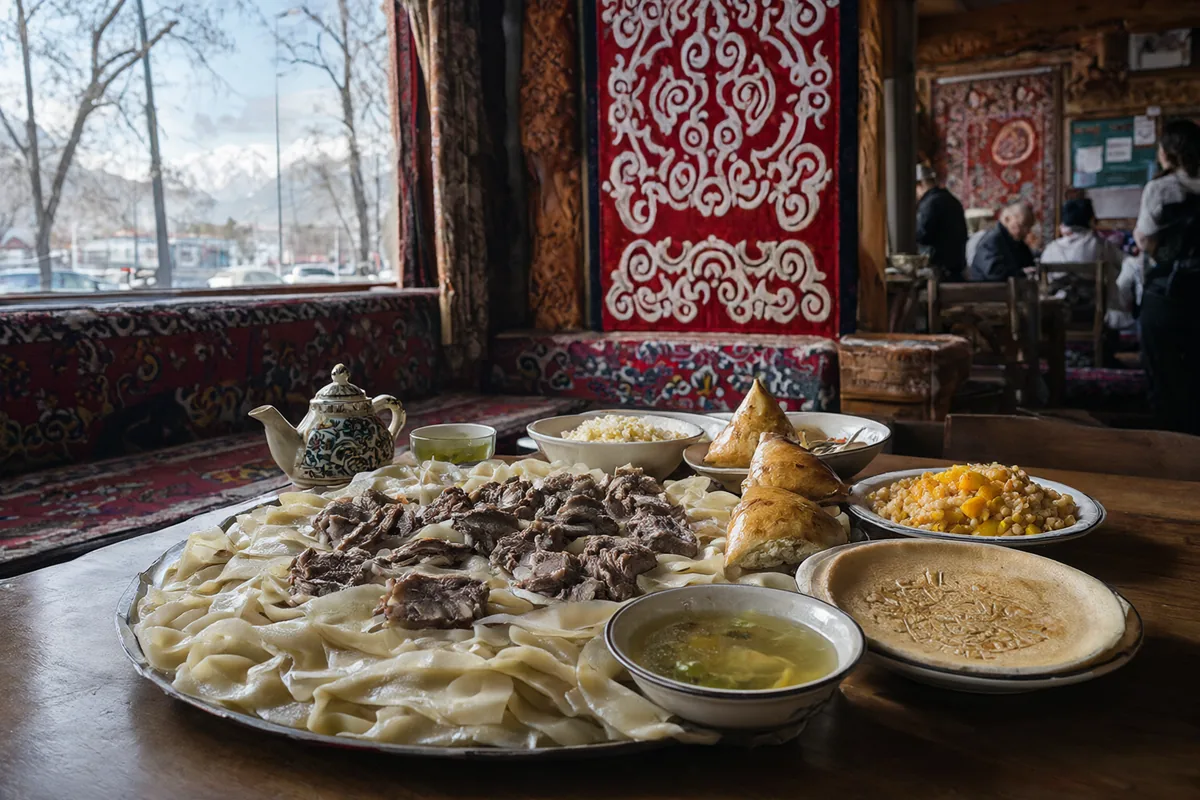
- Beshbarmak (everywhere, the national dish): boiled mutton or horse meat chopped and served over flat noodles with onion, with the meat broth (shorpo) in a bowl on the side. The name means "five fingers", from eating it by hand.
- Plov (everywhere, best in Osh): rice cooked in a huge iron pot (kazan) with mutton, yellow carrots, onion and cumin. In Kyrgyz it is paloo.
- Lagman (everywhere): hand-pulled noodles with a stir-fry of meat, peppers and vegetables, in a little broth or fried as boso lagman. A Uyghur and Dungan dish.
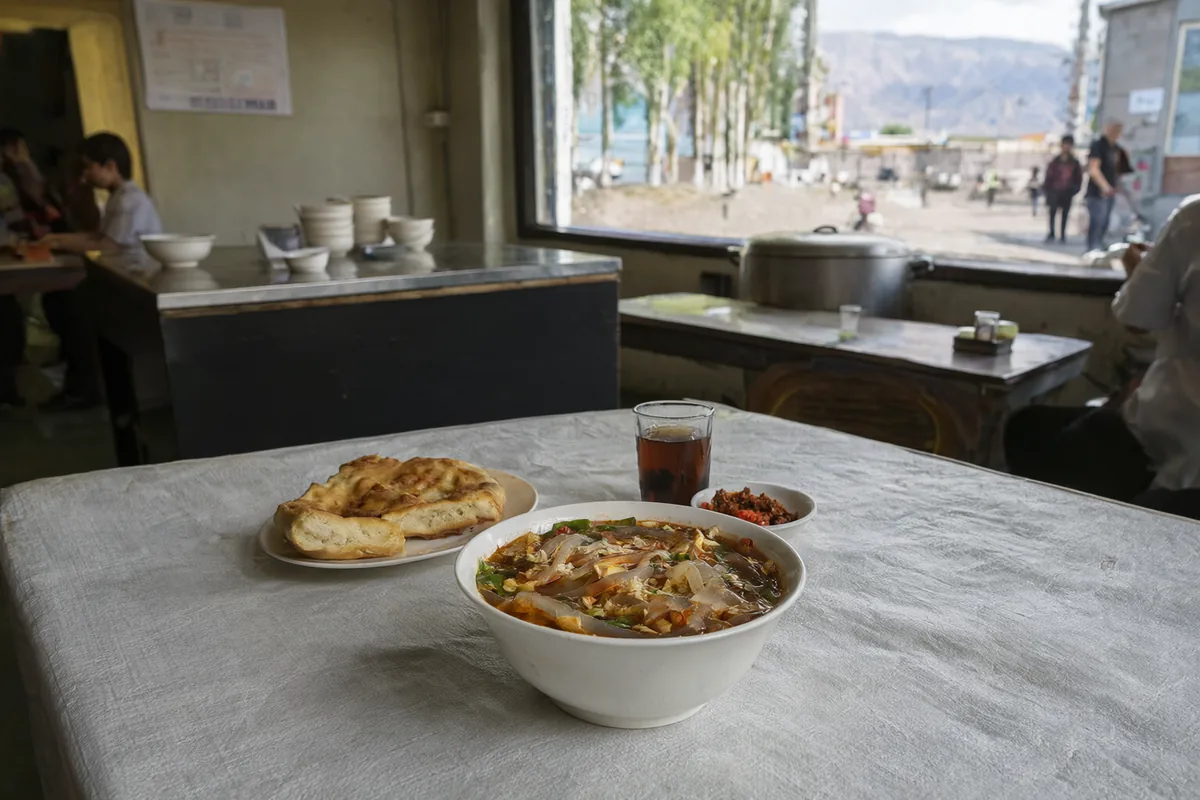
- Ashlyan-fu (Karakol): a cold, spicy, sour soup of noodles and starch jelly in a vinegar and chilli broth, a Dungan speciality and Karakol's signature dish.
- Manty (everywhere): large steamed dumplings filled with chopped mutton, onion and fat, or pumpkin, served with sour cream or vinegar.
- Samsa (everywhere): flaky pastries filled with meat and onion, baked against the wall of a clay tandoor oven.
- Kuurdak (everywhere): chunks of meat and offal fried with onions, sometimes with potatoes, a simple nomadic dish.
- Shorpo (everywhere): a clear meat soup with potatoes, carrots and herbs.
- Oromo (everywhere): a roll of thin dough filled with meat or pumpkin and steamed, then sliced.
- Chuchuk (everywhere, especially at feasts): horse meat sausage, cured or boiled and sliced thin.
- Boorsok (everywhere): small puffs of fried dough piled on the table with jam, honey and kaymak, thick clotted cream.
- Kymyz (summer, the mountains): fermented mare's milk, slightly sour, fizzy and mildly alcoholic, sold in summer from yurts and roadside stalls.
Kyrgyzstan's Korean community, descended from people resettled in Central Asia in the Soviet era, also gave the country spicy carrot and vegetable salads, sold in every bazaar, and Russian dishes such as borscht, pelmeni and salads appear on most restaurant menus.
How to read a Kyrgyz menu
Kyrgyz is a Turkic language written in the Cyrillic alphabet, and Russian is widely spoken, especially in Bishkek and the north. Many menus in Bishkek are printed in Russian first, sometimes with Kyrgyz and English; in Osh you may also see Uzbek. Learning to sound out Cyrillic letters helps a lot. These are the words you will see most, in both languages.
| Kyrgyz | Russian | Meaning |
|---|---|---|
| Тамак (tamak) | Еда (yeda) | Food |
| Эт (et) | Мясо (myaso) | Meat |
| Кой эти (koy eti) | Баранина (baranina) | Mutton, lamb |
| Уй эти (uy eti) | Говядина (govyadina) | Beef |
| Жылкы эти (zhylky eti) | Конина (konina) | Horse meat |
| Тоок (took) | Курица (kuritsa) | Chicken |
| Нан (nan) | Хлеб (khleb) | Bread |
| Шорпо (shorpo) | Суп / шурпа (sup / shurpa) | Soup |
| Палоо (paloo) | Плов (plov) | Plov, rice with meat |
| Жашылча (zhashylcha) | Овощи (ovoshchi) | Vegetables |
| Чай (chay) | Чай (chay) | Tea (кара чай, black; көк чай, green) |
| Кымыз (kymyz) | Кумыс (kumys) | Fermented mare's milk |
| Эсеп (esep) | Счёт (schyot) | The bill |
Menus in Kyrgyzstan often list dishes by weight, with portions shown in grams, and a separate line for bread, tea and the service charge. Photograph the menu with swap.menu and every dish is translated from Russian or Kyrgyz, explained in your language and converted from som to your home currency.
Tipping, paying and meal times in Kyrgyzstan
Many restaurants and cafés in Bishkek and the bigger towns add a service charge of around 10 to 15 percent to the bill, often written as обслуживание (obsluzhivaniye) and shown on the menu. When it is included, there is no need to tip more. Where no service charge is added, leaving around 10 percent for good service is appreciated. In canteens, bazaar stalls and roadside cafés, tipping is not expected. Our guide to tax and service charges on menus explains how these lines work.
The currency is the Kyrgyz som (KGS, сом). Cards are accepted in many restaurants, supermarkets and hotels in Bishkek, and less often in Osh and Karakol, but bazaars, small cafés, guesthouses and yurt camps want cash. ATMs are common in the cities and scarce in the mountains, so take out enough before heading to Song-Kul or Naryn. When a card machine offers to charge you in your home currency, choose som: our guide to paying in local currency explains why.
Lunch is from about noon to 2pm, and many cafés offer a cheap set "business lunch" on weekdays. Dinner is from around 7pm to 9pm, and restaurants in Bishkek stay open later. Tea is served with every meal and between meals, and a guest at a Kyrgyz home will be offered a full dastorkon, a spread of bread, sweets, nuts, dried fruit and boorsok, before the main dish arrives. Alcohol, especially vodka and local beer, is widely available, though many Kyrgyz people do not drink.
Where to eat in Kyrgyzstan, town by town
Most of the restaurants are in Bishkek and Osh, while in the mountains you will eat in guesthouses and yurt camps, often with the family that runs them. Jump to a place:
Where to eat in Bishkek
Bishkek, the capital, is a leafy Soviet-planned city at the foot of the snow-capped Ala-Too mountains, and it has the widest choice of food in Kyrgyzstan. Kyrgyz and Central Asian restaurants serve beshbarmak, plov, lagman and kuurdak, often in dining rooms decorated with felt shyrdak carpets, while chaikhanas (teahouses) serve cheap samsa, manty and tea. Bishkek also has good Uyghur, Dungan, Turkish, Georgian, Korean and Russian restaurants, and a growing coffee and café culture.
The Osh Bazaar, west of the centre, is the city's biggest and most colourful market, with stalls of dried fruit, nuts, spices, Korean salads, honey, kurut (dried salty yoghurt balls) and fresh samsa from tandoor ovens. The smaller Alamedin Bazaar is also good for food. Restaurants in central Bishkek around Chuy Avenue and Ala-Too Square are within walking distance of most hotels. In summer, look for stalls selling cold drinks such as maksym (a fermented grain drink) and chalap (a salty yoghurt drink) on the streets.
Where to eat in Osh
Osh, in the Fergana Valley in the south, is one of the oldest cities in Central Asia and a stop on the ancient Silk Road, with a large Uzbek community and a food culture closer to Uzbekistan than to Bishkek. It is famous across Kyrgyzstan for Osh plov, made with the region's own rice and yellow carrots, cooked in enormous kazans and served at lunchtime, often sold out by early afternoon. Osh is also good for samsa, kebabs (shashlik) and flat round breads stamped with patterns.
The Jayma Bazaar, stretching along the river, is one of the oldest and largest markets in the region, with food stalls, fresh bread, dried fruit, nuts and spices, and small cafés where traders eat plov and lagman. Climb Sulaiman-Too, the sacred mountain in the middle of Osh, in the morning and come down for lunch in a chaikhana. In Osh, more people speak Uzbek and Kyrgyz than Russian, and menus may be in any of the three.
Where to eat in Karakol
Karakol, at the eastern end of Issyk-Kul lake, is the base for trekking in the Tian Shan mountains and the home of Kyrgyzstan's Dungan community, Chinese Muslims who settled here in the 19th century. Its signature dish is ashlyan-fu, a cold bowl of noodles and slippery starch jelly in a sour, spicy vinegar and chilli broth, usually eaten with a fried bread or pastry. Karakol has a whole row of small cafés near the bazaar serving nothing but ashlyan-fu, and a bowl costs very little.
Karakol's Dungan families also cook gan-fan, rice with a stir-fry of meat and vegetables, and multi-course Dungan dinners, which some guesthouses and families arrange for visitors. The town's wooden Dungan Mosque, built in a Chinese temple style, is worth a visit before lunch. The Sunday animal market on the edge of Karakol, where farmers trade sheep, cattle and horses, is busiest early in the morning and has food stalls for the traders. Karakol bazaar is also good for honey from mountain pastures.
Where to eat in Cholpon-Ata
Cholpon-Ata, on the north shore of Issyk-Kul, is the lake's main resort town, busy in July and August when visitors from across Kyrgyzstan, Kazakhstan and Russia come for the beaches. The food is simple and seasonal: summer cafés serve shashlik, plov, lagman and salads, and roadside sellers along the north shore offer smoked fish from the lake, a local favourite to eat with bread and beer.
Fruit is another highlight: the shores of Issyk-Kul grow apricots, apples and sea buckthorn, sold as fresh fruit, jams and juice at markets and roadside stalls. Cholpon-Ata has a small bazaar, and its cafés and guesthouses cater to lake visitors. Outside the summer season, many restaurants in Cholpon-Ata close, so check before you visit in spring or autumn.
Where to eat in Naryn
Naryn, a long, cold town in a river valley in the centre of the country, is the main stop on the road to the Torugart pass and China, and the base for visiting the stone caravanserai at Tash Rabat and the lake at Song-Kul. Naryn is known as one of the most traditionally Kyrgyz parts of the country, and its food reflects the pastoral life of the region: mutton and horse meat, beshbarmak, kuurdak, dairy products and, in summer, kymyz.
Restaurants in Naryn are simple cafés and canteens serving soups, lagman, plov and manty, and guesthouses cook meals for guests. The bazaar sells dairy products such as kurut and kaymak. Naryn is high and cold in winter, so a bowl of shorpo or lagman is welcome at any time of year. Stock up on cash and snacks here before heading to the mountains.
Where to eat at Song-Kul
Song-Kul is a high alpine lake at around 3,000 metres, surrounded by summer pastures where herders bring their flocks from June to September, and it is one of the best places to experience nomadic life. There are no restaurants: visitors stay in yurt camps run by herding families, and meals are cooked in the yurt or in a camp kitchen. Expect bread, boorsok, kaymak, jam, soups such as shorpo, plov or beshbarmak, and plenty of tea.
This is the place to try fresh kymyz, made from the milk of mares grazing around the lake, often offered to guests as a welcome. It is an acquired taste, and it can upset the stomach if you drink a lot at first. Song-Kul is cold even in summer, especially at night, and the camps close in autumn. Bring cash, as meals and accommodation are paid in som, and let your hosts know about any dietary needs when booking.
Vegetarian, vegan and allergy tips
Kyrgyzstan is one of the harder countries in Asia for vegetarians. Traditional dishes are built on meat, meat broth and animal fat, and even vegetable dishes may be cooked in mutton fat. In Bishkek, there are vegetarian-friendly cafés and international restaurants. Elsewhere, look for Korean vegetable salads, pumpkin manty, vegetable lagman, bread, boorsok, dairy and the many fresh and dried fruits and nuts at the bazaars, and ask whether a soup is made with meat broth. The phrase to use is the Russian я не ем мясо (ya ne yem myaso), "I don't eat meat", and for vegetarian, вегетарианец (vegetarianets).
Dairy is everywhere, from kaymak and sour cream to kurut and kymyz. Nuts are common in sweets and on the dastorkon, and wheat is in bread, noodles, dumplings and pastries, so gluten-free eating is very difficult outside plov and grilled meat. Our guide to eating abroad with food allergies explains how to explain an allergy clearly.
Useful Kyrgyz and Russian phrases for ordering
Саламатсызбы Salamatsyzby: "Hello", the polite Kyrgyz greeting (Russian: Здравствуйте, zdravstvuyte)
Меню, пожалуйста Menyu, pozhaluysta: "The menu, please" (Russian)
Это, пожалуйста Eto, pozhaluysta: "This one, please" (Russian, pointing)
Что посоветуете? Chto posovetuyete?: "What do you recommend?" (Russian)
Я не ем мясо Ya ne yem myaso: "I don't eat meat" (Russian)
Сколько стоит? Skolko stoit?: "How much is it?" (Russian)
Счёт, пожалуйста Schyot, pozhaluysta: "The bill, please" (Russian)
Даамдуу, рахмат! Daamduu, rakhmat!: "Delicious, thank you!" (Kyrgyz)
How swap.menu helps you eat in Kyrgyzstan
Menus in Kyrgyzstan are usually in Russian Cyrillic, sometimes with Kyrgyz, and dish names like куурдак, ашлянфу or оромо mean nothing to most visitors. Photograph the menu with swap.menu and every dish appears in your language with the original name beside it and a short explanation, so you know that kuurdak is fried meat and offal, that ashlyan-fu is served cold, and which dishes are horse meat. Every price is converted from som to your home currency, and we point out the service charge and dishes priced per 100 grams.
Tap the dishes you want, add a note such as "no meat" or "no horse meat", typed or spoken, and swap.menu translates your order into Russian or Kyrgyz. Show the waiter your phone, or let them scan the QR code and read your order on their own screen. You can try it right now on a sample menu with the free demo, or see travel pass prices.
Off to Kyrgyzstan? Your first 3 menu scans are free, and a travel pass starts from $4.99 with nothing that renews.
Start free with 3 scansKyrgyzstan food FAQ
Do you tip in restaurants in Kyrgyzstan?
Many restaurants in Bishkek and the larger towns add a service charge of around 10 to 15 percent, so no extra tip is needed. Where there is no service charge, around 10 percent for good service is appreciated. Canteens and bazaar stalls do not expect tips.
What food is Kyrgyzstan famous for?
Beshbarmak, boiled meat on flat noodles, is the national dish. Plov, lagman noodles, manty dumplings, samsa, horse meat sausage, boorsok and kymyz, fermented mare's milk, are just as typical.
Is it easy to be vegetarian in Kyrgyzstan?
It is difficult outside Bishkek, as most dishes are based on meat or meat broth. Salads, bread, dairy, pumpkin manty and fresh fruit and nuts from the bazaars are the safest options in the countryside.
Is Kyrgyzstan expensive to eat out?
No, eating out is cheap. A bowl of lagman or ashlyan-fu, samsa and tea cost very little, and even good restaurants in Bishkek are affordable by Western standards.
Is tap water safe to drink in Kyrgyzstan?
Visitors are usually advised to drink bottled, boiled or filtered water, especially outside Bishkek. Tea, which is boiled, is served everywhere and is a safe choice.
How can I read a menu in Kyrgyzstan?
Menus are usually in Russian, sometimes with Kyrgyz, so learning the Cyrillic alphabet and a few words like мясо (meat) and плов (plov) helps. You can also photograph the menu with swap.menu, which translates every dish, converts prices from som and translates your order for the waiter.
Travelling further in Central Asia? Read our food guides for neighbouring countries:
- Kazakhstan food guide
- Uzbekistan food guide
- Tajikistan food guide
- Turkmenistan food guide
- China food guide
- Mongolia food guide
Or browse every travel food guide.