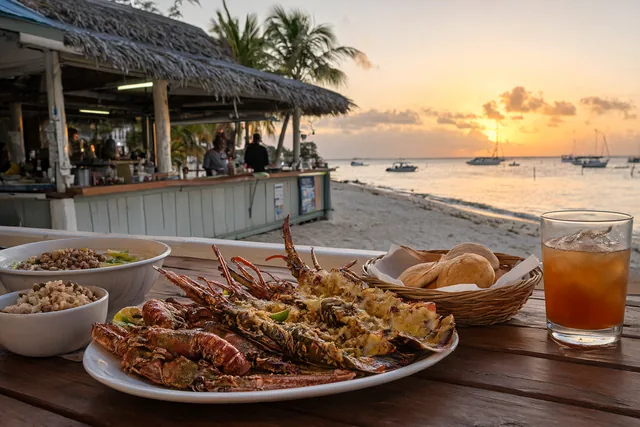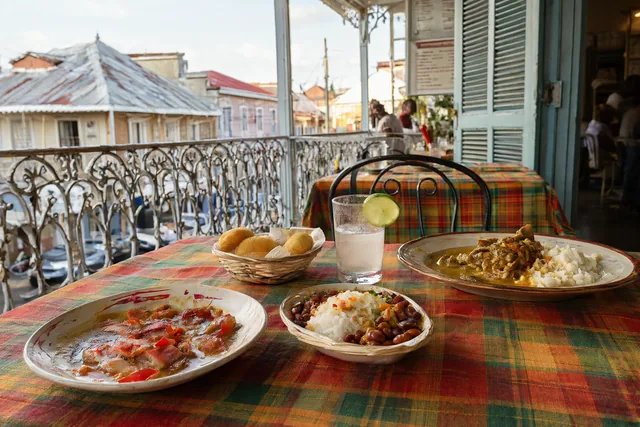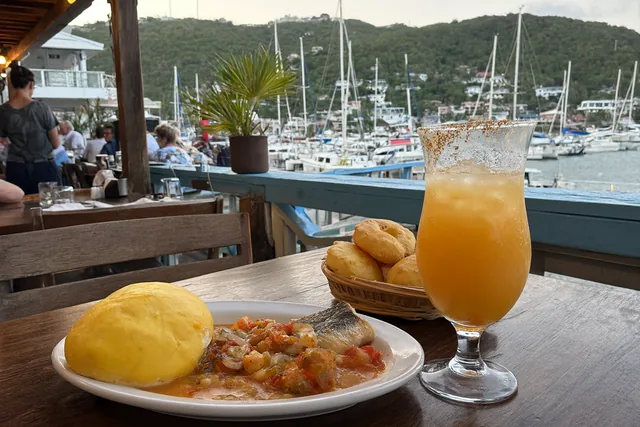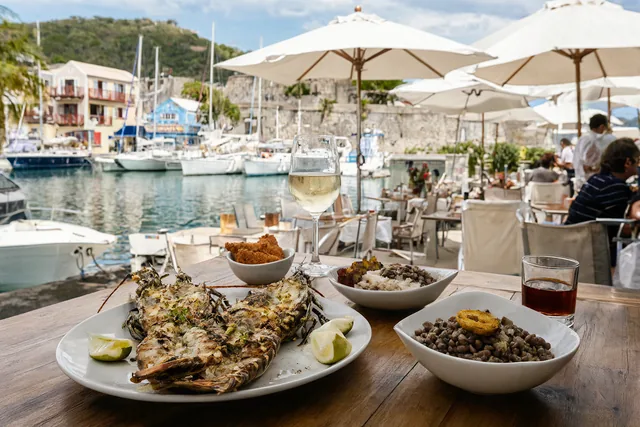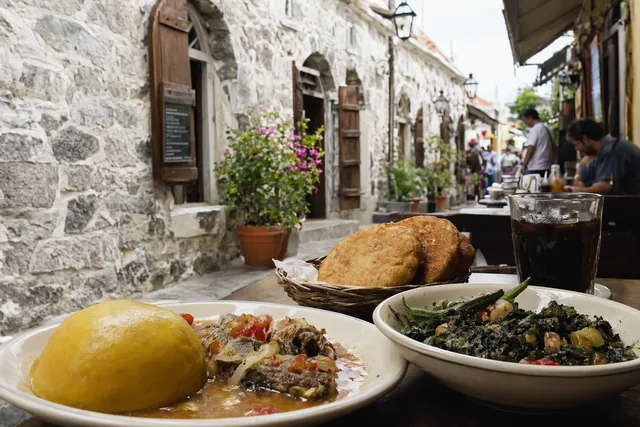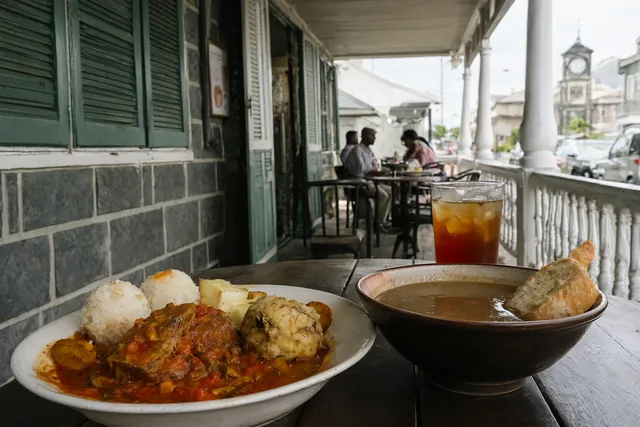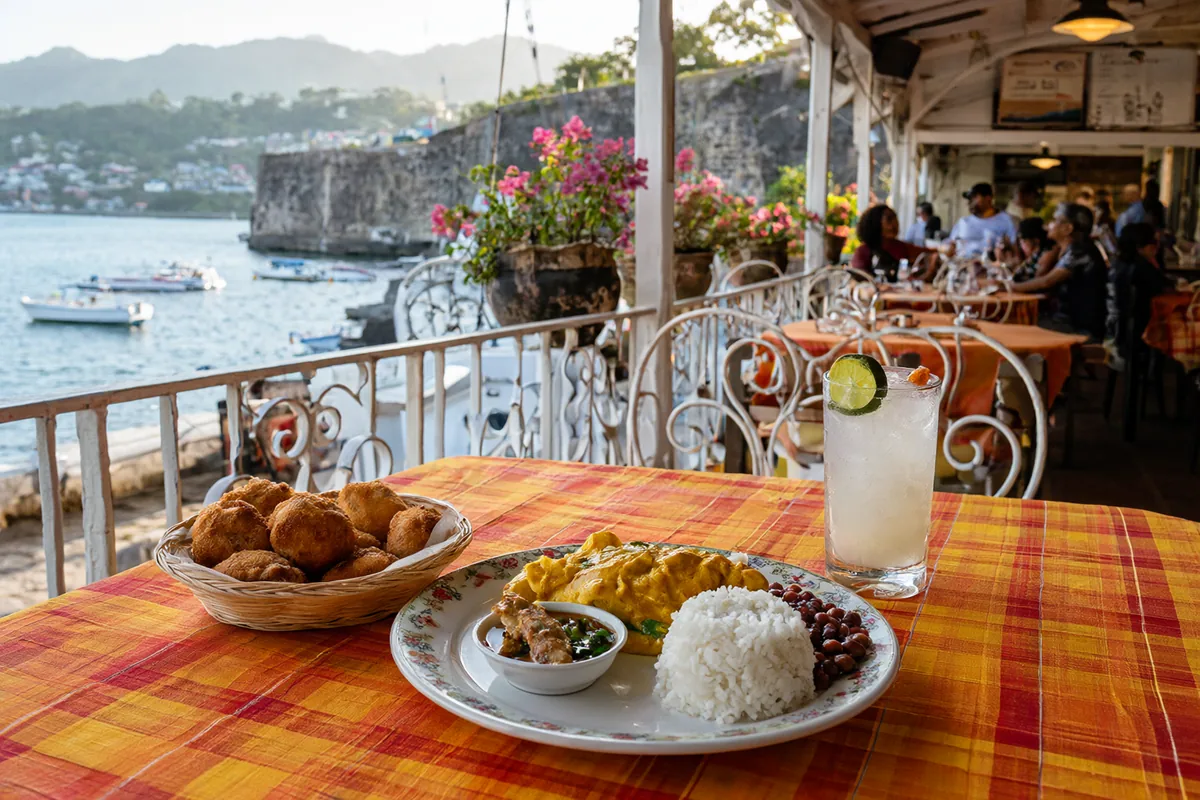
Martinique is a French island in the Caribbean, and its food is Creole cooking with a French accent: salt cod fritters with a ti-punch at noon, fish poached in lime and pepper, curries brought by Indian workers in the 19th century, and a baguette from the bakery every morning. This Martinique food guide covers the dishes to know, how to read a French menu with Creole dish names, tipping and paying in euros, and where to eat in Fort-de-France, Les Trois-Îlets, Sainte-Anne, Saint-Pierre, Le François, Sainte-Luce and Le Diamant. The island is also the home of rhum agricole, rum distilled from fresh sugar cane juice, and its rum is the only one in the world with a French AOC, a protected designation of origin. Eat seafood, drink rum, and order whatever the plat du jour is at a Creole restaurant, and you will eat very well.
What to eat in Martinique: 12 dishes to know
These are the Creole dishes you will meet on menus, at roadside snack vans and on family tables, plus the festive ones worth knowing about.
- Accras de morue (everywhere): small, puffy fritters of salt cod, herbs and hot pepper, served with drinks before any Creole meal. You will also see accras of shrimp, vegetables or tiny fish called titiri.
- Boudin créole (everywhere): a soft, spicy blood sausage with herbs, chives and pepper, served warm as a starter. Look also for white boudin made with fish or conch.
- Colombo (everywhere): Martinique's curry, made with chicken, pork, goat (cabri) or fish and spiced with colombo powder, brought by Indian workers who arrived after the abolition of slavery. Served with rice.
- Court-bouillon de poisson (everywhere): despite the French name, a thick, rich stew of fish such as red snapper in a tomato, onion and pepper sauce, served with rice.
- Blaff (everywhere): fish or shellfish poached in a light broth with lime, garlic, thyme and pepper. The name is said to come from the sound the fish makes when it drops into the pot.
- Féroce d'avocat (everywhere): a fiery starter of mashed avocado, cassava flour, salt cod and hot pepper. The name means "ferocious", and it is.
- Chiquetaille de morue (everywhere): shredded salt cod marinated with lime, onion, herbs and pepper, served cold as a starter.
- Fricassée de chatrou (everywhere): octopus slowly simmered in a tomato and onion sauce until tender, served with rice and red beans.
- Lambi (everywhere): queen conch, served grilled, in fricassée or in a spicy sauce. It needs tenderising and long cooking, and it is a Martinique favourite.
- Matoutou crabe (Easter): a dish of land crabs cooked with rice, spices and herbs, eaten at Easter and Pentecost, when families gather on the beaches to cook it.
- Pâté en pot (weddings and celebrations): a thick soup of lamb offal, vegetables, capers and white wine, served at weddings, baptisms and communions. If you see it on a menu, it is a sign of a traditional kitchen.
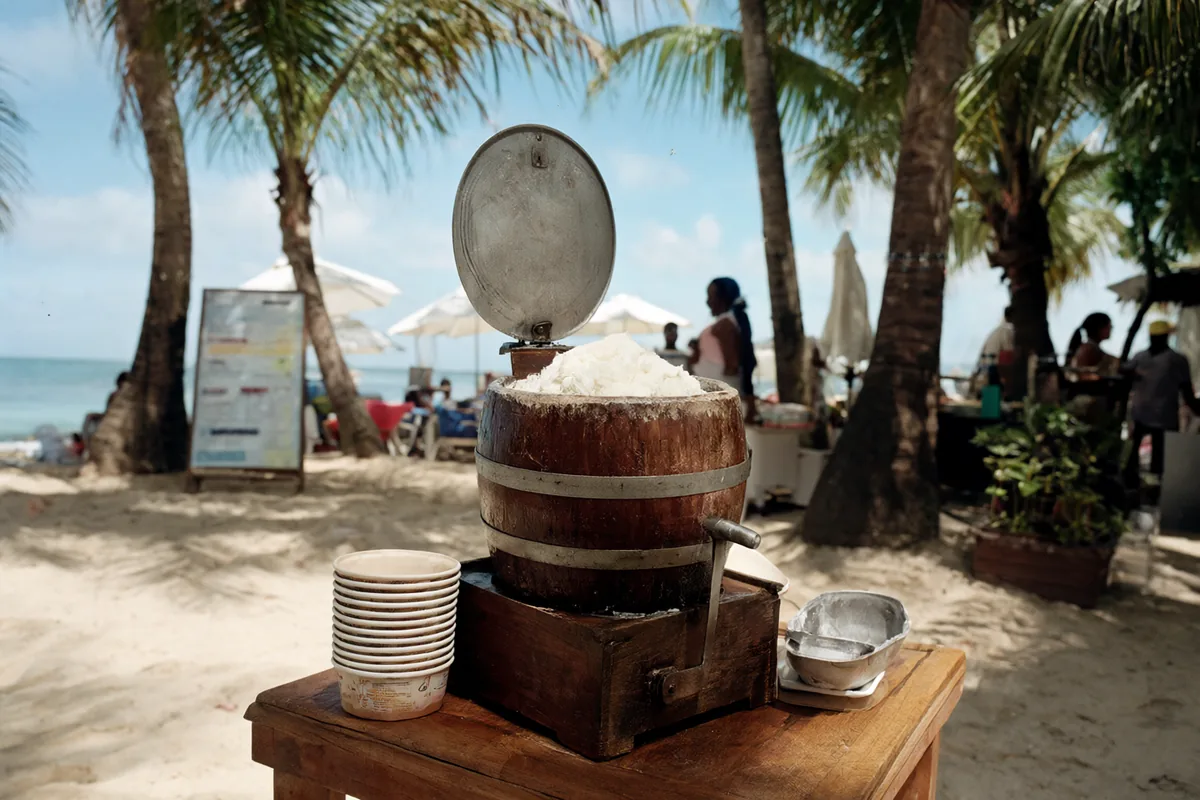
- Sorbet coco (beaches and markets): coconut ice cream churned by hand in a wooden barrel packed with ice and salt, sold at beaches and markets on weekends.
Other things to try: ragoût de cochon (pork stew) and pâtés salés at Christmas, dombrés (flour dumplings) with red beans, gratin de christophine (chayote gratin), blanc-manger coco (coconut pudding), and in short, regulated seasons, sea urchins called oursins or chadrons. For a celebration, Martinicans serve thick spiced hot chocolate with pain au beurre, a soft, rich bread.
To drink, the island classic is the ti-punch: white rhum agricole, a slice of lime and a spoon of cane sugar, mixed in the glass by the drinker. The saying goes "chacun prépare sa propre mort", "everyone prepares their own death", because you pour the rum yourself. A planteur is rum with fruit juices, aged rum (rhum vieux) is sipped like brandy, and at Christmas you will find shrubb, an orange peel rum liqueur. Fresh sugar cane juice (jus de canne) is sold by the roadside.
How to read a menu in Martinique
Menus in Martinique are written in French, laid out the French way, but the dishes and many ingredients have Creole names. Many restaurants offer a formule or menu at a fixed price and a plat du jour at lunch, and beach restaurants often list the catch of the day on a board. Remember that an entrée in French is a starter. These are the words that matter.
| Word | Meaning |
|---|---|
| Formule / menu | Fixed-price meal: two or three courses |
| Entrée / plat / dessert | Starter / main course / dessert |
| Plat du jour | Dish of the day, usually the best-value option |
| Poisson du jour / pêche du jour | Fish of the day / catch of the day |
| Langouste | Spiny lobster, often priced by weight |
| Lambi / chatrou | Conch / octopus |
| Ouassous / z'habitants | Freshwater prawns / large freshwater crayfish |
| Morue | Salt cod |
| Sauce chien | A sharp sauce of lime, oil, onion, herbs and pepper |
| Giraumon | Pumpkin |
| Christophine / dachine | Chayote (choko) / taro root |
| Fruit à pain / ti-nain | Breadfruit / small green bananas, cooked as a vegetable |
| Service compris | Service included in the price |
Langouste and some fish are often priced "au poids" or "les 100 g", so the number on the menu is not the price of your plate. swap.menu flags priced-by-weight items and explains Creole dishes like féroce, chiquetaille and fricassée de chatrou when it reads the menu.
Tipping, tax and paying the bill
As in mainland France, service is included in restaurant prices in Martinique (service compris), so tipping is optional. Locals round up or leave a few euros for good service, and visitors do the same. At snack vans, bakeries and market stalls, nobody expects a tip. Martinique has its own lower rate of French VAT (TVA), which is already included in menu prices. Our guide to tax and service charges on menus explains how these lines work around the world.
The currency is the euro (€). Cards, including contactless, are accepted in most restaurants, supermarkets and shops, but beach snack vans, sorbet coco sellers, roadside grills and market stalls want cash. Prices are generally higher than in mainland France, especially for imported goods, while local fish, fruit and rum are better value. If you are visiting from outside the eurozone and a card machine offers to charge you in your home currency, choose euros: our guide to paying in local currency explains why.
Lunch is from about 12pm to 2pm, and it is often the bigger meal. Dinner starts from about 7:30pm. Many restaurants close one or two days a week, often Sunday evening and Monday, and some close for part of the low season around September and October, so check before driving across the island. Sunday lunch is a big family occasion, and beach restaurants are busy.
Where to eat in Martinique, town by town
Martinique is small enough to drive around, and every part of the island has its own character: the capital in the middle, beaches in the south, the volcano and rain forest in the north, and the calm, reef-lined Atlantic coast to the east. Jump to a place:
Where to eat in Fort-de-France
Fort-de-France, the capital, sits on a wide bay under the green hills, and it is the best place on the island for markets and everyday Creole lunches. The Grand Marché, the covered market in the town centre, is famous for its spice sellers, with bags of colombo powder, vanilla, cinnamon, hot pepper and rum punch mixes, along with fruit, vegetables and juice stalls. The fish market along the Rivière Madame, near the waterfront, is busiest in the morning, and nearby small restaurants and food stalls serve fish of the day, accras and colombo at local prices.
The streets of the centre of Fort-de-France, around the cathedral and the Bibliothèque Schœlcher, are full of small Creole restaurants and snack bars that serve a plat du jour to office workers, and they are where to eat like a local. The La Savane gardens and the seafront promenade by Fort Saint-Louis have kiosks and cafés for a drink or snack. Fort-de-France is busiest by day and quieter at night, when locals often head to the restaurants of the hills above the city or across the bay. Ferries cross the bay to Les Trois-Îlets in about 20 minutes.
Where to eat in Les Trois-Îlets
Les Trois-Îlets, across the bay from Fort-de-France, is the island's main resort area. Its tourist heart is the Pointe du Bout marina, with restaurants, bars and ice cream shops around the harbour, and the nearby beaches of Anse Mitan and Anse à l'Âne are lined with beach restaurants serving grilled fish, langouste, accras and cocktails with views across to the capital. The village of Les Trois-Îlets itself is small and pretty, with a church square and a few local restaurants.
Les Trois-Îlets is also the birthplace of Empress Joséphine, and the area has a pottery village and a museum of sugar cane, a reminder of the plantation history behind the island's rum. Restaurants at Pointe du Bout charge resort prices, so walk to the beaches or drive into the village for better value. In the evening, take the ferry back to Fort-de-France or eat at a beach restaurant at sunset.
Where to eat in Sainte-Anne
Sainte-Anne, in the far south, is a seaside village with a pretty church, a seafront market and some of the island's best beaches nearby, including Grande Anse des Salines, a long curve of white sand lined with coconut palms. At Les Salines, snack vans and food stalls park behind the beach and sell accras, boudin, grilled chicken, fish, fresh juices and sorbet coco, and on weekends Martinican families arrive early with picnics and coolers.
The market on the Sainte-Anne seafront sells spices, rum punches, fruit, madras fabric and crafts, and the village has beach restaurants and Creole places along the waterfront for a long lunch of fish of the day or colombo. Sainte-Anne gets busy in the high season from December to April, so arrive before noon if you want a table by the water. Resorts nearby mean the village is used to visitors, but the food remains Creole.
Where to eat in Saint-Pierre
Saint-Pierre, on the north Caribbean coast under Mont Pelée, was once the island's capital, until the volcano erupted in 1902 and destroyed the town, killing almost all its inhabitants. Today it is a small town among the ruins, with a covered market on the seafront selling fish, fruit, vegetables and spices, and simple restaurants serving Creole lunches. Several rum distilleries in and around Saint-Pierre welcome visitors for tours and tastings, among cane fields on the slopes of the volcano.
North of Saint-Pierre, the coast road to Le Prêcheur and Anse Couleuvre passes black sand beaches and small fishing villages, and to the south, Le Carbet has beach restaurants on its long bay. In Saint-Pierre, lunch is the meal to plan around, as the town is quiet in the evenings. Combine it with a rum distillery visit, and leave someone else to drive.
Where to eat in Le François
Le François, on the Atlantic coast, is a busy small town on a bay protected by a reef and dotted with small islands, the îlets. Its best-known experience is a boat trip out to the fonds blancs, shallow white sandbanks such as the one known as the Baignoire de Joséphine (Joséphine's bathtub), where you stand waist-deep in warm water while the crew serves ti-punch and planteur, and some trips go on to a grilled fish or langouste lunch on one of the islets.
On land, Le François has a waterfront with seafood restaurants, a market and snack bars, and the Atlantic coast towns of Le Robert and Le Vauclin nearby are fishing towns where you can buy fish straight off the boats in the morning. The east coast is also cane country, and rum distilleries and estates near Le François are open to visitors.
Where to eat in Sainte-Luce and Le Diamant
Sainte-Luce and Le Diamant sit on the south Caribbean coast, and both are seaside towns popular with holidaymakers. Sainte-Luce is a fishing village with a waterfront of restaurants serving fish of the day, accras and Creole plates, and a coast of small beaches and coves. Le Diamant looks out over the Diamond Rock, a volcanic islet just offshore, along one of the longest beaches on the island, with snack bars and restaurants along the main road behind it.
The food in Sainte-Luce and Le Diamant is beach and fish food: grilled fish with sauce chien, langouste, lambi, blaff and cold drinks, and weekend sorbet coco sellers. These are good bases for exploring the south, and their restaurants are often better value than those at Pointe du Bout. Evenings are quiet, so book dinner at weekends.
Vegetarian, vegan and allergy tips
Creole cooking in Martinique leans heavily on fish, seafood and meat, and salt cod turns up in many starters, so vegetarians need to ask. The French word is végétarien (végan or végétalien for vegan). Good options include vegetable accras (check they contain no cod), gratin de christophine, giraumon, breadfruit, dachine, rice and red beans, salads and tropical fruit. Watch for hidden ingredients: red beans and vegetable dishes are often cooked with salted pork, and many sauces use fish or meat stock.
Shellfish, especially shrimp, conch and crayfish, is in many dishes, and hot pepper is everywhere, though usually as a whole pepper you can avoid. Coconut appears in desserts and some sauces. Our guide to eating abroad with food allergies explains how to explain an allergy clearly when you do not speak the language.
Useful French and Creole phrases for ordering
Bonjour / Bonsoir "Good morning / Good evening". Always greet before you ask for anything
Bonjou, sa ou fè? "Hello, how are you?" in Martinican Creole
Une table pour deux, s'il vous plaît "A table for two, please"
Quel est le plat du jour ? "What is the dish of the day?"
Pas trop pimenté, s'il vous plaît "Not too spicy, please"
Je suis allergique aux fruits de mer "I am allergic to seafood"
L'addition, s'il vous plaît "The bill, please"
Mèsi anpil "Thank you very much" in Creole
How swap.menu helps you eat in Martinique
Martinique's menus are in French, but even French visitors from the mainland stop at words like chatrou, féroce, z'habitants and chiquetaille. Photograph the menu with swap.menu and every dish appears in your language with the original name beside it and a short explanation, so you know that fricassée de chatrou is octopus stew, court-bouillon is a thick fish stew rather than a stock, and féroce is a very hot avocado and salt cod starter. Every price is converted from euros to your home currency, and we flag langouste and fish priced by weight and point out that service is already included.
Tap the dishes you want, add a note such as "no seafood" or "not too spicy, please", typed or spoken, and swap.menu translates your order into French. Show the waiter your phone, or let them scan the QR code and read your order on their own screen. You can try it right now on a sample menu with the free demo, or see travel pass prices.
Off to Martinique? Your first 3 menu scans are free, and a travel pass starts from $4.99 with nothing that renews.
Start free with 3 scansMartinique food FAQ
Do you tip in restaurants in Martinique?
Tipping is optional in Martinique, because service is included in menu prices as in mainland France. Rounding up or leaving a few euros for good service is appreciated. Nobody expects a tip at snack vans, bakeries or market stalls.
What food is Martinique famous for?
Martinique is famous for accras de morue, colombo curry, fish court-bouillon and blaff, boudin créole and féroce d'avocat. It is also known for rhum agricole, the only rum with a French AOC, drunk as ti-punch with lime and cane sugar.
Is Martinique expensive to eat out?
Martinique is fairly expensive, with restaurant prices similar to or a little above mainland France. A plat du jour at a local Creole restaurant, beach snack vans and market food are the best-value ways to eat, while resort restaurants charge more.
What time do people eat dinner in Martinique?
Dinner usually starts from about 7:30pm and lunch is from about 12pm to 2pm. Many restaurants close on Sunday evening and Monday, and some close for part of the low season in September and October.
Is tap water safe to drink in Martinique?
Tap water in Martinique is treated to French standards and is generally safe to drink. Some areas have occasional supply interruptions, and bottled water is sold everywhere if you prefer it.
How can I read a menu in Martinique if I do not speak French?
Learn the course words (entrée, plat, dessert) and a few Creole dishes like accras and colombo, or photograph the menu with swap.menu. It translates every dish into your language, explains Creole dishes, converts prices from euros to your currency and translates your order into French.
Travelling further in the Caribbean? Read our food guides for nearby islands:
- Guadeloupe food guide
- Saint Lucia food guide
- Dominica food guide
- Barbados food guide
- French Guiana food guide
- France food guide
Or browse every travel food guide.