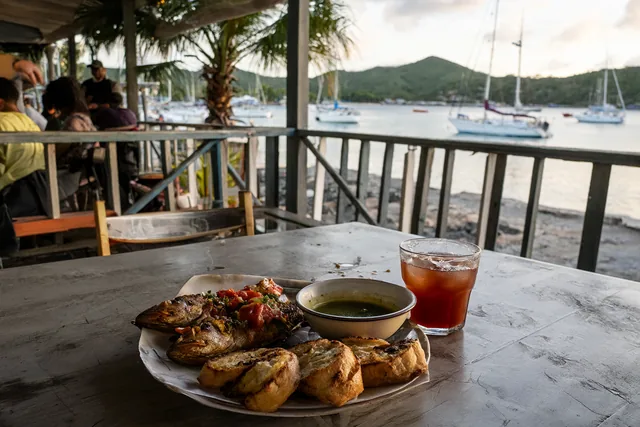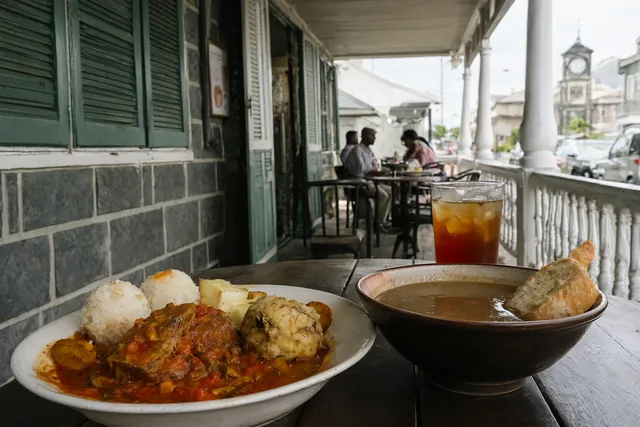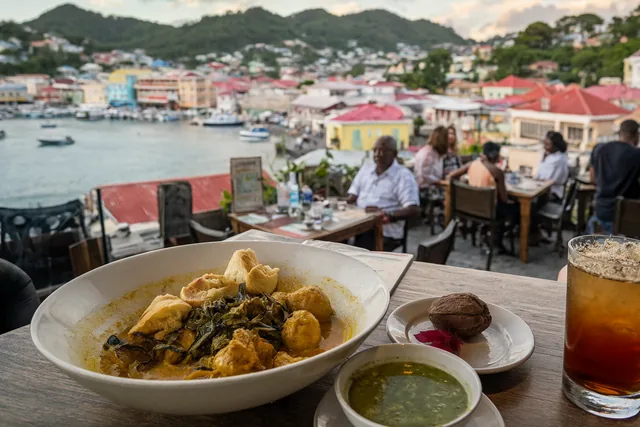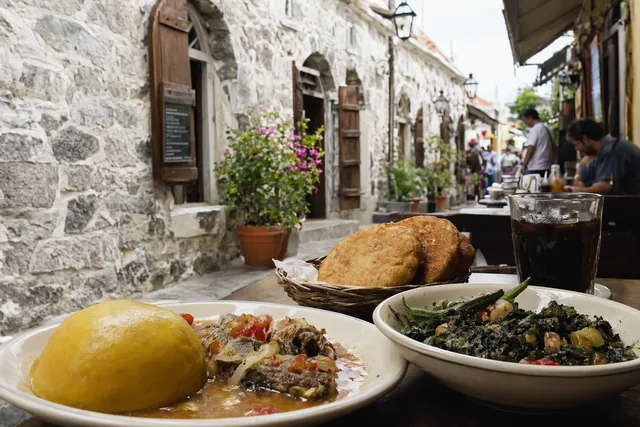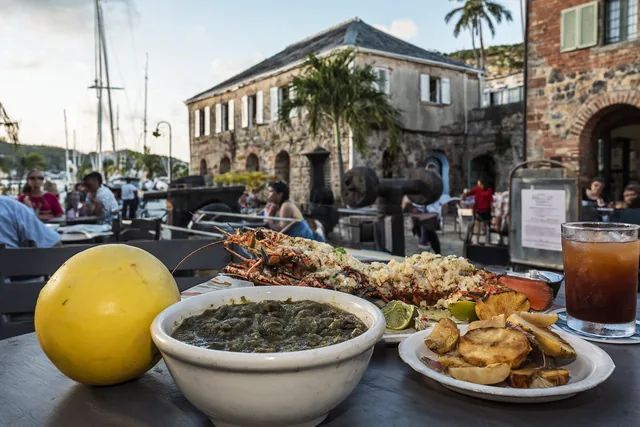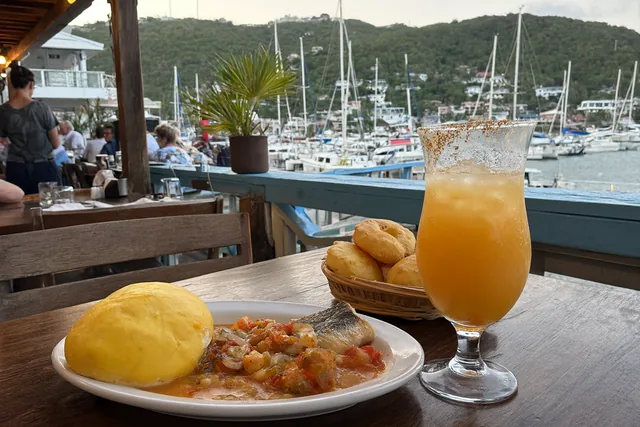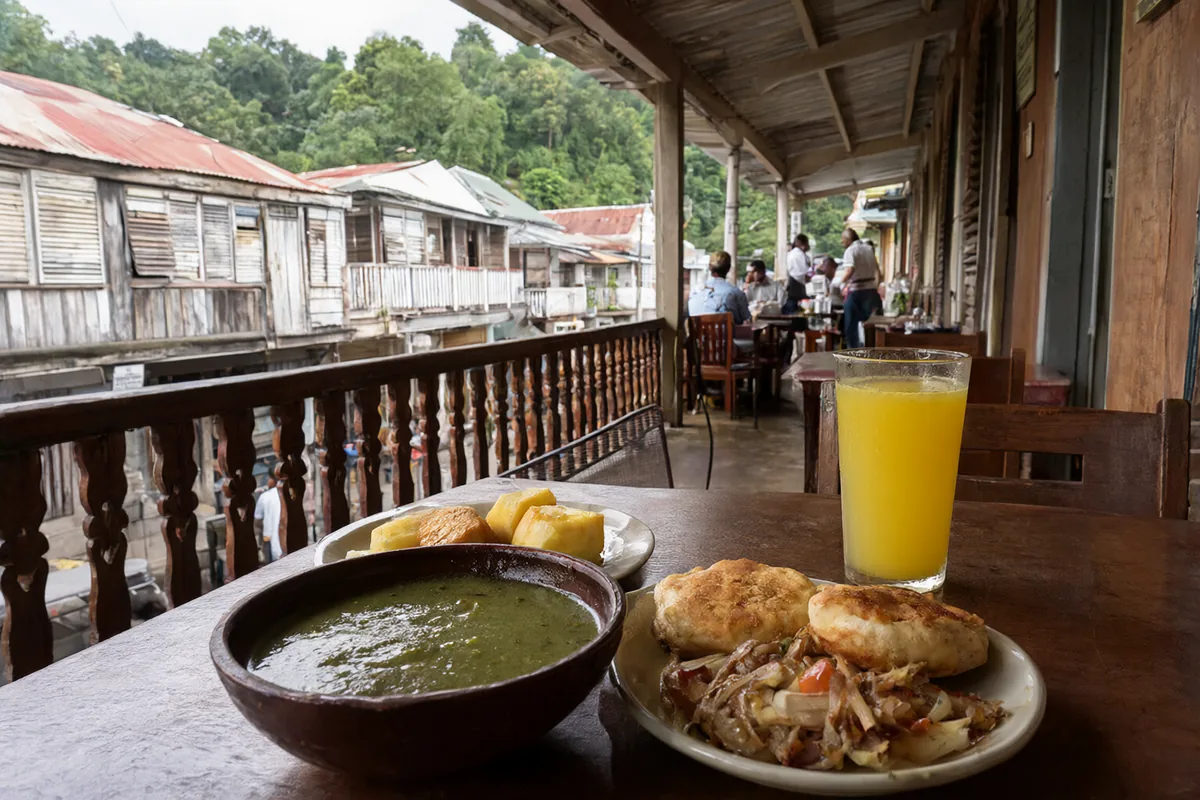
Dominica is the Nature Island of the Caribbean, all rainforest, rivers and volcanic peaks, and its food comes straight from that landscape: dasheen, tannia, breadfruit and plantain from hillside farms, fish from the west coast, fruit from every garden and cassava bread from the Kalinago Territory. There are no big resort strips, so you eat in small family restaurants, market stalls and village cookshops. This Dominica food guide covers the dishes to order, the Kwéyòl menu words worth knowing, how VAT, service and tipping work, then goes place by place through where to eat in Roseau, Soufrière and Scotts Head, Portsmouth, Calibishie and the Kalinago Territory.
What to eat in Dominica: 12 dishes to know
Dominican cooking is Creole home cooking, shaped by African, French, British and Kalinago traditions. These are the dishes and drinks to know.
- Callaloo soup (everywhere): the national dish. Dasheen leaves cooked with okra, coconut milk, garlic, herbs and sometimes crab or salted meat into a thick green soup. It replaced the mountain chicken, a giant frog now critically endangered and protected.
- Bakes and saltfish (breakfast): fried dough bakes with salt cod sautéed with onion, tomato, peppers and thyme. The standard Dominican breakfast.
- Accra (everywhere): fried saltfish fritters. In season, titiri accra are made with tiny fish caught where rivers meet the sea.
- Crab backs (seasonal): land crab meat, seasoned and stuffed back into the shell, then baked. A prized local delicacy when the crabs are in season.
- Kubouyon fish (the coasts): from the French court-bouillon, fish poached in a spicy broth of tomato, onion, garlic, lime and herbs.
- Provisions (everywhere): boiled dasheen, tannia, yam, sweet potato, breadfruit and green banana, served with almost every main dish.
- Grilled or fried fish (the west coast): tuna, mahi-mahi, kingfish, snapper and flying fish, often with Creole sauce, rice and peas and salad.
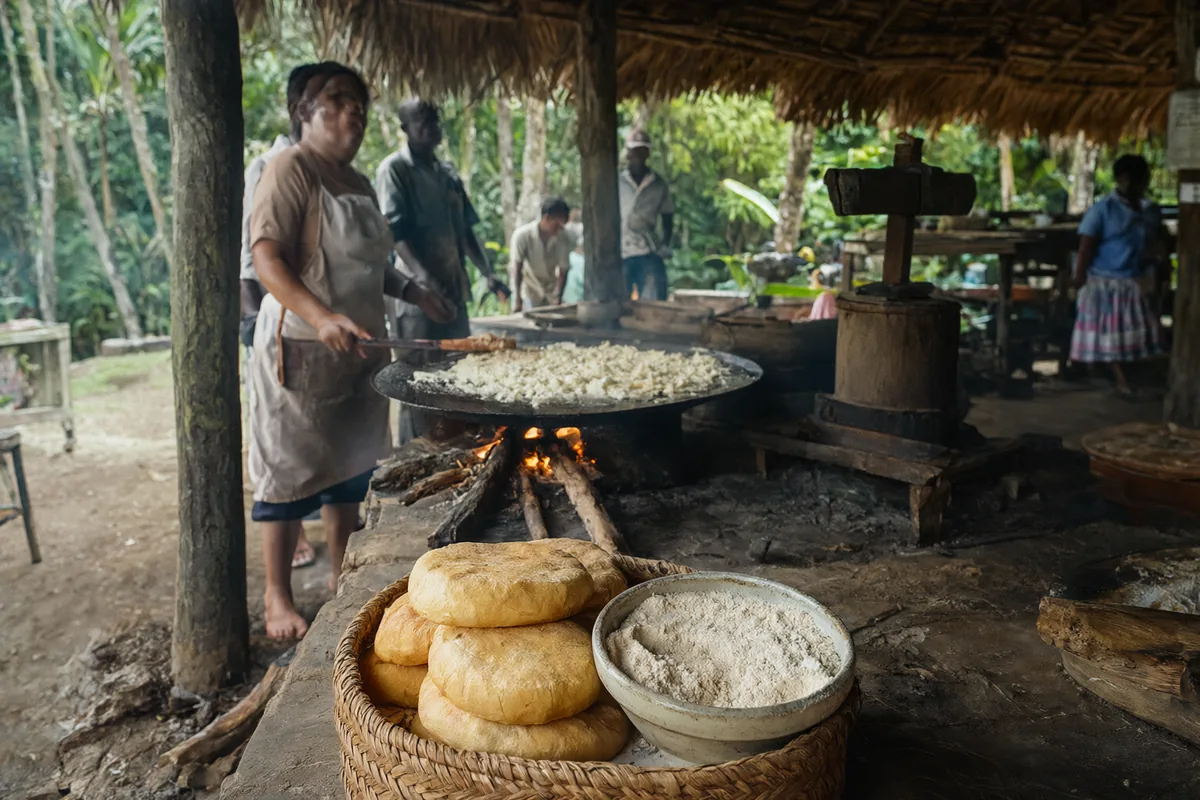
- Cassava bread (Kalinago Territory): flat, crisp-edged bread made from grated cassava and baked on a large iron griddle, a Kalinago tradition.
- Smoked herring and saltfish dishes (everywhere): preserved fish cooked with onion, peppers and oil, a reminder of the island's old trading diet.
- Fresh juices (everywhere): passion fruit, guava, soursop, grapefruit, golden apple, sorrel and lime, often made to order with fruit picked that morning.
- Cocoa tea and bush tea (everywhere): spiced hot chocolate made from local cocoa sticks, and herbal teas brewed from garden plants.
- Rum and local lager (everywhere): Dominica makes its own rum and lager, and rum shops sell house rums infused with spices, bark, fruit and herbs.
How to read a menu in Dominica
Menus are in English, but many Dominican dishes keep their Kwéyòl names, and in villages there may be no written menu at all: the cook tells you what is in the pot. These are the terms worth knowing.
| Local term | What it means |
|---|---|
| Callaloo | Dasheen leaves, usually as a thick green soup |
| Kubouyon | Fish poached in a spicy tomato and lime broth |
| Accra / titiri | Saltfish fritters / tiny seasonal fish, made into fritters |
| Crab backs | Seasoned land crab meat baked in the shell |
| Bakes | Fried dough cakes, eaten with saltfish |
| Provisions / ground provisions | Boiled root vegetables: dasheen, tannia, yam, sweet potato |
| Fig | Green banana, boiled as a starch |
| Farine | Toasted, coarse cassava flour |
| Kasav (cassava bread) | Flatbread made from grated cassava |
| Creole sauce | A sauce of tomato, onion, peppers, garlic and thyme |
| Bush tea | Herbal tea made from local leaves |
| Pepper / pepper sauce | Hot chilli or hot sauce. "No pepper" means no chilli |
| Plus VAT and service | Tax and a service charge will be added to the listed price |
Most Dominican menus price in EC dollars, but some guest houses, dive shops and tours quote US dollars with the same $ sign. swap.menu reads the menu, shows which currency is in use, converts every price to your home currency and explains Kwéyòl dish names such as kubouyon and titiri accra.
VAT, tipping and paying the bill
Dominica charges VAT on restaurant meals, and some restaurants, especially at hotels and eco-lodges, also add a 10 percent service charge. Small local restaurants usually include tax in the price and do not add service. If service is on the bill, an extra tip is optional. If not, tip around 10 percent at sit-down restaurants for good service. Market stalls, roadside vendors and rum shops do not expect a tip. Our guide to tax and service charges on menus explains these lines in more detail.
The currency is the Eastern Caribbean dollar (EC$, XCD), fixed to the US dollar. US dollars are accepted at hotels, dive shops and for tours, but change comes back in EC dollars, and in villages EC dollars are much easier. Card acceptance is more limited than on busier islands: hotels and some restaurants in Roseau and Portsmouth take cards, but markets, cookshops, rum shops and village restaurants need cash. If a card machine offers to charge you in your home currency, decline: our guide to paying in local currency explains why.
Dominicans eat breakfast early, lunch from noon to 2pm and dinner from 6:30pm. Many small restaurants close early in the evening and on Sundays, and in villages it is often best to tell a cook in the morning that you would like dinner. Saturday morning is market day in Roseau, and it starts before dawn.
Late October and early November are the best time for Dominican food. Creole Day, at the end of October, brings traditional dishes, national dress and Kwéyòl to schools, offices and streets, the World Creole Music Festival fills Roseau with food stalls, and Independence Day on 3 November closes the season. Dominica's carnival, Mas Domnik, is held before Lent.
Where to eat in Dominica, town by town
Dominica is mountainous, and driving takes longer than distances suggest, so plan meals around where you are each day. The capital and the south have the most choice, the north has a relaxed harbour town and fishing villages, and the east coast is home to the Kalinago. Jump to a place:
Where to eat in Roseau
Roseau, the capital on the southwest coast, is a compact town of wooden and stone Creole houses with balconies, many rebuilt after Hurricane Maria in 2017. It is the best place on the island to eat local food. The Roseau market, near the mouth of the Roseau River at the north end of the Bay Front, is busiest on Saturday mornings from first light, when farmers from across the island bring dasheen, plantain, citrus, cocoa, herbs, peppers and flowers, and vendors sell bakes, accra, cocoa tea and fresh juice for breakfast.
Around the market and the streets behind the Bay Front, small Roseau restaurants serve Creole plate lunches: stewed chicken, kubouyon fish, callaloo, provisions, rice and peas and salad, with a fresh juice of the day. Many close by late afternoon, so Roseau is a lunch town more than a dinner town. In the evening, waterfront hotels and a handful of restaurants along the Bay Front stay open, and on weekends locals head south to the bars of Loubiere and Pointe Michel or north to Mero beach.
Where to eat in Soufrière and Scotts Head
Soufrière and Scotts Head, at the southwestern tip of the island, sit on the edge of the Soufrière Scotts Head Marine Reserve, one of Dominica's best areas for snorkelling and diving. Scotts Head is a fishing village on a narrow strip of land between the Caribbean and the Atlantic, with a few small restaurants serving fish straight from the boats. Soufrière has hot springs, a sulphur-scented bathing pool and a handful of local places for lunch.
This is the place in Dominica for simple seafood: grilled or fried fish, kubouyon, fish broth and accra, often eaten at a plastic table with a view of the bay. Ask what came in that morning. Weekend afternoons are the liveliest, when Dominicans come to swim, eat and lime by the water. The road between Roseau and Soufrière passes fishing villages where vendors sell fresh fish and fruit by the roadside.
Where to eat in Portsmouth
Portsmouth, Dominica's second town, sits on the wide Prince Rupert Bay in the north, a popular anchorage for yachts. It is a relaxed place with a small market, rum shops and a handful of restaurants and beach bars along the bay, serving grilled fish, chicken, callaloo soup, provisions and fresh juices. Yachting visitors are well looked after here, and a weekly beach barbecue for visiting boats is a Portsmouth tradition.
From Portsmouth, rowing boat tours go up the Indian River through a mangrove forest, ending at a small riverside bar serving rum punch and local drinks. The Cabrits National Park, on a headland north of town, has an old fort and walking trails. Local guides in Portsmouth are generous with tips on where to eat, and many guest houses cook dinner if you ask in advance. Bring cash, as card payments are limited.
Where to eat in Calibishie
Calibishie is a fishing village on the northeast coast, with sheltered beaches, reef-protected water and views towards Guadeloupe. It is one of the most pleasant places to stay in Dominica, and its food scene is small but warm: a handful of family restaurants and guest houses serving Creole fish, chicken, lobster in season, callaloo and plates of provisions, plus a couple of bakeries and rum shops.
Meals in Calibishie are often cooked to order, so ask in the morning what will be on the menu that evening. The area around the village grows coconuts, cocoa and fruit, and roadside stalls sell coconut water, bananas and local honey. Nearby, the Red Rocks at Pointe Baptiste and the beaches at Batibou and Hodges are good stops, and Calibishie is a short drive from the Kalinago Territory.
Where to eat in the Kalinago Territory
The Kalinago Territory, on Dominica's east coast, is home to the Kalinago people, the island's Indigenous inhabitants and the descendants of the Caribs who once lived across the Lesser Antilles. It is a rural area of villages, farms and Atlantic coastline, with a heritage village where visitors can learn about Kalinago life, crafts and food. The food tradition to look for is cassava bread: cassava is grated, pressed to remove its juice, then baked on a large iron griddle over a wood fire into flat, crisp-edged rounds, sometimes with coconut.
Roadside stalls in the Kalinago Territory sell cassava bread, farine (toasted cassava flour), fruit, coconut water and handmade baskets, and a few small restaurants serve local lunches of fish, chicken and provisions. There is no restaurant scene to speak of, so treat the visit as a chance to eat cassava bread warm from the griddle and buy produce directly from the people who grow it. Bring cash in EC dollars and small notes.
Vegetarian, vegan and allergy tips
Dominica is one of the easier Caribbean islands for vegetarians, thanks to its farms and a strong Rastafarian ital tradition. Provisions, breadfruit, plantain, callaloo, rice and peas, cassava bread, vegetable stews and fresh fruit are everywhere, and many cooks are happy to make a vegetarian plate if you ask. Ask for vegetarian and be specific: callaloo soup may contain crab or salt meat, soups often start with meat or fish stock, and some cooks consider saltfish a seasoning rather than meat.
Fish is common, and crab backs and lobster appear in season, so seafood allergies need a clear explanation. Coconut milk is used in callaloo and many sauces, and pepper sauce is very hot. Bakes and accra contain wheat, while cassava bread and farine are made from cassava. Our guide to eating abroad with food allergies explains how to describe an allergy clearly.
Kwéyòl words and local ordering terms
English is Dominica's official language, but many Dominicans also speak Kwéyòl, a French-based Creole close to the language of neighbouring Martinique and Guadeloupe, and it is widely heard in villages and markets.
Bonjou / Bonswè "Good morning / Good evening". Always greet before you order
Mwen byen "I'm fine", the reply when someone asks how you are
Mèsi / Mèsi anpil "Thank you / Thank you very much"
I bon! "It's good!", praise for the food
What's in the pot today? How to ask what a village cook has made
Lil pepper / no pepper "A little hot sauce / no hot sauce"
What juice you have? Most places make one or two fresh juices each day
Lime Hanging out with friends, usually with food and drink
How swap.menu helps you eat in Dominica
Dominica's menus are in English, but dishes like kubouyon, titiri accra, crab backs and farine, and ingredients like tannia and dasheen, are new to most visitors. Photograph a menu or a chalkboard with swap.menu and every dish is explained in plain language, with the Kwéyòl name kept beside it. Visitors from France, Germany, Italy, the Netherlands or anywhere else can read the menu in their own language, in any of 29 languages.
Every price is converted from EC or US dollars to your home currency, and we flag VAT and service charge lines so the bill holds no surprises. Menus you scan are saved, so you can find that Roseau lunch spot or Calibishie guest house again. Add a note such as "vegetarian, no fish stock" or "no crab, please", typed or spoken, and show your phone to the cook. Try it now with the free demo, or see travel pass prices.
Off to Dominica? Your first 3 menu scans are free, and a travel pass starts from $4.99 with nothing that renews.
Start free with 3 scansDominica food FAQ
Do you tip in restaurants in Dominica?
Some hotel and lodge restaurants add a 10 percent service charge, and if it is on the bill an extra tip is optional. Otherwise, around 10 percent is appreciated at sit-down restaurants. Market vendors and rum shops do not expect a tip.
What is the national dish of Dominica?
Callaloo soup, made with dasheen leaves, okra and coconut milk, is the national dish. It replaced mountain chicken, a giant frog that is now critically endangered and protected.
Can you still eat mountain chicken in Dominica?
No. Mountain chicken is a large frog that has become critically endangered and is protected, so it should not be on any menu. Callaloo soup is now the national dish.
Is tap water safe to drink in Dominica?
Dominica has plentiful fresh water from mountain rivers, and treated tap water in Roseau and the main towns is generally considered safe. After heavy rain or storms, drink bottled or boiled water.
Is Dominica expensive to eat out?
Dominica is one of the cheaper islands in the Eastern Caribbean for food. Local restaurants, market stalls and cookshops serve generous plates at modest prices, while eco-lodges and hotels charge more.
Can swap.menu help with Dominica menus?
Yes. swap.menu explains Dominican dishes and Kwéyòl terms such as kubouyon, titiri accra and crab backs, translates the menu into 29 languages, converts prices from EC or US dollars to your home currency and flags VAT and service charges.
Travelling further in the Caribbean? Read our food guides for nearby islands:
- Guadeloupe food guide
- Martinique food guide
- Saint Lucia food guide
- Antigua and Barbuda food guide
- Saint Kitts and Nevis food guide
Or browse every travel food guide.