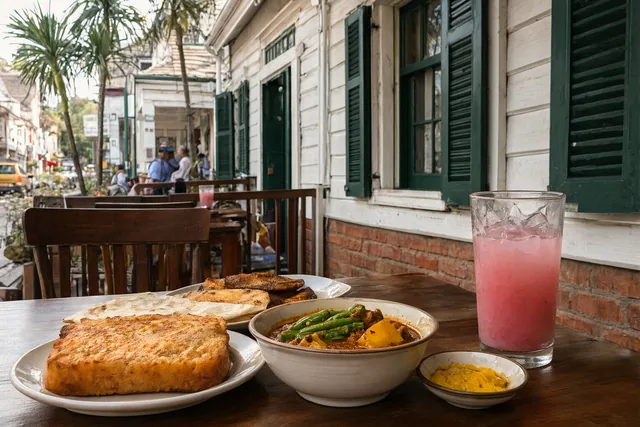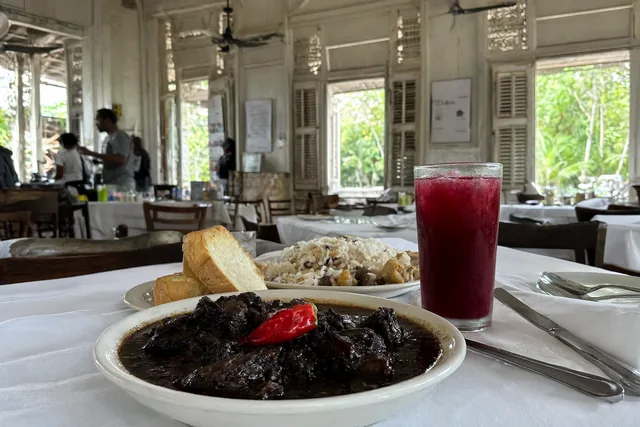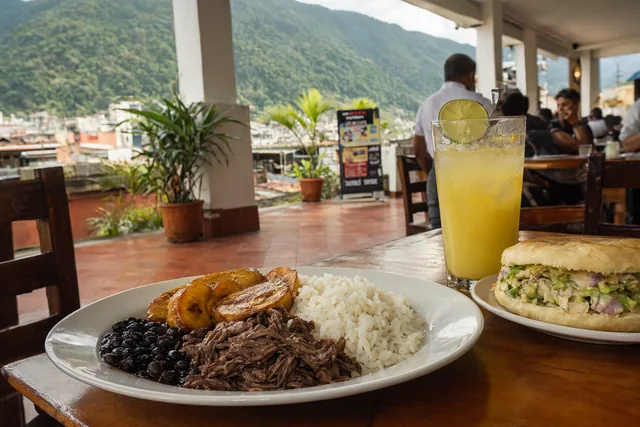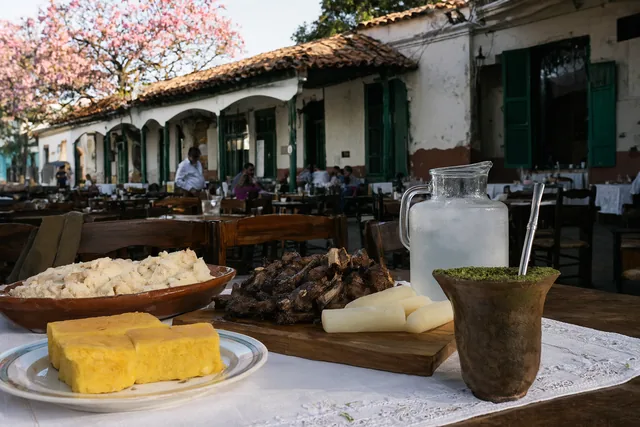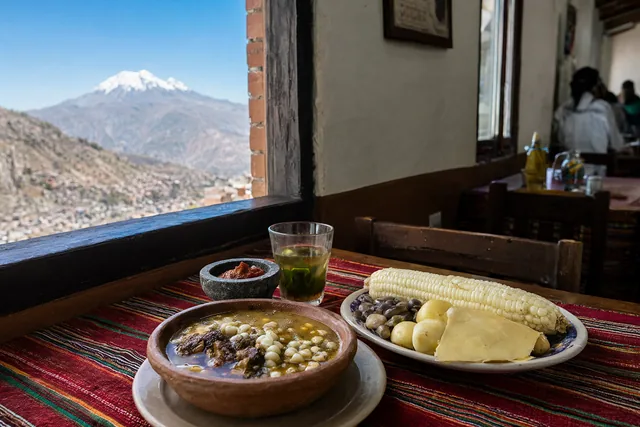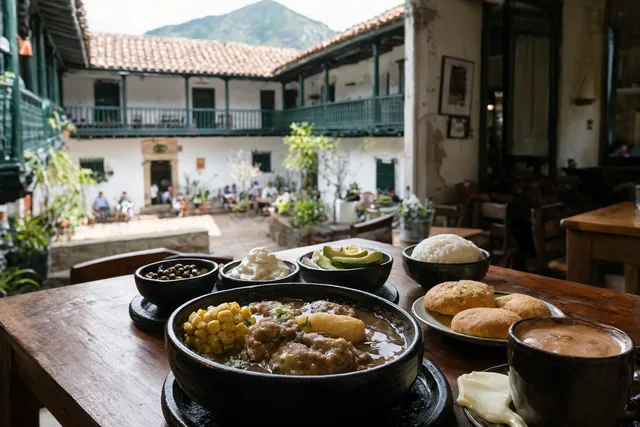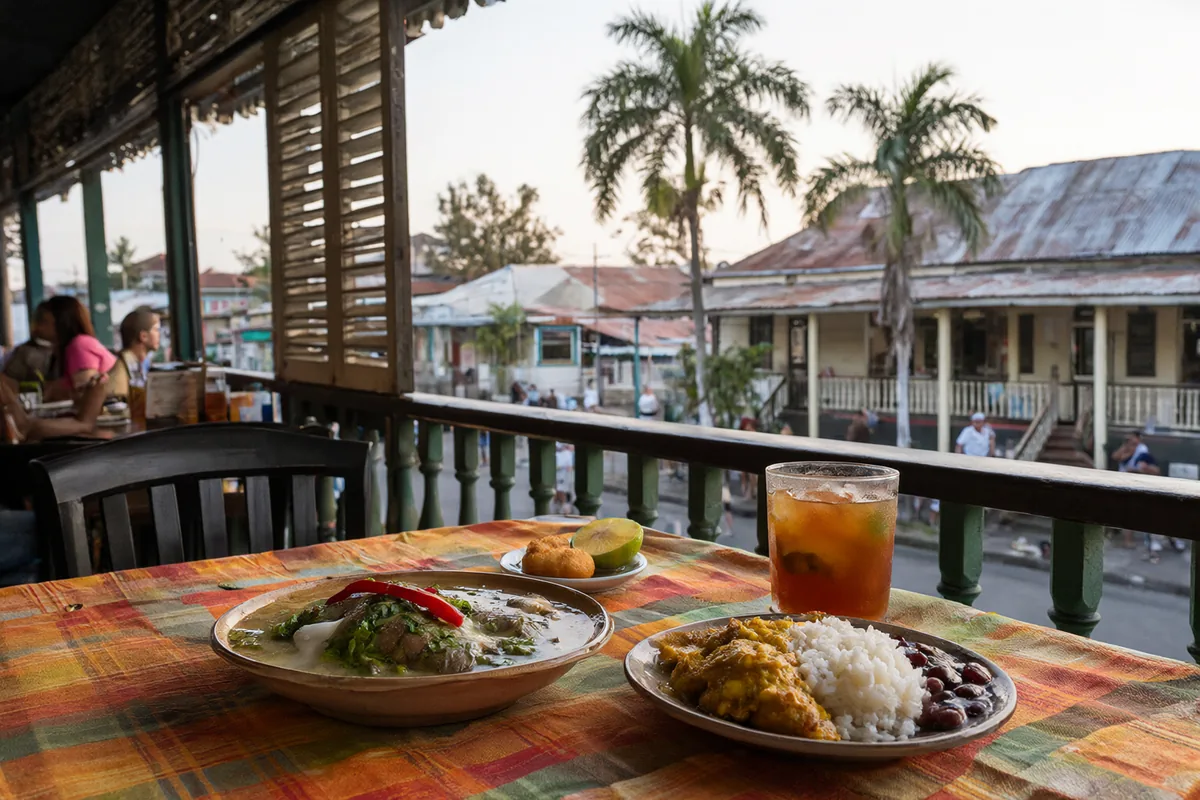
French Guiana is a corner of France on the north-east coast of South America, almost entirely covered in rainforest, and its food is as mixed as its population. Creole cooking is the base, with Amerindian cassava traditions, Maroon cooking from the rivers, Hmong market food, Chinese grocery culture, Brazilian grills and Surinamese roti all part of everyday eating, alongside French bread, cheese and wine. This French Guiana food guide covers the dishes to know, how to read a French menu with Creole dish names, tipping and paying in euros, and where to eat in Cayenne, Rémire-Montjoly, Kourou, the Îles du Salut, Saint-Laurent-du-Maroni and the Hmong village of Cacao. Fish, shrimp and river fish are excellent, and the Easter dish of bouillon d'awara comes with a promise: eat it and you will come back to French Guiana.
What to eat in French Guiana: 12 dishes to know
These are the dishes and drinks you will see on menus, at markets and at family tables, with the community they come from where it matters.
- Bouillon d'awara (Creole, Easter and Pentecost): the emblematic Guianese dish, a thick, orange stew built on a paste of awara palm fruit, cooked for many hours with smoked fish, smoked meats, salt pork, shrimp, crab and vegetables such as green papaya, cucumber and green beans. The saying goes that whoever eats it will return to French Guiana.
- Blaff (Creole): fish or shrimp poached in a clear broth with lime, garlic, thyme, chives and a whole hot pepper. Fresh, light and the best way to taste the local catch.
- Colombo (Creole, from Indian roots): a curry of chicken, pork, goat or fish spiced with colombo powder (turmeric, coriander, cumin and more), served with rice.
- Fricassée (Creole): meat, shrimp or fish browned and simmered in a thick, savoury tomato and onion sauce, served with rice and red beans.
- Pimentade (Creole): fish simmered in a spicy tomato and pepper sauce, a classic Sunday dish in Cayenne.
- Accras (Creole): small fried fritters of salt cod, shrimp or vegetables, served with drinks before a meal.
- Boudin créole (Creole): a soft, spicy blood sausage with herbs and hot pepper, sold warm at markets and at Christmas.
- Poulet boucané (everywhere): chicken smoked and grilled over wood, sold from roadside grills and at weekend markets.
- Couac and cassave (Amerindian): couac is toasted, granulated cassava, eaten with fish and sauces or soaked in wassaï, and cassave is a large, thin cassava flatbread.
- Atipa (Creole and Amerindian): a small armoured freshwater catfish, cooked in colombo or a spicy sauce and eaten off its bony shell. Locals say it ties you to the country too.
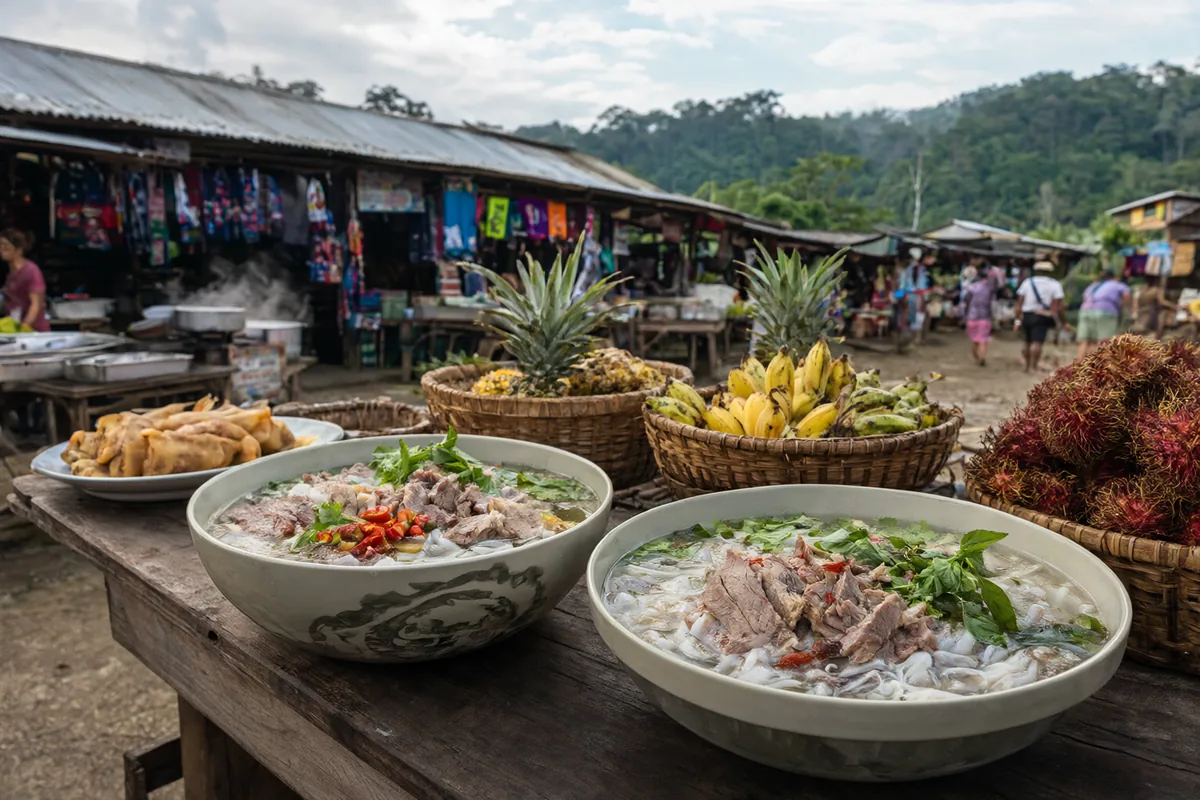
- Hmong soup (Hmong, markets): bowls of rice noodle soup with beef or chicken, herbs and chilli, served at market stalls and in Cacao, alongside spring rolls and sweets.
- Wassaï (everywhere): the local name for açaí, the dark purple palm fruit, served as a thick drink with sugar and often with couac sprinkled in.
Fish you will see on menus include acoupa (a meaty sea fish), machoiran (a catfish) and mulet (mullet), and freshwater prawns called ouassous appear in blaff and fricassée. To drink, French Guiana shares the Caribbean love of rum: ti-punch is white rum with lime and cane sugar, and planteur is rum with fruit juices. Look also for fresh juices of maracuja (passion fruit), coconut, soursop (corossol) and parépou, the peach palm fruit, which is boiled and eaten as a snack.
How to read a French menu in French Guiana
Menus in French Guiana are in French, laid out the French way, with Creole dish names on top. Many restaurants offer a formule or menu, a fixed-price combination of two or three courses, and a plat du jour at lunch. Note that an entrée in French is a starter, not a main course. These are the words to know.
| Word | Meaning |
|---|---|
| Formule / menu | Fixed-price meal: two or three courses |
| Entrée / plat / dessert | Starter / main course / dessert |
| Plat du jour | Dish of the day |
| À la carte | Ordered individually from the full menu |
| Blaff / colombo / fricassée | Poached in broth / curried / in tomato and onion sauce |
| Boucané | Smoked |
| Couac | Toasted granulated cassava |
| Ouassous | Large freshwater prawns |
| Giraumon | Pumpkin, often in a purée or gratin |
| Dachine / christophine | Taro root / chayote (choko) |
| Gibier / viande de bois | Game meat from the forest |
| Sauce chien | A sharp sauce of lime, oil, herbs, onion and pepper, served with fish |
| Service compris | Service included in the price |
"Gibier" on a Guianese menu can mean game such as peccary or agouti, and the sauce chien is not made with dogs. swap.menu explains Creole dish names like blaff, pimentade and fricassée de ouassous when it reads the menu, so you know what will arrive.
Tipping, tax and paying the bill
As in mainland France, service is included in menu prices in French Guiana (service compris), so there is no service charge to add and tipping is optional. Locals round up or leave a few euros for good service in restaurants, and nothing at all at market stalls, bakeries or snack bars. French VAT (TVA) is not applied in French Guiana, but prices are still high, because so much food is imported. Our guide to tax and service charges on menus explains how these lines work around the world.
The currency is the euro (€). Cards are widely accepted in Cayenne and Kourou, in restaurants, supermarkets and petrol stations, and contactless is normal. Markets, roadside grills, the Sunday market in Cacao and small places in the villages want cash, and ATMs can be few and far between away from the coast towns. If you are visiting from outside the eurozone and a card machine offers to charge you in your home currency, choose euros: our guide to paying in local currency explains why.
Meal times follow the French pattern: lunch from about 12pm to 2pm, and dinner from about 7:30pm. Many restaurants close between services and on Sunday evenings or Mondays, and small towns are quiet at night. Breakfast is French-style, with bread and coffee, or a Hmong soup at the market.
Where to eat in French Guiana, town by town
Almost everyone in French Guiana lives along the coast, and that is where the restaurants are. Jump to a place:
Where to eat in Cayenne
Cayenne, the capital, is a compact town of wooden Creole houses with balconies and shutters, laid out around the palm-lined Place des Palmistes. Its best-known food stop is the Marché de Cayenne, the covered central market, where stalls sell fruit, vegetables, spices, couac and fish, and a row of Hmong and Vietnamese-style soup stalls serve big bowls of noodle soup to queues of locals, busiest on Saturday mornings. Try a bowl with a fresh juice of wassaï or maracuja, then buy a bag of the market's hot peppers or colombo spice to take home.
Restaurants in Cayenne range from Creole places serving blaff, colombo and fricassée to French bistros, Brazilian grills, Chinese, Vietnamese and Lebanese restaurants. The streets around the Place des Palmistes and the old town are the easiest place to find lunch, and the seafront by the Place des Amandiers is pleasant in the evening. The little shops known as chez le Chinois, Chinese-run grocery stores on almost every corner, sell drinks, snacks and basics until late. Cayenne's carnival, which runs from Epiphany to Ash Wednesday, is one of the longest in the world, and food stalls follow the weekend parades.
Where to eat in Rémire-Montjoly
Rémire-Montjoly is the beach suburb just east of Cayenne, with long sandy beaches, the forest trails of the Mahury hills and turtle nesting beaches in season. It is where many Cayenne families go out to eat at weekends, and its restaurants run along the coast road and near the beaches, serving grilled fish, seafood, Creole plates and pizza. Brazilian-style grill houses and snack bars are common here too.
The food in Rémire-Montjoly is relaxed rather than ambitious: a plate of accras and grilled fish with a cold drink after a swim, or a Sunday lunch of colombo with the family. The Montjoly area also has supermarkets and bakeries, good for picnic supplies if you are heading to the beach. Turtle nesting season brings evening visitors, so eat early if you plan to watch.
Where to eat in Kourou
Kourou is the town of the Guiana Space Centre, the European spaceport, and much of its population works in the space industry. The town is modern and spread out, with restaurants in the centre and in the Vieux Bourg, the old village by the river mouth, which has restaurants and bars facing the water. Menus in Kourou mix Creole dishes, French bistro cooking, pizza, Brazilian food and Asian restaurants, reflecting a population drawn from mainland France, the Caribbean, Brazil and further afield.
The Kourou market is the place for fruit, vegetables and simple snacks, and the town's bakeries sell French bread and pastries alongside Creole pâtés, small savoury pastries filled with meat. Around rocket launches, Kourou fills with visitors and restaurants get busy, so book ahead if your trip coincides with one. Kourou is also the departure point for boats to the Îles du Salut.
Where to eat on the Îles du Salut
The Îles du Salut, three small islands about an hour's boat ride from Kourou, held the most notorious part of the French penal colony, and today they are a protected site with forest paths, ruined prison buildings, monkeys and agoutis. Only Île Royale has facilities for visitors, including a restaurant and simple accommodation in restored buildings, which serves lunch with fish and Creole dishes.
Many visitors come on a catamaran day trip from Kourou, and some trips include lunch on board or a picnic. If you want to eat at the restaurant on Île Royale, book ahead, particularly at weekends and in the dry season. Otherwise bring a picnic, water and snacks, as there is nowhere else to buy food on the islands.
Where to eat in Saint-Laurent-du-Maroni
Saint-Laurent-du-Maroni sits on the Maroni River, which forms the border with Suriname, and it was the arrival point for convicts sent to the penal colony, whose Camp de la Transportation can be visited. The town has a strong Maroon and Surinamese character, and its food reflects that: Surinamese roti, bami and moksi meti, Maroon dishes of rice, cassava and fish with peanut sauce, and Creole cooking. Sranan Tongo and Maroon languages are heard as much as French.
The market near the river is the heart of the town, with fruit, vegetables, smoked fish, cassava products and food stalls, busiest in the mornings. Pirogues cross the river to Albina in Suriname, and many people shop and eat on both sides. Saint-Laurent-du-Maroni has a small number of restaurants and snack bars in the centre; eat at lunchtime, when the choice is best.
Where to eat in Cacao
Cacao is a village in the forested hills about 75 kilometres from Cayenne, settled in the late 1970s by Hmong refugees from Laos. The Hmong families cleared the forest for farms, and today they grow a large share of French Guiana's fruit and vegetables. On Sunday mornings, Cacao holds a market that draws visitors from all over the coast: stalls sell bowls of Hmong noodle soup, spring rolls, grilled meats, sticky rice, coconut and pandan sweets, fresh fruit juices, and piles of tropical fruit and vegetables, alongside Hmong embroidery and textiles.
Arrive in Cacao in the mid-morning for the widest choice of food, and bring cash. Outside the Sunday market the village is very quiet, with few places open to eat. Another Hmong village, Javouhey, near Mana in the west, also has a market. A trip to Cacao is easy to combine with a walk in the surrounding forest.
Vegetarian, vegan and allergy tips
French Guiana is not an easy place for vegetarians, as Creole cooking is built on fish, shrimp, meat and smoked or salted meat for flavour. The French word is végétarien (végan or végétalien for vegan). Good options include vegetable accras, giraumon and christophine gratins, rice and red beans, salads, fruit and fresh juices, Hmong vegetable dishes and Chinese and Vietnamese restaurants. Watch for hidden ingredients: beans and vegetable dishes are often cooked with salted pork, bouillon d'awara contains many kinds of smoked fish and meat, and many sauces use fish or meat stock.
Shellfish, especially shrimp and crab, is in a great many Creole dishes, and hot peppers are used freely, though usually whole so they can be removed. Cassava products such as couac and cassave are naturally gluten-free. Our guide to eating abroad with food allergies explains how to explain an allergy clearly when you do not speak the language.
Useful French and Creole phrases for ordering
Bonjour / Bonsoir "Good morning / Good evening". Always greet before you order, it matters in French Guiana
Bonjou "Hello" in Guianese Creole, a friendly touch at a market stall
Une table pour deux, s'il vous plaît "A table for two, please"
Qu'est-ce que vous me conseillez ? "What do you recommend?"
Pas trop pimenté, s'il vous plaît "Not too spicy, please"
Je suis allergique aux crustacés "I am allergic to shellfish"
L'addition, s'il vous plaît "The bill, please"
Mèsi / Merci beaucoup "Thank you" in Creole / "Thank you very much" in French
How swap.menu helps you eat in French Guiana
A menu in French Guiana is French on the surface and Creole underneath, with Amerindian, Hmong and Brazilian words mixed in. Photograph it with swap.menu and every dish appears in your language with the original name beside it and a short explanation, so you know that fricassée de ouassous is freshwater prawns in tomato sauce, blaff is fish poached in a lime broth and couac is toasted cassava. Every price is converted from euros to your home currency, and we point out that service is already included so you do not tip twice.
Tap the dishes you want, add a note such as "no shellfish" or "not too spicy, please", typed or spoken, and swap.menu translates your order into French. Show the waiter your phone, or let them scan the QR code and read your order on their own screen. You can try it right now on a sample menu with the free demo, or see travel pass prices.
Off to French Guiana? Your first 3 menu scans are free, and a travel pass starts from $4.99 with nothing that renews.
Start free with 3 scansFrench Guiana food FAQ
Do you tip in restaurants in French Guiana?
Tipping is optional in French Guiana, because service is included in menu prices as in mainland France. Rounding up or leaving a few euros for good service is appreciated in restaurants. Nobody expects a tip at markets, bakeries or snack bars.
What food is French Guiana famous for?
French Guiana is best known for bouillon d'awara, a palm fruit stew with smoked fish and meats eaten at Easter. Fish blaff, colombo, fricassée, accras, boudin créole, couac and wassaï are everyday favourites, and the Hmong soups of Cacao and the Cayenne market are famous too.
Is French Guiana expensive to eat out?
Yes, French Guiana is expensive, with restaurant prices similar to or higher than mainland France because much of the food is imported. Markets, Hmong soup stalls, roadside grills and snack bars are the most affordable ways to eat well.
What time do people eat dinner in French Guiana?
Dinner usually starts from about 7:30pm, and lunch is from about 12pm to 2pm, following the French pattern. Many restaurants close between services and on Sunday evenings or Mondays.
Is tap water safe to drink in French Guiana?
Tap water in Cayenne, Kourou and the main coastal towns is treated to French standards and is generally safe to drink. In the interior and in remote villages, drink bottled or filtered water.
How can I read a menu in French Guiana if I do not speak French?
Learn the course words (entrée, plat, dessert) and a few Creole dish names like blaff and colombo, or photograph the menu with swap.menu. It translates every dish into your language, explains Creole dishes, converts prices from euros to your currency and translates your order into French.
Travelling further in the region? Read our food guides for neighbouring and related destinations:
- Suriname food guide
- Brazil food guide
- Guyana food guide
- Martinique food guide
- Guadeloupe food guide
- France food guide
Or browse every travel food guide.