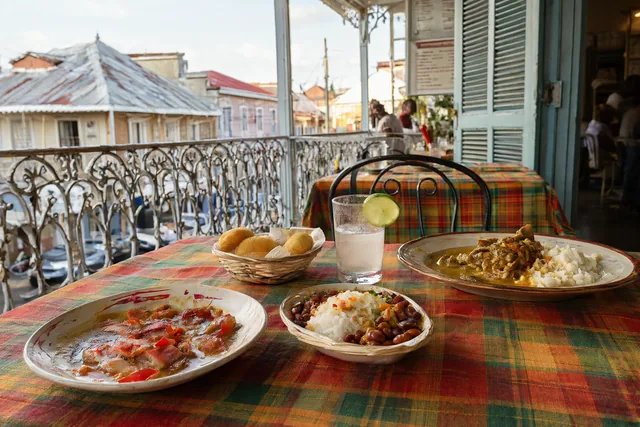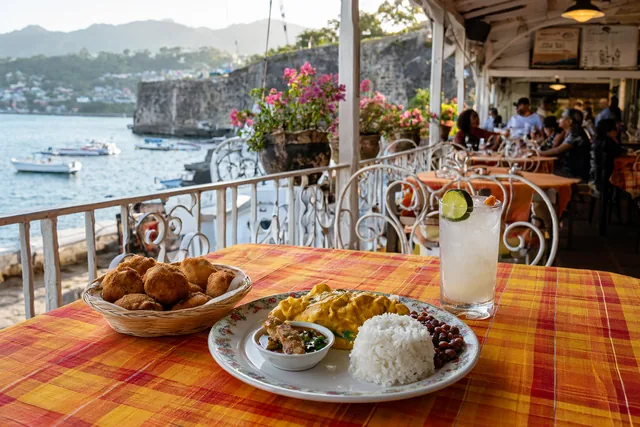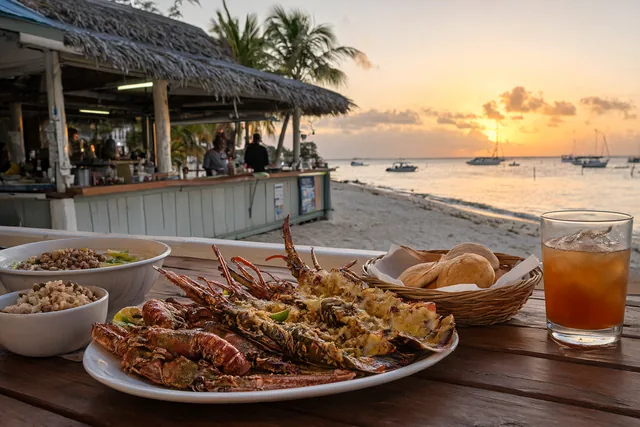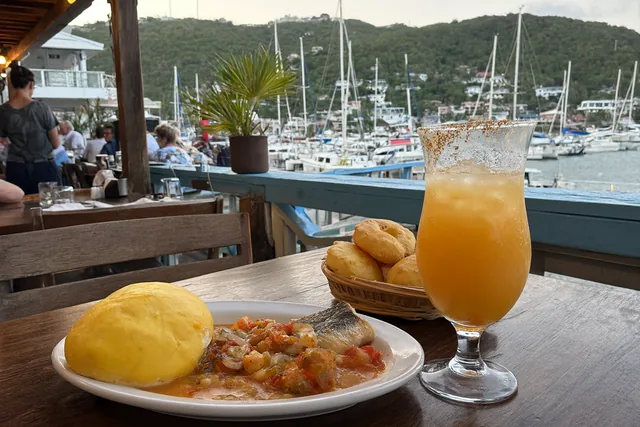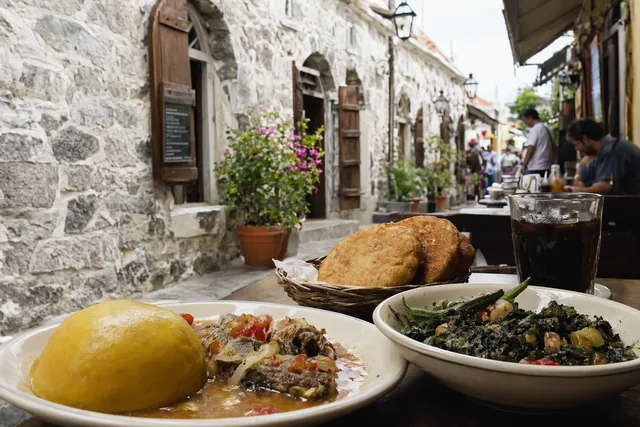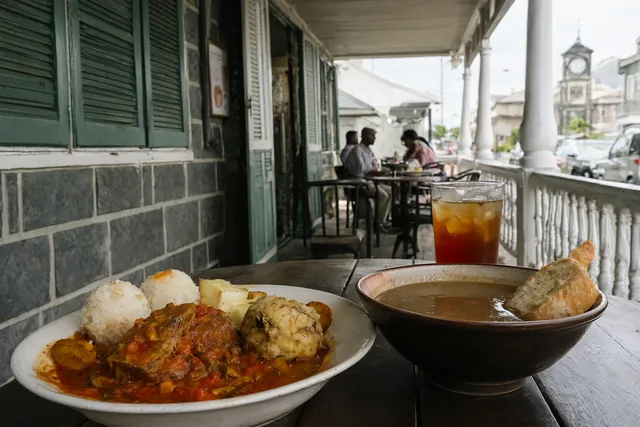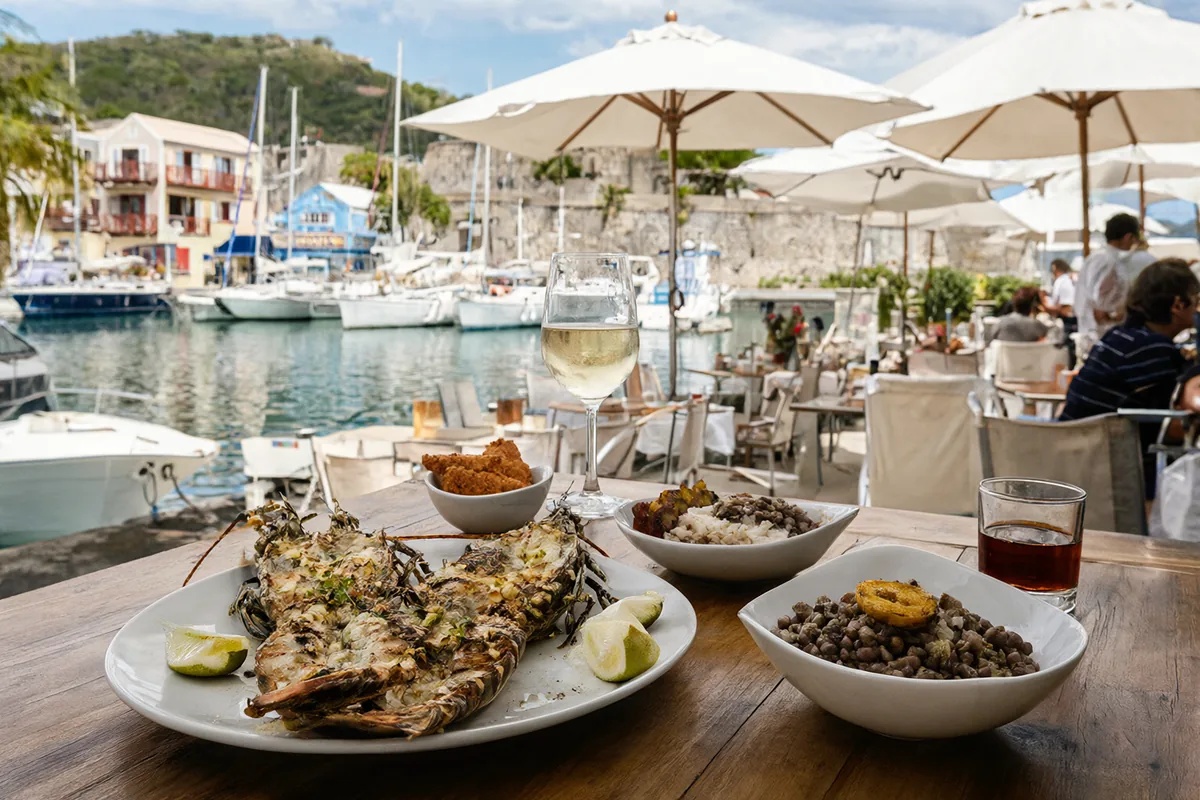
Saint Martin is a small Caribbean island shared by two countries: the northern part is French Saint-Martin, and the southern part is Dutch Sint Maarten, with no border controls between them. That makes it one of the most varied places to eat in the Caribbean for its size, with French bakeries and fine dining, Creole cooking, West Indian barbecue stands and American-style beach bars all a short drive apart. This Saint Martin food guide covers the dishes to know, the menu words on both sides, tipping, service charges and the three currencies in play, and where to eat in Marigot, Grand Case, Orient Bay, Philipsburg, Simpson Bay, Maho and Cupecoy. Grand Case calls itself the gourmet capital of the Caribbean, but its roadside lolos, the barbecue stands grilling ribs and lobster over oil drums, are just as much a reason to go.
What to eat on Saint Martin: 12 dishes to know
The island's food mixes West Indian home cooking (the island's own St Martiner tradition), French Creole dishes from the wider French Caribbean and French cuisine. These are the dishes and drinks to look for.
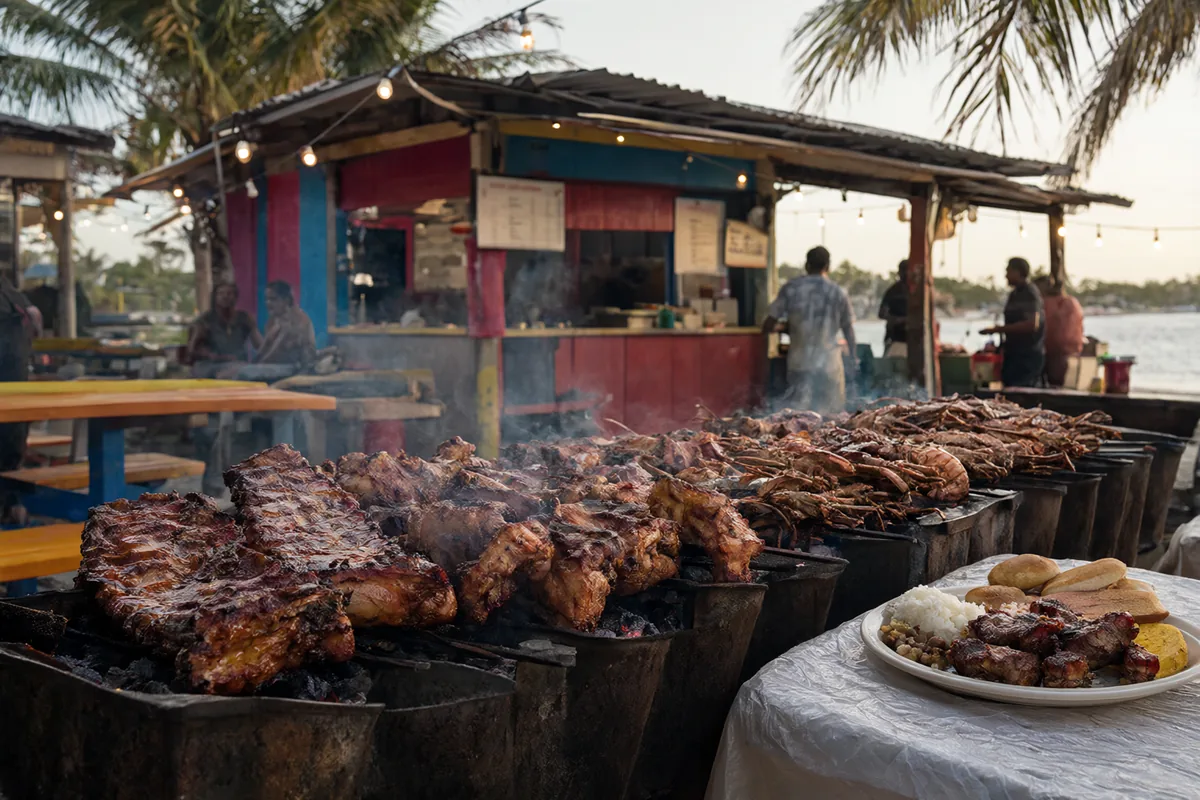
- Lolo ribs and chicken (Grand Case, Marigot): pork ribs and chicken marinated and grilled over charcoal in half oil drums at the lolos, served with rice and peas, fried plantain, potato salad, macaroni pie or johnnycakes.
- Johnnycakes (everywhere): small, fluffy fried dough breads, eaten at breakfast with saltfish or cheese, or on the side at a lolo.
- Saltfish (everywhere, breakfast): salted cod sautéed with onion, tomato, peppers and herbs, eaten with johnnycakes or bread. Breakfast of saltfish and johnnycakes is a St Martin classic.
- Conch and dumplings (everywhere): tender stewed conch in a savoury sauce with flour dumplings, one of the dishes most associated with the island's home cooking.
- Spiny lobster (Grand Case, Orient Bay): Caribbean spiny lobster (langouste), grilled with garlic butter or Creole sauce, often chosen live from a tank and priced by weight.
- Callaloo soup (everywhere): a thick green soup of callaloo leaves (or spinach) with okra, often with crab, salt pork or salt beef.
- Rice and peas (everywhere): rice cooked with pigeon peas or red beans, the standard side to almost any West Indian plate.
- Pâtés (bakeries and snack stands): fried or baked pastries filled with saltfish, spiced beef or chicken, sold warm as a snack.
- Accras and boudin (French side): Creole salt cod fritters and spicy blood sausage, the classic starters at a French-side Creole restaurant.
- Colombo (French side): Creole curry of chicken, goat or fish with colombo spice, as in Guadeloupe and Martinique.
- Fish Creole style (everywhere): red snapper, mahi-mahi or grouper, fried or grilled and served with a tomato, onion and pepper Creole sauce or with French sauce chien.
- Guavaberry (everywhere, especially at Christmas): the island's traditional rum liqueur, made with the small wild guavaberry fruit that grows in the hills, sweet, woody and spicy. Guavaberry colada is the cocktail version.
Other things to try: fresh baguettes, croissants and pastries from the French-side bakeries, which are good enough that people drive over from the Dutch side for breakfast, stewed goat and oxtail, coconut tarts and sweet potato pudding, soursop and passion fruit juices, homemade ginger beer, and bush teas. On the French side, the ti-punch of white rum, lime and cane sugar is the aperitif, and many bars make flavoured rums infused with fruit and spices in big glass jars.
How to read a menu on Saint Martin
On the Dutch side, Sint Maarten, menus are almost always in English, and English is spoken across the whole island. On the French side, Saint-Martin, many menus are in French, often with English underneath, and the layout is French: a formule or menu at a fixed price, a plat du jour, and courses listed as entrée, plat and dessert. Note that an entrée in French is a starter. These are the words you will meet on both sides.
| Word | Where | Meaning |
|---|---|---|
| Entrée / plat / dessert | French side | Starter / main course / dessert |
| Plat du jour / formule | French side | Dish of the day / fixed-price meal |
| Langouste | French side | Spiny lobster, often priced by weight |
| Poisson du jour | French side | Fish of the day |
| Morue | French side | Salt cod (saltfish) |
| Lambi | French side | Conch |
| Service compris / non compris | French side | Service included / not included |
| Lolo | Both sides | An open-air barbecue stand or local eatery |
| Johnnycake | Both sides | Small fried dough bread |
| Saltfish | Both sides | Salted cod, cooked with onion and peppers |
| Provisions | Both sides | Starchy root vegetables: yam, sweet potato, cassava |
| Market price (MP) | Both sides | Price varies daily, usually for lobster and fish |
| Service charge (15%) | Dutch side | Service charge added to the bill |
Lobster on Saint Martin is often listed at "market price" or by weight, and on the French side "service non compris" means a tip is expected on top. swap.menu flags priced-by-weight items and service lines when it reads the menu, so the bill holds no surprises.
Tipping, service charges and paying
Tipping works differently on the two sides of the island, so read every bill. On the Dutch side, many restaurants add a service charge, often 15 percent, and if it is already there, an extra tip is optional. If there is no service charge, 15 percent is the norm. On the French side, French rules mean service is usually included (service compris), but many restaurants that serve mostly American visitors write "service non compris" and expect a tip of around 10 to 15 percent. At lolos, bakeries and snack stands, tipping is not expected. Our guide to tax and service charges on menus explains how these lines work around the world.
Three currencies are in use. The French side uses the euro (€). The Dutch side uses the Caribbean guilder (Cg, code XCG), which replaced the Netherlands Antillean guilder in 2025. In practice, the US dollar is accepted everywhere, and most prices on the Dutch side are shown in dollars. Many French-side restaurants also accept dollars, at an exchange rate they set themselves, so compare it with paying by card in euros. Saint-Martin does not apply French VAT, and Sint Maarten has its own turnover tax, which may be included in prices or added to the bill.
Cards are widely accepted in restaurants, bars and shops on both sides, but lolos, market stalls and some small places want cash, in dollars or euros. When a card machine offers to charge you in your home currency, decline and pay in the local currency of the bill: our guide to paying in local currency explains why. Meal times are relaxed: lunch is from about 12pm to 3pm, and dinner from about 6:30pm on the Dutch side and a little later on the French side. Many restaurants close one day a week, and some close in September and October, the quietest months.
Where to eat on Saint Martin, area by area
The island is small enough to drive across in half an hour, traffic permitting, so you can have breakfast in Marigot, lunch on Orient Bay and dinner in Simpson Bay. Jump to an area:
Where to eat in Marigot
Marigot is the capital of French Saint-Martin, a small town on a bay under the ruins of Fort Louis, with a French feel: bakeries, cafés, pharmacies and shops with French products. The Marigot market on the waterfront is busiest on Wednesday and Saturday mornings, when stalls sell fruit, vegetables, spices, fish and crafts, and food stalls nearby serve local breakfasts and lunches of johnnycakes, saltfish, ribs, fish and rice and peas. Start the day in Marigot with a croissant and coffee from a boulangerie, which is as close to France as the Caribbean gets.
The Marina Royale and the Marina Fort Louis have rows of restaurants by the water, serving French, Creole and seafood menus, busy at lunch and in the evening. Marigot's restaurants are a good place for a plat du jour at lunch, and the town is quieter in the evening than Grand Case or Simpson Bay. On market days, park early, as the waterfront fills up quickly.
Where to eat in Grand Case
Grand Case, a fishing village on a long bay on the French side, is the food destination of the island. Its one main street, the Boulevard de Grand Case, is lined with restaurants on both sides, many with terraces over the beach, serving French and Creole cooking, seafood and lobster, and it has long marketed itself as the gourmet capital of the Caribbean. These are some of the most expensive restaurants on the island, and booking ahead in the high season is wise.
In the middle of the village, the lolos are the other side of Grand Case: a group of open-air barbecue stands with picnic tables where cooks grill ribs, chicken, lobster and fish over oil drums and serve them with rice and peas, plantain and johnnycakes, at a fraction of the price of the restaurants across the road. From January to April, Grand Case holds Harmony Nights on Tuesday evenings, a street festival with music, stalls and the restaurants and lolos at full tilt. Come hungry, and decide on the spot whether tonight is a lolo night or a white tablecloth night.
Where to eat on Orient Bay
Orient Bay, on the east coast of the French side, is the island's best-known beach, a long arc of white sand lined with beach clubs, each with its own sunbeds, umbrellas and restaurant. Lunch here is the main event: grilled fish, lobster, salads, burgers and French and Creole dishes, with rosé and cocktails, served at tables on the sand or under thatched roofs. The village of Orient Bay behind the beach has a few more restaurants and cafés.
From the nearby bay of Cul-de-Sac, small ferries run across to Pinel Island (Îlet Pinel), a tiny islet with a couple of beach restaurants serving grilled lobster and fish, and good snorkelling. On Orient Bay, expect to pay for sunbeds if you sit in a beach club's area, and arrive by noon to get a table for lunch. The far southern end of the beach is a naturist area.
Where to eat in Philipsburg
Philipsburg is the capital of Dutch Sint Maarten, set on a narrow strip of land between the Great Bay and the Great Salt Pond. Its main street, Front Street, is a long line of duty-free shops, jewellers and bars, and on the beach side the Boardwalk along Great Bay beach has beach bars and restaurants serving seafood, burgers, ribs and cocktails with the cruise ships in view. Back Street, one street behind, has more local eateries and snack places.
Philipsburg is busiest when cruise ships are in port and much quieter in the evening. For local food, look for small West Indian restaurants and snack places serving conch and dumplings, stewed chicken, fish, rice and peas and johnnycakes, and try a tasting of guavaberry liqueur, which is made and sold in town. In late April, Philipsburg hosts Sint Maarten Carnival, when the carnival village fills with food stalls selling ribs, johnnycakes, pâtés and local drinks.
Where to eat in Simpson Bay
Simpson Bay, on the Dutch side between the airport and the big lagoon, is where most of the island's restaurants and bars are concentrated, along the main road and around the marinas on the lagoon. The choice is wide and international: steakhouses, sushi, Italian, Indian, seafood, Caribbean and casual bars, many with happy hours and live music, catering to the yacht crowd, timeshare visitors and residents. It is the easiest place on the island to find dinner late, and the busiest at night.
The beach at Simpson Bay and nearby Kim Sha Beach have beach bars for lunch and sunset drinks. Simpson Bay restaurants generally price in US dollars and often add a 15 percent service charge, so read the bill. Traffic on the main road can be slow at rush hour and in the evening, so allow time if you are driving over from the French side.
Where to eat in Maho and Cupecoy
Maho, at the end of the runway of Princess Juliana International Airport, is famous for Maho Beach, where planes fly low over the sand as they land and visitors gather to watch. The beach bars here are busy all day with plane-spotters, and the Maho village area just up the road has restaurants, bars and casinos open into the night.
Further along the west coast, Mullet Bay has a wide beach with simple food and drink stalls, and Cupecoy is an area of apartments and resorts above small cliff-backed beaches, with restaurants in the residential complexes. The food in Maho and Cupecoy is mostly casual and international, good for a beach lunch or a sunset drink, with the more interesting local food a short drive away. Stay well back from the runway fence when planes take off, as the jet blast is dangerous.
Vegetarian, vegan and allergy tips
Saint Martin's local cooking is based on seafood, saltfish and meat, but the island's international restaurants make it easier for vegetarians than many Caribbean islands. The French word is végétarien (végan for vegan), and in English "vegetarian" is widely understood. Good options include salads, vegetable curries, pasta, pizza and Asian restaurants in Simpson Bay, French bakeries, fruit and juices. Watch for hidden ingredients: rice and peas and callaloo are often cooked with salted meat, and many Creole dishes contain salt cod or seafood stock.
Shellfish, especially lobster, conch and shrimp, is everywhere on the island, and hot pepper sauce is on every table. Johnnycakes and pâtés contain wheat and are fried in shared oil. Restaurants on both sides are used to visitors with dietary needs, so explain clearly when you order. Our guide to eating abroad with food allergies explains how to explain an allergy clearly when you do not speak the language.
Useful French phrases for ordering
Bonjour / Bonsoir "Good morning / Good evening". On the French side, greet before you order
Une table pour deux, s'il vous plaît "A table for two, please"
Qu'est-ce que vous me conseillez ? "What do you recommend?"
C'est combien, la langouste ? "How much is the lobster?"
Le service est compris ? "Is service included?"
Je suis allergique aux fruits de mer "I am allergic to seafood"
L'addition, s'il vous plaît "The bill, please"
Good morning / Good night On the Dutch side and in local English, people greet each other before anything else; "good night" is also used as a greeting after dark
How swap.menu helps you eat on Saint Martin
On one island you can meet a French menu in Grand Case, an English menu priced in US dollars in Simpson Bay and a lolo board with nothing but "ribs, chicken, lobster, johnnycakes". Photograph any of them with swap.menu and every dish appears in your language with the original name beside it and a short explanation, so you know that lambi is conch, accras are salt cod fritters and conch and dumplings is a stew, not a fried snack. Prices are converted from euros, Caribbean guilders or US dollars to your home currency, and we flag "service non compris", 15 percent service charges and lobster priced by weight.
Tap the dishes you want, add a note such as "no shellfish" or "not too spicy, please", typed or spoken, and swap.menu translates your order into French for French-side restaurants. Visitors whose first language is not English or French can read any menu on the island in their own language, in any of 29 languages. You can try it right now on a sample menu with the free demo, or see travel pass prices.
Off to Saint Martin? Your first 3 menu scans are free, and a travel pass starts from $4.99 with nothing that renews.
Start free with 3 scansSaint Martin food FAQ
Do you tip in restaurants on Saint Martin?
On the Dutch side, many restaurants add a service charge, often 15 percent, and if there is none, 15 percent is the normal tip. On the French side, service is usually included, but restaurants that write "service non compris" expect around 10 to 15 percent. Always check the bill.
What food is Saint Martin famous for?
Saint Martin is famous for the restaurants and lolos of Grand Case, where ribs, chicken and lobster are grilled over oil drums. Conch and dumplings, saltfish with johnnycakes, Creole dishes like accras and colombo, French pastries and guavaberry liqueur are also island favourites.
What currency is used on Saint Martin?
The French side uses the euro and the Dutch side uses the Caribbean guilder, but US dollars are accepted everywhere and most Dutch-side prices are in dollars. Cards are widely accepted, while lolos and market stalls prefer cash.
Is Saint Martin expensive to eat out?
Restaurants on Saint Martin are expensive, especially in Grand Case, Orient Bay and Simpson Bay, and lobster can be very costly. The lolos, the food stalls at the Marigot market and local snack places in Philipsburg are much cheaper and very good.
Is tap water safe to drink on Saint Martin?
Tap water on Saint Martin comes mainly from desalination plants and is treated, but most visitors drink bottled water, which is sold everywhere. Some villas and guesthouses use cistern water, so ask your host.
How can I read menus on Saint Martin if I do not speak French?
English is spoken across the island and most Dutch-side menus are in English, but French-side menus may not be. Photograph the menu with swap.menu to translate every dish into your language, convert euro or dollar prices to your currency, flag service charges and translate your order into French.
Travelling further in the Caribbean? Read our food guides for nearby islands:
- Anguilla food guide
- Guadeloupe food guide
- Saint Kitts and Nevis food guide
- Antigua and Barbuda food guide
- British Virgin Islands food guide
- Curaçao food guide
Or browse every travel food guide.