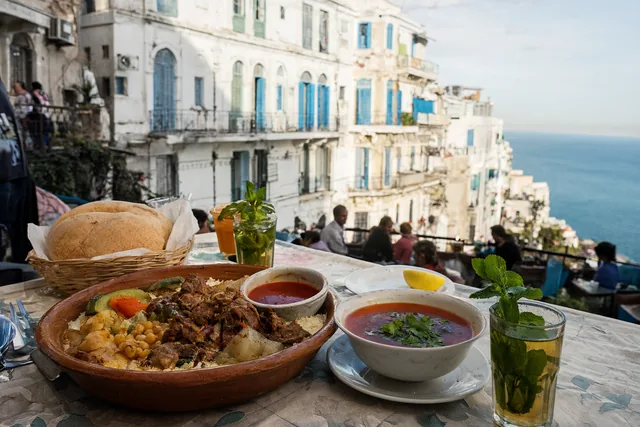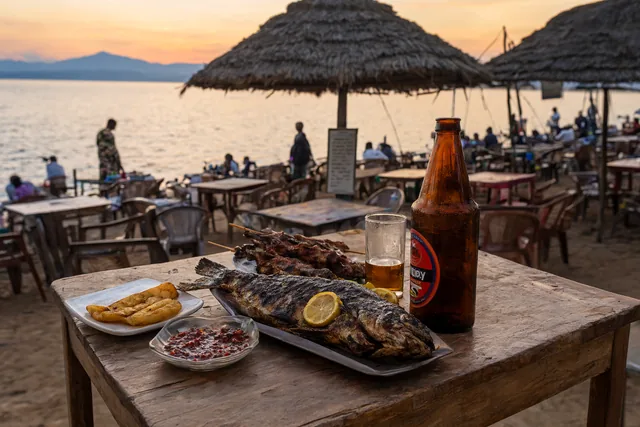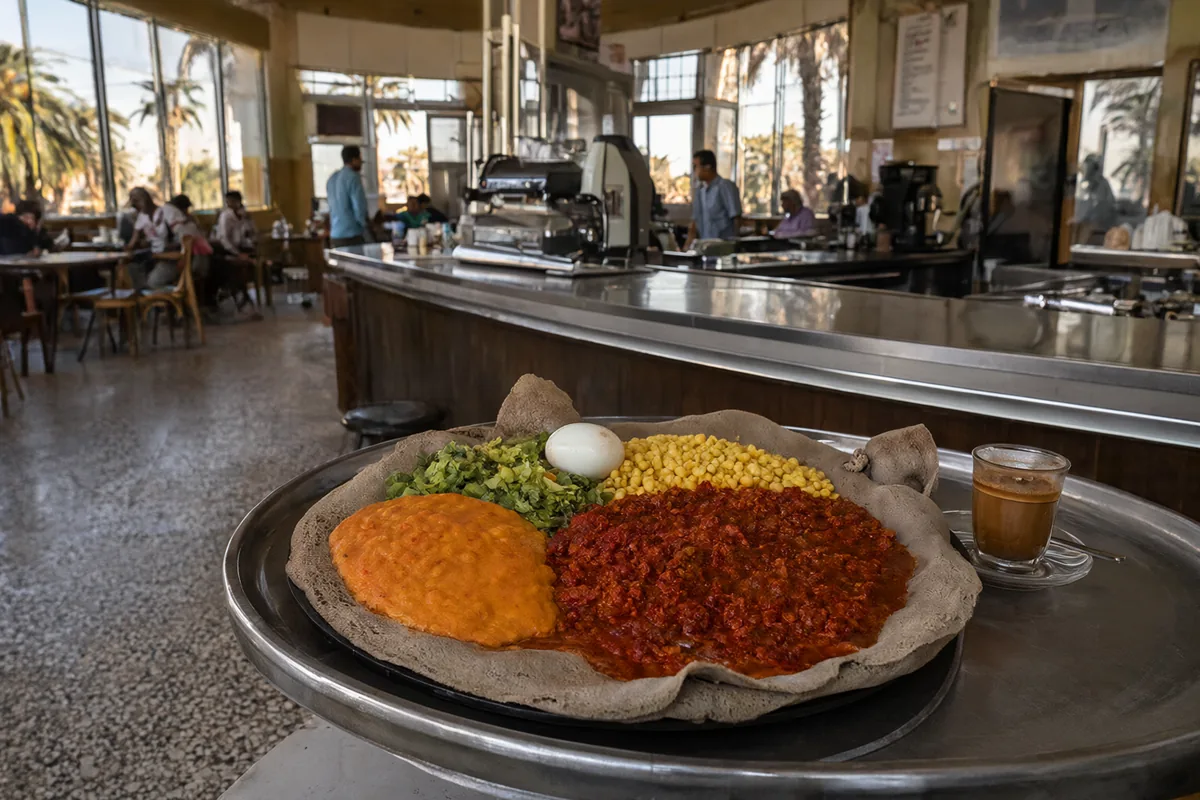
Eritrea's food is two traditions on one table. From the highlands comes a cuisine shared with northern Ethiopia: sour taita (injera) flatbread, spicy stews coloured with berbere, chickpea shiro and a coffee ceremony that can take an hour. From fifty years of Italian rule comes a love of pasta, pizza, pastries and properly made espresso, served in the modernist cafés of Asmara. This Eritrea food guide covers the dishes to know, how to read a menu in Tigrinya, cash and tipping, fasting food for vegetarians and vegans, and then where to eat in Asmara, Massawa, Keren, Mendefera and Adi Keyih. Visitors are few and restaurants simple outside the capital, so this guide sticks to what is genuinely there.
What to eat in Eritrea: 12 dishes to know
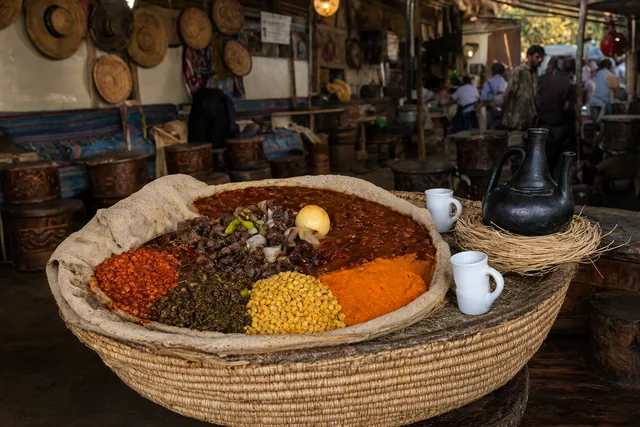
Eritrean meals are shared from a single large platter covered with taita, with stews spooned on top. You tear off pieces of bread with your right hand and use them to scoop up the food.
- Taita (injera): a large, spongy, slightly sour flatbread made from fermented batter, traditionally of teff, sorghum or a mix. It is plate, cutlery and staple at once.
- Zigni: the signature Eritrean stew, beef or lamb slow-cooked with onions, tomato and plenty of berbere, the red chilli and spice blend. Rich and hot.
- Tsebhi derho: a spicy chicken stew with whole boiled eggs, the dish for holidays and guests.
- Shiro: ground chickpeas cooked into a smooth, spiced stew, often brought bubbling to the table in a small clay pot (shiro tegamino). Vegan and eaten all over the country.
- Ful: mashed fava beans with oil, onion, tomato, green chilli and sometimes yoghurt or egg, eaten for breakfast with bread rolls.
- Fata: pieces of bread soaked in a spiced sauce, often with ful or yoghurt, a filling breakfast.
- Kitcha fit-fit: shredded thin flatbread mixed with spiced butter and berbere, served with yoghurt.
- Ga'at: a thick barley or wheat porridge shaped into a mound with a well of spiced butter and berbere in the centre, surrounded by yoghurt. A traditional breakfast.
- Tibsi: cubes of meat pan-fried with onions, peppers, rosemary and butter, served sizzling. Ask for it mild or hot.
- Hilbet: a smooth paste of fava beans or lentils whipped with fenugreek, eaten cold with taita.
- Pasta and pizza: an Italian legacy, cooked in Eritrea for generations. A plate of pasta with a berbere-tinged tomato sauce is a standard lunch, and lasagne appears on many menus.
- Bun: the coffee ceremony, in which green beans are roasted over charcoal, ground by hand and brewed three times in a clay pot (jebena), served with popcorn or roasted barley. In cafés, order a macchiato.
Look out also for himbasha, a round, cardamom-scented celebration bread, beles, prickly pears sold from street carts in the highland summer, and mies, a honey wine. In the cafés, the Italian pastries and cakes are a daily habit.
How to read a Tigrinya menu
Tigrinya, the most widely spoken language in the highlands, is written in the Ge'ez script, in which each character stands for a syllable. Arabic, Tigre and other languages are spoken in the lowlands, and English is used in schools and on some signs. Many restaurant menus in Asmara are in English or have no menu at all, but cafés and small restaurants may write the day's dishes in Tigrinya. Italian words are common in everyday food talk.
| Tigrinya | Romanised | Meaning |
|---|---|---|
| ጣይታ | taita | Injera, sour fermented flatbread |
| ጽብሒ | tsebhi | Stew |
| ዝግኒ | zigni | Spicy meat stew |
| ስጋ | siga | Meat |
| ደርሆ | derho | Chicken |
| ዓሳ | asa | Fish |
| ሽሮ | shiro | Chickpea flour stew |
| ፉል | ful | Fava beans |
| ጥብሲ | tibsi | Pan-fried meat |
| ባኒ | bani | Bread roll, from the Italian "pane" |
| ጾም | tsom | Fasting food, made without animal products |
| ቡን | bun | Coffee |
| ሻሂ | shahi | Tea |
| ማይ | mai | Water |
Many restaurants serve a combination platter of several stews on one taita, often listed as a mixed or "combination" dish, which is the easiest way to try several at once. Dishes marked tsom or "fasting" are vegan.
A handwritten Tigrinya board in Asmara looks impenetrable at first, because the Ge'ez script has hundreds of characters. swap.menu reads it, explains each dish, tells you which ones are fasting food and converts nakfa prices to your home currency, so you can order without guessing.
Cash, tipping and paying
Check your government's current travel advice before planning a trip. Eritrea is a cash-only country for visitors. Foreign cards do not work in shops, restaurants or ATMs, so bring all the money you need in cash, ideally US dollars or euros in clean notes, and change it at banks or official exchange offices. Foreign currency must be declared on arrival, and it is wise to keep your exchange receipts.
The currency is the nakfa (ERN, written Nfa). Restaurant menus show prices in nakfa, and service charges are unusual outside the larger hotels. Our guide to tax and service charges on menus explains how these lines work around the world, and our guide to paying in local currency explains why you should always pay in the local currency wherever cards are offered.
Tipping is not compulsory, but it is appreciated. Rounding up at cafés and leaving around 10 percent in sit-down restaurants is generous, and guides and drivers are usually tipped at the end of a trip. If you are invited to a family coffee ceremony, stay for all three rounds, called awel, kalay and bereka, as leaving early is impolite.
Breakfast is often ful or fata with bread and tea or coffee. Lunch is from about 12pm to 2pm, and dinner from about 7pm to 9pm. In Asmara, the early evening is the time for a passeggiata, a stroll along the main avenue followed by a coffee or a beer.
Alcohol is legal and widely available in Asmara and the highland towns, where bars serve locally brewed lager, and homemade drinks include sowa, a home-brewed grain beer, and mies, honey wine. Eritrea is roughly half Christian and half Muslim. Orthodox Christians fast on Wednesdays and Fridays and during long fasting periods such as the weeks before Easter, eating no animal products, so fasting food is easy to find. During Ramadan, most restaurants stay open, but in mainly Muslim towns such as Massawa and Keren, be discreet about eating and drinking in public by day.
Where to eat in Eritrea, town by town
Foreign visitors need a travel permit, issued in Asmara, to travel outside the capital, so plan your route before you set off. Jump to a town:
Where to eat in Asmara
Asmara, the capital, sits at 2,300 metres on the highland plateau, and its centre is a UNESCO World Heritage Site for its Italian modernist architecture of the 1930s. It is also one of the great café cities of Africa. Along Harnet Avenue, the palm-lined main street, and the streets around it, old cafés and bars with original Italian espresso machines serve excellent macchiato and cappuccino with pastries, and the cafés are where Asmara meets in the morning and early evening. Ordering a macchiato at a counter on Harnet Avenue is the classic Asmara experience.
For Eritrean food, look for traditional restaurants in Asmara serving zigni, shiro and tibsi on taita, some with woven basket tables and a coffee ceremony, and for small Italian-style restaurants serving pasta, pizza and lasagne. The central market is a good place to see grain, spices, dried chillies for berbere and fresh produce, and next to it the Medeber market is a fascinating workshop district where metalworkers recycle everything, including coffee pots and charcoal stoves. Asmara tip: it gets cold at night at this altitude, so bring a layer for evening drinks.
Where to eat in Massawa
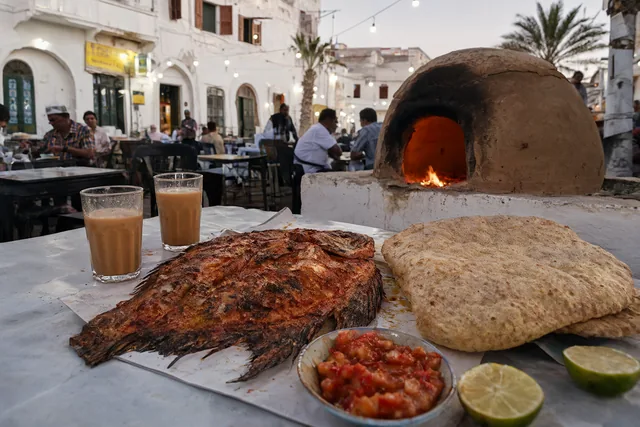
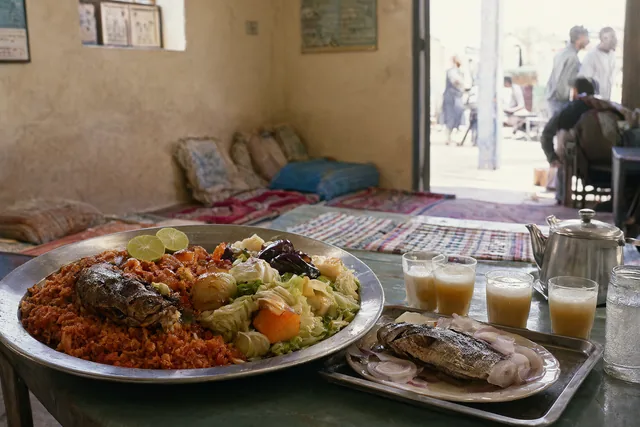
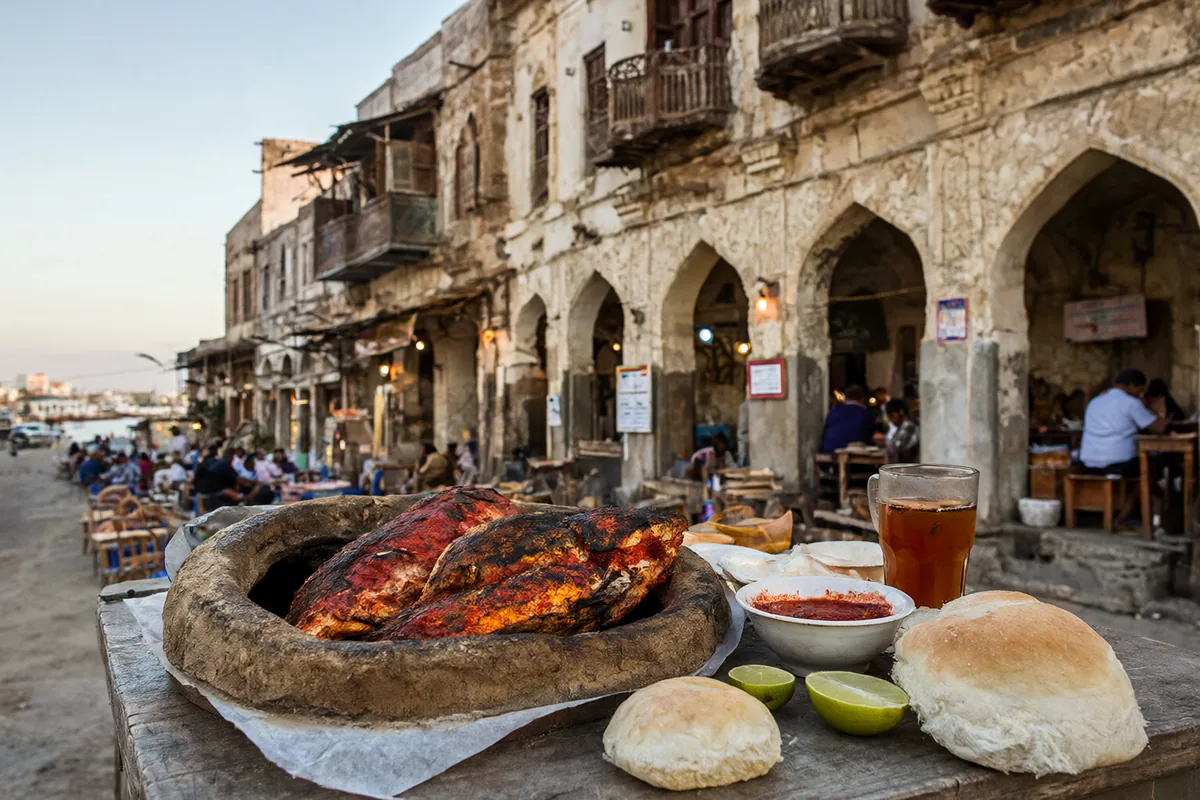
Massawa, Eritrea's Red Sea port, is a two-to-three hour drive down from Asmara through mountains and switchback roads, and a different world: hot, humid and built of coral stone, with Ottoman and Egyptian-era buildings, arcades and old merchants' houses on its island old town. Massawa is the place for fish. Its fish restaurants bake whole fish in clay ovens, Yemeni-style, or grill or fry it, and serve it with bread rolls, spicy sauce and lime, usually in the evening when the heat eases.
The old town of Massawa has simple restaurants and tea shops in its arcaded streets, and there are hotels and beach spots on the mainland nearby. Massawa is the departure point for boat trips to the Dahlak Islands, which need separate arrangements. Massawa is more Muslim and more Arab-influenced than the highlands, with Arabic and Tigre spoken alongside Tigrinya, and tea is often spiced. Avoid the hottest months from around June to September, when daytime temperatures are fierce.
Where to eat in Keren
Keren, Eritrea's second town, lies in a green valley north-west of Asmara, surrounded by mountains, and has a relaxed lowland feel. It is best known for its Monday livestock market, where camels, goats, sheep and cattle are traded on the edge of town, one of the most memorable sights in Eritrea. The town market sells fruit, grain, spices and silver jewellery, and Keren's gardens and the farms around it grow fruit and vegetables.
The food scene in Keren is simple: small restaurants and tea houses serving zigni, tibsi, ful, pasta and grilled meat, and cafés with tea and pastries. Keren is a largely Muslim town, home to the Bilen and Tigre peoples, so many restaurants do not serve alcohol, and tea is the drink of choice. Go to the market early on Monday, then have breakfast of ful and bread at a café afterwards.
Where to eat in Mendefera
Mendefera, on the highland plateau south of Asmara, is a regional market town with a small food scene. Its restaurants and bars serve the classic highland dishes: zigni, tsebhi derho, shiro, tibsi and taita, with ful and fata for breakfast, and cafés serve macchiato and tea, as everywhere in Eritrea. Market days bring farmers in from the surrounding villages with grain, vegetables and livestock.
Mendefera has no restaurants aimed at tourists, so expect Tigrinya or no menu at all, and point at what others are eating if needed. It is a pleasant stop on a road trip through the southern highlands, and a good place to try homemade sowa and to see daily life away from the capital. Prices in Mendefera are lower than in Asmara.
Where to eat in Adi Keyih
Adi Keyih, a highland town south-east of Asmara, is the base for visiting the ancient sites of Qohaito and Metera, with ruins from the Aksumite period and earlier, on the edge of the escarpment. The town itself has a handful of simple restaurants, tea shops and bars serving shiro, zigni, tibsi and ful, and small shops for supplies.
There is little else in the way of dining, so treat Adi Keyih as a lunch stop on a day trip, and bring water and snacks for the walk around the archaeological sites. The highland villages around Adi Keyih grow barley, wheat and sorghum, and if you are offered ga'at or fresh himbasha bread, accept: this is the kind of home cooking that makes travel in Eritrea worthwhile.
Vegetarian, vegan and allergy tips
Eritrea is surprisingly good for vegetarians and vegans, thanks to the Orthodox fasting tradition. On Wednesdays, Fridays and during long fasting periods, restaurants serve tsom (fasting) dishes with no meat, dairy or eggs, and many keep them on the menu every day: shiro, hilbet, lentil stews, spiced vegetable stews called alicha, and salads, all on taita. Ask for tsom or bizey siga (without meat). Pasta with tomato sauce is another reliable fallback.
Outside fasting days, watch for spiced butter (tesmi) in many stews, yoghurt with breakfast dishes, and eggs in tsebhi derho and ful. Taita made from teff is naturally gluten-free, but many versions mix in wheat or barley, so coeliacs should ask. Berbere is very hot, and chilli is in almost everything unless you ask. Our guide to eating abroad with food allergies explains how to communicate an allergy clearly when you do not speak the language.
Useful Tigrinya phrases for ordering
Many Eritreans speak some English, and older people may use Italian words such as "ciao" and "grazie". These Tigrinya phrases will be warmly received.
ሰላም Selam: "Hello"
ከመይ ኣለኻ? Kemey aleka?: "How are you?" (kemey aleki to a woman)
እዚ እደሊ Izi ideli: "I would like this" (pointing)
ብዘይ ስጋ Bizey siga: "Without meat"
ጾም ኣሎ? Tsom allo?: "Is there fasting food?"
ሕሳብ በጃኻ Hisab bejaka: "The bill, please" (bejaki to a woman)
የቐንየለይ Yekenyeley: "Thank you"
ጥዑም እዩ Tium iyu: "It is delicious"
How swap.menu helps you eat in Eritrea
An Eritrean menu, where there is one, may be a handwritten board in Ge'ez script, and even English menus list dishes like zigni, hilbet and kitcha fit-fit with no explanation. Photograph it with swap.menu and every dish appears in your language with the Tigrinya name beside it and a short description, so you know which stews are spicy, which are fasting food and that ga'at is a porridge, not a stew. Prices in nakfa are converted to your home currency, which helps you keep track of the cash you brought.
Tap the dishes you want, add a note such as "not spicy" or "no butter, please", typed or spoken, and swap.menu translates your order into Tigrinya. Show the waiter your phone, or let them scan the QR code and read your order on their own screen. Try it now on a sample menu with the free demo, or see travel pass prices.
Off to Eritrea? Your first 3 menu scans are free, and a travel pass starts from $4.99 with nothing that renews.
Start free with 3 scansEritrea food FAQ
What food is Eritrea famous for?
Eritrea is known for zigni (spicy meat stew), shiro (chickpea stew), tsebhi derho (chicken stew) and ful, all eaten with taita, the sour injera flatbread. Its Italian legacy also makes it famous for coffee, especially the macchiatos of Asmara's cafés, and for pasta.
Can I use a credit card in Eritrea?
No. Foreign cards do not work in Eritrea, in shops, restaurants or ATMs. Bring enough cash for your whole trip in US dollars or euros, declare it on arrival and change it at banks or official exchange offices.
Do you tip in Eritrea?
Tipping is not compulsory, but rounding up at cafés and leaving around 10 percent in restaurants is appreciated. Guides and drivers are usually tipped at the end of a trip.
Is Eritrean food the same as Ethiopian food?
The highland cuisines are closely related, sharing injera, berbere, shiro and the coffee ceremony, though dish names and recipes differ. Eritrea also has a strong Italian influence, with pasta, pizza and espresso part of everyday life.
Is tap water safe to drink in Eritrea?
No, drink bottled water, which is sold in towns. Carry water on trips outside Asmara, especially in hot Massawa and the lowlands.
How can I read a menu in Eritrea?
Many menus are in English or there is no menu at all, but some are written in Tigrinya in the Ge'ez script. Learn a few words such as zigni, shiro and tsom, or photograph the menu with swap.menu, which translates every dish, explains it, converts prices to your currency and translates your order.
Travelling further in the Horn of Africa? Read our food guides for neighbouring countries:
Or browse every travel food guide.