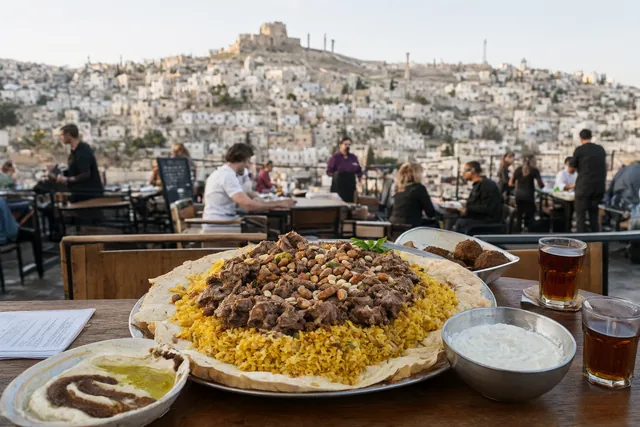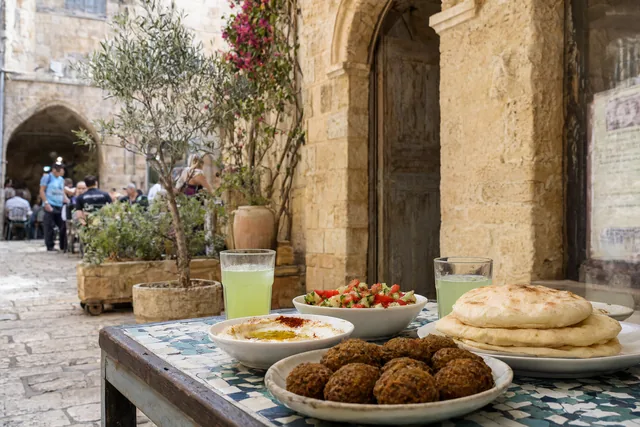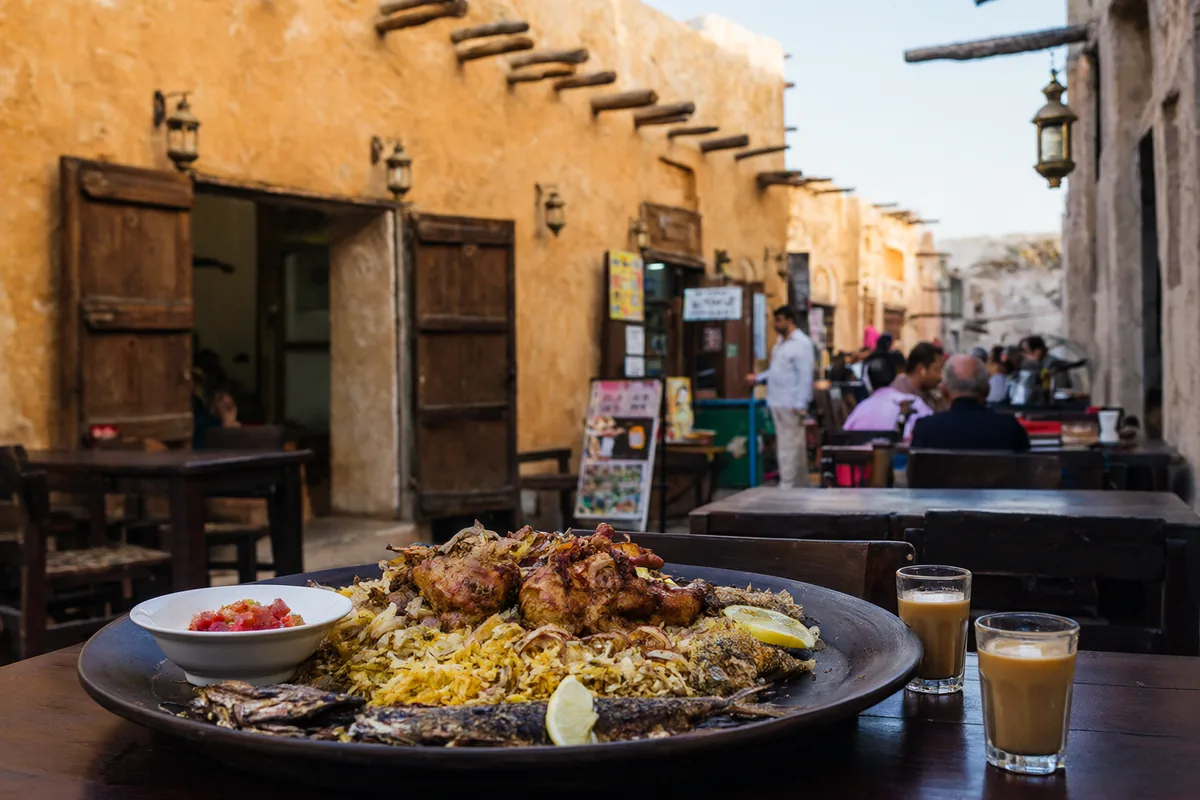
Qatar is small, and almost everything happens in and around Doha, but it eats well. Traditional Qatari food is the cooking of the Gulf coast: spiced rice, fish, dates and slow-cooked wheat dishes, with flavours carried over centuries from Persia, India and East Africa. On top of that sits a huge population from South Asia, the Arab world and the Philippines, which means excellent cheap curries, grills and karak tea on every corner. This Qatar food guide covers the dishes to know, the Arabic words on a menu, tipping and service charges, the rules on alcohol and Ramadan, then goes area by area through where to eat in Doha, West Bay, The Pearl, Lusail, Al Wakrah and Al Khor.
What to eat in Qatar: 12 dishes to know
Qatari dishes are hearty and share a lot with the rest of the Gulf. These are the ones worth seeking out, plus the daily favourites you will end up eating anyway.
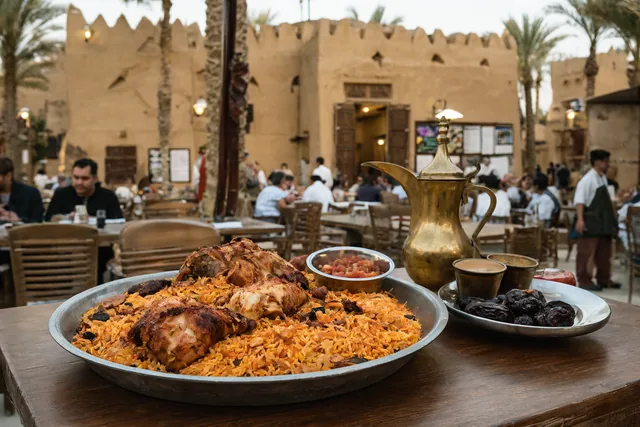
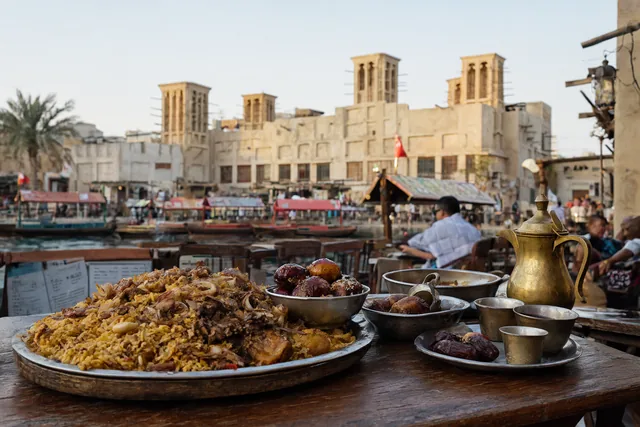
- Machboos: the national dish, rice cooked with spiced chicken, lamb or fish, dried black lime (loomi), tomato and a spice mix called bezar.
- Mehammar: sweet rice cooked with sugar or date syrup, cardamom and saffron, traditionally served with fried or grilled fish. The contrast of sweet and salty is the point.
- Madrooba: rice cooked with chicken or salted fish and spices and beaten until it is smooth, a comforting, porridge-like dish.
- Harees: wheat and meat cooked for hours until they melt together, topped with ghee and sometimes cinnamon. Essential in Ramadan.
- Thareed: thin bread soaked in a stew of meat and vegetables, another Ramadan favourite.
- Saloona: a simple spiced stew of meat, fish or vegetables in tomato sauce, eaten with rice.
- Balaleet: sweet vermicelli with saffron and cardamom, topped with a thin omelette. A breakfast dish.
- Chebab: soft yeasted pancakes with cardamom and saffron, served with date syrup or cheese.
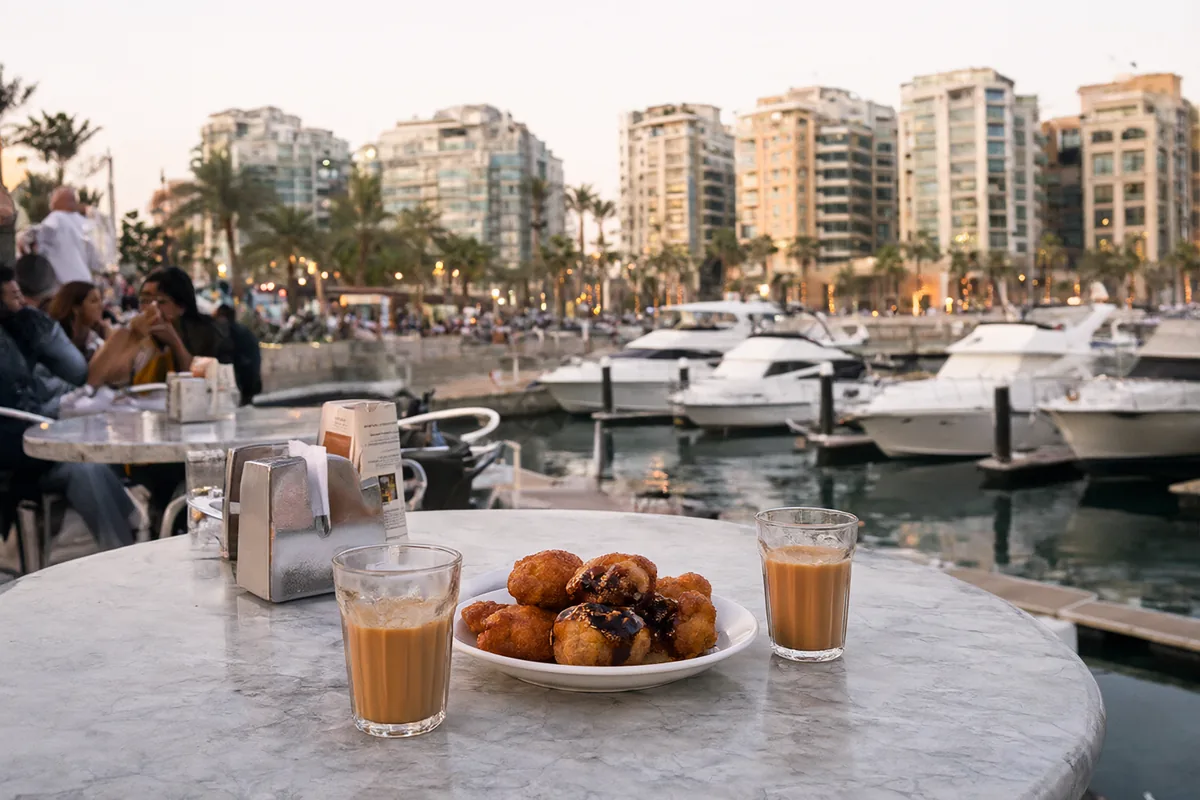
- Luqaimat: crisp fried dumplings soaked in date syrup or honey, sold hot in Souq Waqif in the evening.
- Grilled hamour: the local grouper, the most popular fish in the Gulf, grilled whole or in fillets with a spice rub.
- Karak and chapati: strong tea boiled with milk, cardamom and sugar, with a thin flatbread, often filled with egg, cheese or honey. The classic late-night snack from a roadside karak shop.
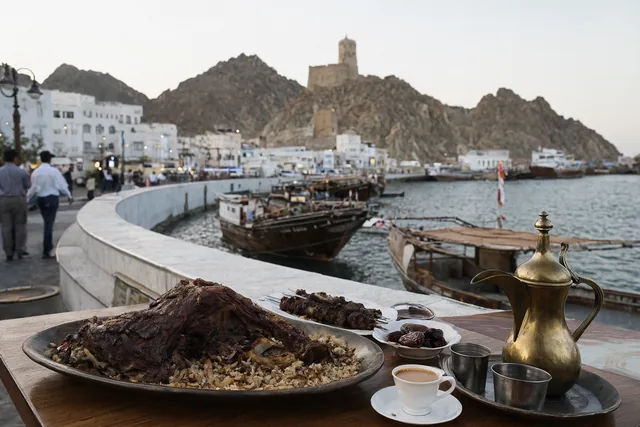
- Gahwa and dates: light Arabic coffee with cardamom and sometimes saffron, served in tiny cups with dates whenever guests arrive.
Lebanese and Syrian grills, Yemeni mandi, Indian biryani and Iranian kebabs are all part of everyday eating in Qatar, and some of the country's best cheap meals come from these kitchens.
How to read an Arabic menu
Most restaurant menus in Qatar are in English and Arabic, but small cafeterias, karak shops and traditional restaurants may show prices, specials or the whole board in Arabic only. Arabic is written from right to left. These are the words you will see most often.
| Arabic | Romanised | Meaning |
|---|---|---|
| مجبوس | machboos | Spiced rice with meat, chicken or fish |
| لحم | lahm | Meat, usually lamb |
| دجاج | dajaj | Chicken |
| سمك | samak | Fish |
| هامور | hamour | Grouper, the favourite Gulf fish |
| روبيان | rubyan | Prawns |
| عيش | eish | Rice in Gulf Arabic |
| خبز | khubz | Bread |
| مشاوي | mashawi | Grills |
| مقبلات | muqabbilat | Starters, mezze |
| حلويات | halawiyat | Desserts, sweets |
| كرك | karak | Spiced milk tea |
| حلال | halal | Prepared according to Islamic dietary law |
| نباتي | nabati | Vegetarian |
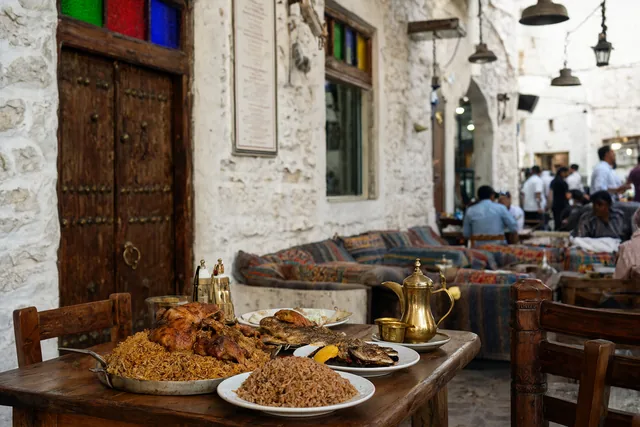
All meat served in Qatar is halal, and pork is not served in restaurants. Traditional Qatari restaurants often offer floor seating on cushions as well as tables, and dishes such as machboos come on large shared platters, so one order may feed two or three.
Hotel restaurants in Qatar often print "++" next to prices, meaning extra charges are added to the bill. swap.menu flags those lines when it reads the menu and converts every price from riyals to your home currency, so you can compare a hotel dinner with a meal in Souq Waqif.
Tipping, service charges and paying
In hotel restaurants and some upmarket venues, a service charge and other fees are added to the bill, shown on the menu as "++" or in the small print. Casual restaurants, cafés and souq eateries usually charge the price on the menu. Our guide to tax and service charges on menus explains how these lines work.
Tipping is not compulsory in Qatar, but it is common. Where no service charge has been added, around 10 percent is appreciated in sit-down restaurants, and many people leave a little cash for the waiter even when it has, since service charges do not always reach staff. Small change for karak shop and cafeteria staff is welcome.
The currency is the Qatari riyal (QAR, QR). Cards and contactless payments are accepted almost everywhere, including in Souq Waqif, though a few small stalls and karak shops prefer cash. If a card machine offers to charge you in your home currency, decline and pay in riyals: our guide to paying in local currency explains why.
Lunch runs from about 1pm to 3pm and dinner from 8pm, often much later, with souqs and cafés busiest after 9pm. The weekend is Friday and Saturday, and many places open later on Friday after midday prayers.
Alcohol is served only in licensed hotel restaurants and bars, and a few other licensed venues, to people aged 21 and over. Visitors cannot buy alcohol in shops, it is not served in Souq Waqif or ordinary restaurants, and being drunk in public is an offence. During Ramadan, alcohol is generally not served, most restaurants are closed during daylight hours, and eating, drinking or smoking in public in the daytime is not permitted and can be fined. After sunset, Doha comes alive with iftar buffets, Ramadan tents and late-night suhoor.
Where to eat in Qatar, area by area
Most of Qatar's restaurants are in Doha and its new districts, with fishing towns to the north and south. Jump to an area:
Where to eat in Doha
The heart of eating in Doha is Souq Waqif, the traditional market rebuilt in the old style with mud-rendered walls, wooden beams and narrow lanes. In the evening its main street fills with restaurants and terraces serving Qatari, Lebanese, Iranian, Yemeni, Moroccan and Indian food, and stalls in the lanes fry luqaimat and pour karak. Inside the souq you can buy spices, dates, saffron and Arabic coffee, and the restaurants with Qatari dishes are the easiest place in Doha to try machboos, mehammar, madrooba and balaleet.
Next to Souq Waqif, the redeveloped Msheireb Downtown has cafés and restaurants in modern buildings designed around old Qatari forms. The Corniche, the long seafront promenade around Doha Bay, is the place for an evening walk, and MIA Park, beside the Museum of Islamic Art, has cafés with views of the skyline. For cheap Indian, Pakistani, Sri Lankan, Nepali and Filipino food, head to the older districts of Doha such as Al Mansoura, Najma and the area around the old airport. Karak shops, often with drive-up service, are everywhere and open late.
Where to eat in West Bay and Katara
West Bay is Doha's business district of glass towers and big hotels, and its hotel restaurants are where you will find most of the city's fine dining, international cuisines and licensed bars. Prices are high, and "++" charges apply, but the views across Doha Bay are excellent, especially from upper-floor restaurants at sunset. Hotel brunches on Fridays are popular with residents.
A short drive north, Katara Cultural Village is a district built for the arts, with an amphitheatre, galleries, a mosque, traditional pigeon towers and a public beach. Its streets and seafront have a wide range of restaurants, including Turkish, Lebanese, Indian and Qatari, plus cafés selling karak and sweets. Katara is busy with families on weekend evenings and is a more relaxed place to eat than West Bay, with outdoor seating in the cooler months.
Where to eat on The Pearl
The Pearl is an artificial island off the north of Doha, built on a former pearl-diving ground, with apartment towers, marinas and promenades. The main dining area is Porto Arabia, where a long marina boardwalk is lined with cafés and restaurants serving Lebanese, Turkish, Italian, Asian and Western food, with yachts moored in front. The colourful canal-side district of Qanat Quartier has smaller cafés and dessert shops.
The Pearl is popular with Doha's international residents, and prices are higher than in the souqs. It is at its best in the cooler months, roughly November to March, when the terraces are full in the evening. A few hotels and venues on The Pearl are licensed to serve alcohol, but most restaurants are not, so check before you book if it matters to you.
Where to eat in Lusail
Lusail is a new city just north of Doha, built in the years before the 2022 World Cup, whose final was played at Lusail Stadium. Its main dining areas are Lusail Marina, a waterfront promenade with cafés and restaurants, and Lusail Boulevard, a wide avenue that hosts events and festivals. The Qetaifan Island North development and the large malls in Lusail add more restaurants, from casual chains to upmarket dining.
Lusail is still growing, and its restaurant scene is mostly modern and international rather than traditional. It is a good choice for a relaxed evening by the water, especially during festivals and events. Lusail is linked to central Doha by the metro and tram, which makes it easy to visit for dinner.
Where to eat in Al Wakrah
Al Wakrah, a coastal town about 20 minutes south of Doha, was a fishing and pearling village, and it keeps more of that character than the capital. Its seafront Al Wakrah Souq, built in traditional style with low stone and mud-rendered buildings, has restaurants and cafés serving grilled fish, seafood, Qatari rice dishes and karak, with tables looking out over the beach. It is quieter and often cheaper than Souq Waqif.
The fishing harbour in Al Wakrah is still active, and local restaurants serve fresh hamour, kingfish and prawns grilled or in rice. Combine a visit with an afternoon on the beach, then stay for dinner in the souq as the heat drops. Al Wakrah is also home to Al Janoub Stadium, one of the World Cup venues.
Where to eat in Al Khor
Al Khor, about 50 kilometres north of Doha, is a small town on a natural bay with a working fishing harbour and a waterfront corniche. Its food is simple and local: grilled fish, fried prawns, Qatari rice dishes and South Asian cafeterias serving biryani, curry and karak. The harbour area is where to see dhows unloading their catch in the morning.
Most visitors come to Al Khor for nature rather than restaurants. The mangroves at Purple Island and Al Thakhira are popular for kayaking and birdwatching, so bring water and snacks, then eat in town afterwards. Al Bayt Stadium, built in the shape of a traditional Bedouin tent, is just south of Al Khor.
Vegetarian, vegan and allergy tips
Traditional Qatari dishes are built around meat and fish, and rice is often cooked in meat stock, so vegetarians need to look beyond the Qatari menu. Fortunately Doha has many Indian restaurants with full vegetarian menus, and Lebanese places serve meat-free mezze such as hummus, moutabal, tabbouleh, falafel and fattoush. The Arabic word for vegetarian is nabati, and "without meat" is bidoon lahm.
For allergies, watch for sesame in tahini, hummus and many breads and sweets, nuts, especially pistachios, almonds and pine nuts in desserts and rice dishes, dairy and ghee in harees and sweets, and gluten in harees, thareed and chapati. Hotel restaurants usually handle allergy requests well. Our guide to eating abroad with food allergies explains how to describe an allergy clearly when you do not share a language.
Useful Arabic phrases for ordering
English is spoken in most restaurants in Qatar, and many staff are from South Asia, the Philippines or other Arab countries. A few words of Arabic are still a friendly touch.
السلام عليكم As-salaam alaikum: "Peace be upon you", the standard greeting
ممكن المنيو؟ Mumkin al-menu?: "Could I have the menu?"
أبغى هذا Abgha hadha: "I want this" (pointing)
كرك واحد لو سمحت Karak wahid law samaht: "One karak, please"
بدون سكر Bidoon sukkar: "Without sugar"
عندي حساسية من... Indi hasasiya min...: "I am allergic to..."
الحساب لو سمحت Al-hisaab law samaht: "The bill, please"
شكراً، لذيذ وايد Shukran, ladheedh wayed: "Thank you, very tasty"
How swap.menu helps you eat in Qatar
A Qatari restaurant menu can list madrooba, mehammar, thareed and harees with little explanation, and a karak shop board may be in Arabic only. Photograph it with swap.menu and every dish appears in your language with a short description, so you know that mehammar is sweet rice served with fish before you order it. Every price is converted from riyals to your home currency, and we point out "++" charges on hotel menus so the bill holds no surprises.
Tap the dishes you want, add a note such as "no nuts" or "less sugar", typed or spoken, and swap.menu translates your order into Arabic, or into Hindi, Urdu or Tagalog if that is what your waiter reads. Show them your phone, or let them scan the QR code and read your order on their own screen. You can try it now with the free demo, or see travel pass prices.
Off to Qatar? Your first 3 menu scans are free, and a travel pass starts from $4.99 with nothing that renews.
Start free with 3 scansQatar food FAQ
Do you tip in restaurants in Qatar?
Tipping is not compulsory, but around 10 percent is appreciated in sit-down restaurants where no service charge has been added. Hotel restaurants usually add a service charge, and many diners still leave a little cash for the waiter.
Can you drink alcohol in Qatar?
Alcohol is served only in licensed hotel restaurants, bars and a few other licensed venues, to people aged 21 and over. Visitors cannot buy it in shops, it is generally not served during Ramadan, and being drunk in public is an offence.
What is the national dish of Qatar?
Machboos, spiced rice cooked with chicken, lamb or fish, is the national dish. Harees, thareed, madrooba, mehammar and luqaimat are other traditional favourites, and karak tea is the everyday drink.
Is it expensive to eat out in Doha?
Hotel restaurants in West Bay and on The Pearl are expensive, especially with extra charges. Souq Waqif is mid-priced, and South Asian cafeterias and karak shops across Doha are very cheap.
Is tap water safe to drink in Qatar?
Tap water in Qatar is desalinated and treated, but most residents and restaurants use bottled or filtered water for drinking. Bottled water is cheap and available everywhere.
How can I read an Arabic menu in Qatar?
Most menus are in English and Arabic, but dish names are rarely explained. Photograph the menu with swap.menu to have every dish described in your language, prices converted from riyals, extra charges flagged and your order translated into Arabic.
Travelling further in the Gulf? Read our food guides for nearby countries:
- Bahrain food guide
- United Arab Emirates food guide
- Saudi Arabia food guide
- Oman food guide
- Jordan food guide
Or browse every travel food guide.